A student vigorously rubs a clean, initially neutral glass rod with a dry silk cloth. As a result of this friction, the glass rod acquires a net positive charge of +8.0 × 10⁻¹¹ C.
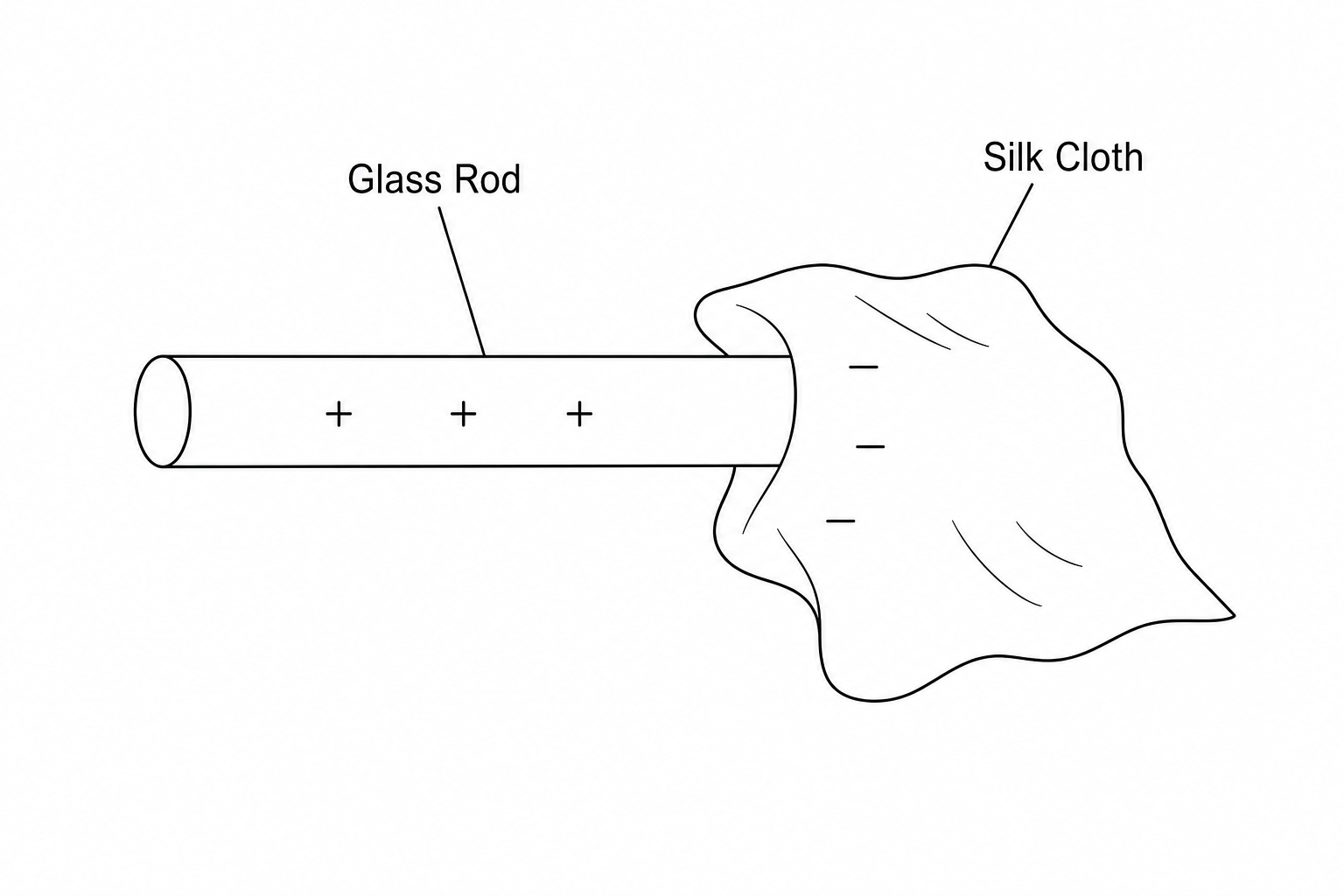
Which of the following statements correctly identifies the charge carriers transferred during this process and the resulting change in the mass of the glass rod?
(Take the elementary charge to be e=1.60×10⁻¹⁹ Ce = 1.60 \times 10^{-19}\text{ C}e=1.60×10⁻¹⁹ C, the mass of an electron to be me=9.11×10⁻³¹ kgm_e = 9.11 \times 10^{-31}\text{ kg}me=9.11×10⁻³¹ kg, and the mass of a proton to be mp=1.67×10⁻²⁷ kgm_p = 1.67 \times 10^{-27}\text{ kg}mp=1.67×10⁻²⁷ kg.)
The glass rod gained 5.0×1085.0 \times 10^85.0×10⁸ electrons, and its mass increased by 4.6×10⁻²² kg4.6 \times 10^{-22}\text{ kg}4.6×10⁻²² kg.
The glass rod lost 5.0×1085.0 \times 10^85.0×10⁸ electrons, and its mass decreased by 4.6×10⁻²² kg4.6 \times 10^{-22}\text{ kg}4.6×10⁻²² kg.
The glass rod gained 5.0×1085.0 \times 10^85.0×10⁸ protons, and its mass increased by 8.4×10⁻¹⁹ kg8.4 \times 10^{-19}\text{ kg}8.4×10⁻¹⁹ kg.
The glass rod lost 5.0×1085.0 \times 10^85.0×10⁸ protons, and its mass decreased by 8.4×10⁻¹⁹ kg8.4 \times 10^{-19}\text{ kg}8.4×10⁻¹⁹ kg.