A student charges a plastic rod by rubbing it vigorously with a woollen cloth, transferring 4.5 × 10¹¹ electrons from the cloth to the rod. The charged rod is then held near a light, uncharged metal-coated sphere suspended by an insulating thread, as shown in the diagram below.
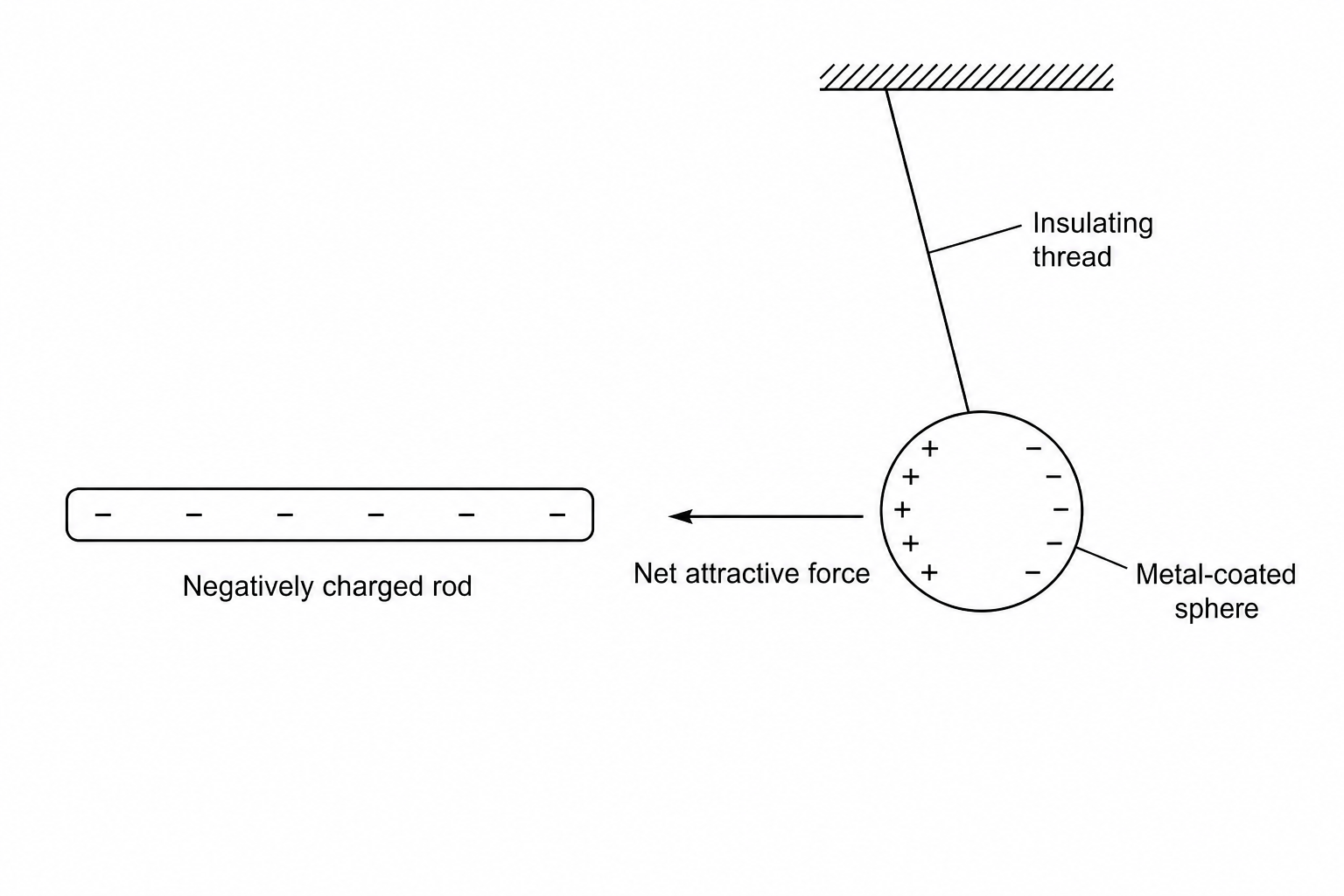
Which of the following options correctly identifies both the electrostatic charge Q Q\,Q on the rod and the correct explanation for the net attractive force experienced by the sphere?
Charge QQQ: −72 nC-72\text{ nC}−72 nC
Explanation: The negative rod repels free electrons to the far side of the sphere. Since the induced positive charges on the near side are closer to the rod than the induced negative charges, the attractive Coulomb force is stronger than the repulsive Coulomb force.
Charge QQQ: +72 nC+72\text{ nC}+72 nC
Explanation: The positive rod attracts electrons to the near side of the sphere. Since the induced negative charges on the near side are closer to the rod than the induced positive charges, the attractive Coulomb force is stronger than the repulsive Coulomb force.
Charge QQQ: −72 nC-72\text{ nC}−72 nC
Explanation: The negative rod polarizes the sphere. Since the magnitudes of the induced positive and negative charges on the sphere are equal, the net attractive force is due to an induced magnetic field alignment in the metal coating.
Charge QQQ: −7.2 nC-7.2\text{ nC}−7.2 nC
Explanation: The negative rod repels free electrons to the far side of the sphere. Since the induced positive charges on the near side are closer to the rod than the induced negative charges, the attractive Coulomb force is stronger than the repulsive Coulomb force.