6.1.2a Describing waves: amplitude, wavelength, frequency and period
Amplitude
Amplitude
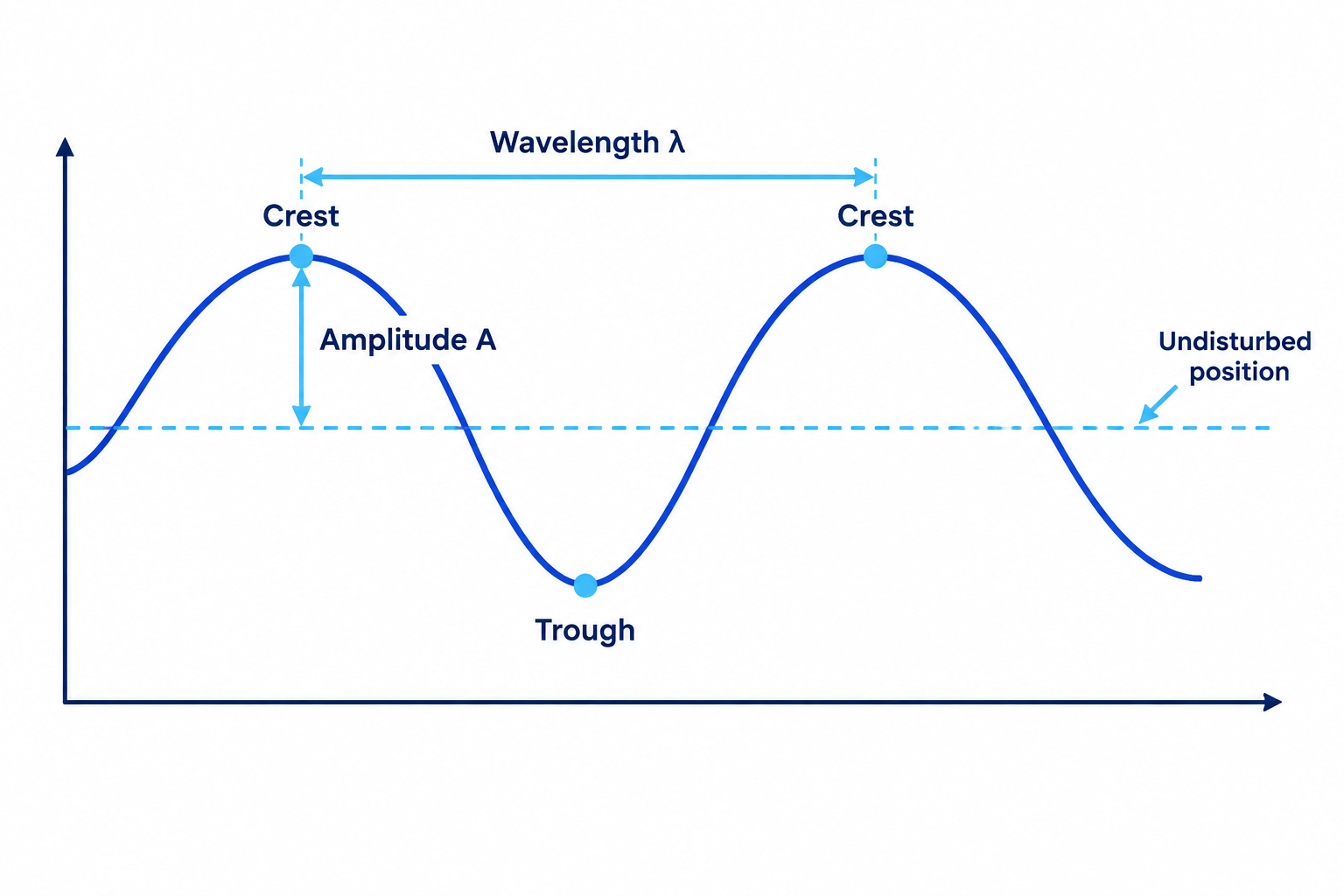
The amplitude of a wave is the maximum displacement of a point on the wave from its undisturbed position.
- The undisturbed position is where the point would sit if no wave were passing, usually shown as a centre line on a wave diagram.
- Amplitude is measured from this centre line to a crest or from the centre line to a trough, not from crest to trough.
- A wave with a greater amplitude carries more energy and has a greater maximum displacement.
Wavelength
Wavelength
The wavelength of a wave is the distance from a point on one wave to the equivalent point on the next wave.
- The symbol for wavelength is λ\lambdaλ, and it is measured in metres, m\text{m}m, because it is a distance.
- Wavelength can be measured from one crest to the next crest, from one trough to the next trough, or between any pair of equivalent points on adjacent waves.
- The two points must be on adjacent waves; measuring to the second-next crest would cover two wavelengths.
Frequency
Frequency
The frequency of a wave is the number of complete waves passing a point each second.
- The symbol for frequency is fff, and it is measured in hertz, Hz\text{Hz}Hz.
- A frequency of 1 Hz1\ \text{Hz}1 Hz means one complete wave passes a point each second, and 5 Hz5\ \text{Hz}5 Hz means five waves pass each second.
- A higher frequency means more waves pass the point each second.
Period
Period
The period of a wave is the time taken for one complete wave to pass a point.
- The symbol for period is TTT, and it is measured in seconds, s\text{s}s.
- Period and frequency are linked by the equation: T=1fT = \frac{1}{f}T=f1.
- TTT is the period in seconds, s\text{s}s.
- fff is the frequency in hertz, Hz\text{Hz}Hz.
- Period and frequency are inversely related, so a higher frequency means a shorter period.
A wave has a frequency of 4 Hz4\ \text{Hz}4 Hz. Calculate its period.
- State the equation: T=1fT = \dfrac{1}{f}T=f1.
- Substitute the frequency: T=14 HzT = \dfrac{1}{4\ \text{Hz}}T=4 Hz1.
- Calculate the answer: T=0.25 sT = 0.25\ \text{s}T=0.25 s.
Reading amplitude and wavelength from a diagram
- To read the amplitude, measure the vertical distance from the centre line to a crest or trough.
- To read the wavelength, measure the horizontal distance between equivalent points on adjacent waves, most clearly from one crest to the next crest.
- Do not measure amplitude from a trough to a crest; that distance is twice the amplitude.
- Do not measure wavelength from a crest to the next trough; those are not equivalent points, so it is only half a wavelength.
- Do not confuse frequency (waves per second, in Hz\text{Hz}Hz) with period (time for one wave, in s\text{s}s).
- For definitions, use the exact phrases maximum displacement from the undisturbed position for amplitude and equivalent point on the adjacent wave for wavelength.
- When finding the period, write T=1fT = \dfrac{1}{f}T=f1 first, substitute the frequency, then give the answer in seconds.
- What is the amplitude of a wave?
- What is the wavelength of a wave, and what is its symbol and unit?
- What is frequency, and in what unit is it measured?
- What is the period of a wave, and how is it linked to frequency?
- Why is the distance from a trough to a crest not the amplitude?
6.1.2b The wave equation and measuring wave speed (required practical)
Wave speed and the wave equation
Wave speed
Wave speed is the speed at which energy is transferred, or the wave moves, through a medium, measured in metres per second, m/s\text{m/s}m/s.
Frequency
Frequency is the number of complete waves passing a point each second, measured in hertz, Hz\text{Hz}Hz.
Wavelength
Wavelength is the distance from one point on a wave to the equivalent point on the next wave, measured in metres, m\text{m}m.
- All waves obey the wave equation, which links wave speed, frequency and wavelength. v=fλv = f\lambdav=fλ.
- vvv is the wave speed in metres per second, m/s\text{m/s}m/s.
- fff is the frequency in hertz, Hz\text{Hz}Hz.
- λ\lambdaλ is the wavelength in metres, m\text{m}m.
- For a fixed wave speed, increasing the frequency decreases the wavelength, because more waves must fit into the same distance each second.
A water wave has a frequency of 5.0 Hz5.0\ \text{Hz}5.0 Hz and a wavelength of 0.12 m0.12\ \text{m}0.12 m. Calculate its wave speed.
- State the equation: v=fλv = f\lambdav=fλ.
- Substitute the values: v=5.0×0.12v = 5.0 \times 0.12v=5.0×0.12.
- Calculate the answer: v=0.60 m/sv = 0.60\ \text{m/s}v=0.60 m/s.
Measuring the speed of sound in air
- Connect two microphones to a data logger or oscilloscope and place them a measured distance apart in a straight line.
- Measure the distance between the microphones with a metre ruler or tape measure.
- Make a short, sharp sound just beyond the first microphone so the sound travels past both.
- Use the data logger to read the time delay between the sound reaching the first and second microphones.
- Calculate the speed of sound from speed=distancetime\text{speed} = \dfrac{\text{distance}}{\text{time}}speed=timedistance, then repeat and take a mean.
- Place the microphones as far apart as is practical, because a longer time delay gives a smaller percentage uncertainty in the timing.
Investigation: measuring waves in a ripple tank
You observe water waves in a ripple tank and judge how suitable the apparatus is for measuring their frequency, wavelength and speed.
- Set up the ripple tank with a large sheet of white card on the floor beneath it, and pour water to a depth of about 5 mm5\ \text{mm}5 mm.
- Lower the straight wooden rod (the dipper) until it just touches the water surface.
- Switch on the lamp above the tank and the small electric motor that vibrates the rod.
- Adjust the speed of the motor until slow, low-frequency ripples spread out as clear, straight wavefronts.
- Adjust the height of the lamp so the wavefronts show up as sharp bright and dark bands on the white card.
- Lay a metre ruler across the pattern at right angles to the wavefronts and measure the length of as many whole waves as possible, then divide by the number of waves to find the wavelength λ\lambdaλ.
- Count how many wavefronts pass a fixed point in 10 s10\ \text{s}10 s and divide by 101010 to find the frequency fff; a stroboscope can "freeze" the pattern to make counting easier.
- Calculate the wave speed from v=fλv = f\lambdav=fλ; a typical result is about f≈4.5 Hzf \approx 4.5\ \text{Hz}f≈4.5 Hz and λ≈0.025 m\lambda \approx 0.025\ \text{m}λ≈0.025 m, giving v≈0.11 m/sv \approx 0.11\ \text{m/s}v≈0.11 m/s.
Safety and accuracy
- Keep the electrical supply and connections away from the water in the ripple-tank activity, and check that no one is affected by strobe lighting before using a stroboscope.
- Measuring across several waves and repeating the readings reduces the percentage uncertainty in the wavelength.
Investigation: measuring waves on a stretched string
You use a vibration generator to send waves along a stretched string (a wave in a solid) and measure their frequency, wavelength and speed.
- Attach a vibration generator driven by a signal generator to one end of a string, run the string over a pulley at the edge of the bench, and hang a 100 g100\ \text{g}100 g mass hanger from it to provide tension, resting a wooden bridge under the string.
- Switch on the vibration generator so the string begins to vibrate.
- Slowly change the frequency of the signal generator, or move the wooden bridge, until a clear standing-wave pattern appears and looks stationary.
- Measure the length of as many loops (half-wavelengths) as possible with a metre ruler, divide by the number of loops, then multiply by 222 to find the wavelength λ\lambdaλ.
- Read the frequency fff directly from the signal generator.
- Calculate the wave speed from v=fλv = f\lambdav=fλ, then repeat for several frequencies such as 5 Hz5\ \text{Hz}5 Hz, 10 Hz10\ \text{Hz}10 Hz and 15 Hz15\ \text{Hz}15 Hz; the speed should stay roughly constant at about 17 m/s17\ \text{m/s}17 m/s.
Safety and accuracy
- Switch off the signal generator between readings, keep fingers clear of the vibrating string and pulley, and check the masses are secure on the hanger.
- Wave speed is not the speed at which the particles travel forwards; the particles vibrate about fixed positions while energy moves through the medium.
- Measure wavelength between equivalent points such as crest to crest, since crest to the next trough is only half a wavelength.
- Always convert centimetres to metres before using v=fλv = f\lambdav=fλ.
- In a method question, name the measuring instrument, state exactly what distance or time it measures, explain how the speed is found, and include repeats.
- To improve accuracy, measure across several wavelengths and divide by the number of wavelengths, rather than measuring a single wave.
- What is the wave equation, and what is the unit of each quantity?
- How can two microphones and a data logger be used to find the speed of sound in air?
- In the ripple-tank activity, how do you find the wavelength and the frequency?
- For the stretched string, why do you measure several loops and multiply by two?
- Why does measuring across several wavelengths reduce the uncertainty?
6.1.2c Sound waves passing between media (physics only)
Velocity, frequency and wavelength
Wave velocity
Wave velocity is the distance travelled by a wave each second, measured in metres per second, m/s\text{m/s}m/s.
- A medium is the material a sound wave travels through, such as air, water or a solid.
- The velocity, frequency and wavelength of a wave are linked by the wave equation. v=fλv = f\lambdav=fλ.
- vvv is the wave velocity in m/s\text{m/s}m/s, fff is the frequency in Hz\text{Hz}Hz, and λ\lambdaλ is the wavelength in m\text{m}m.
Passing from one medium into another
- When a sound wave crosses the boundary into a new medium, its frequency stays the same.
- The frequency is fixed because it is set by the source producing the sound, and the waves must arrive at and leave the boundary at the same rate.
- The velocity usually changes, because the particles and the forces between them are different in the new medium.
- Since v=fλv = f\lambdav=fλ and fff is constant, a change in velocity forces a change in wavelength in the same proportion.
- If the velocity increases, the wavelength increases; if the velocity is halved, the wavelength is halved.
When a sound wave passes between media, its velocity and wavelength change in the same proportion, because its frequency stays constant.
A sound wave of frequency 1000 Hz1000\ \text{Hz}1000 Hz travels at 340 m/s340\ \text{m/s}340 m/s in air, then enters water where its velocity is 1500 m/s1500\ \text{m/s}1500 m/s. Calculate its wavelength in each medium.
- Rearrange the wave equation: λ=vf\lambda = \dfrac{v}{f}λ=fv.
- In air: λ=3401000=0.34 m\lambda = \dfrac{340}{1000} = 0.34\ \text{m}λ=1000340=0.34 m.
- In water the frequency is still 1000 Hz1000\ \text{Hz}1000 Hz: λ=15001000=1.5 m\lambda = \dfrac{1500}{1000} = 1.5\ \text{m}λ=10001500=1.5 m.
- The wave has a greater velocity in water, so it also has a greater wavelength, while its frequency is unchanged.
- Do not say the frequency changes when the sound enters a new medium; the source fixes it, so it stays constant.
- Do not assume a higher velocity means a higher frequency; here the higher velocity produces a longer wavelength instead.
- Link all three quantities: the frequency is constant because it is set by the source, the velocity changes in the new medium, so from v=fλv = f\lambdav=fλ the wavelength must change.
- In a calculation, use the velocity for the correct medium and keep the frequency the same unless a new source frequency is given.
- What equation links wave velocity, frequency and wavelength?
- Which quantity stays constant when a sound wave enters a new medium, and why?
- What happens to the wavelength if the velocity increases while frequency is constant?
- If the velocity doubles at a boundary, what happens to the wavelength?