6.1.3 Reflection and refraction of waves (required practical)
Waves at a boundary between materials
Reflection
Reflection is when a wave reaches a boundary and changes direction so it travels back into the original material.
Transmission
Transmission is when a wave passes through a boundary into the second material.
Absorption
Absorption is when the energy carried by a wave is transferred to the material it travels through.
- An interface is the boundary between two different materials.
- At an interface a wave may be reflected, transmitted or absorbed, and often all three happen at once in differing amounts.
- Light hitting a window, some is reflected faintly, some transmitted through the glass, some absorbed, warming it (absorption).
- How much is reflected, transmitted or absorbed depends on the materials and the type of surface.
Reflection and ray diagrams
Normal
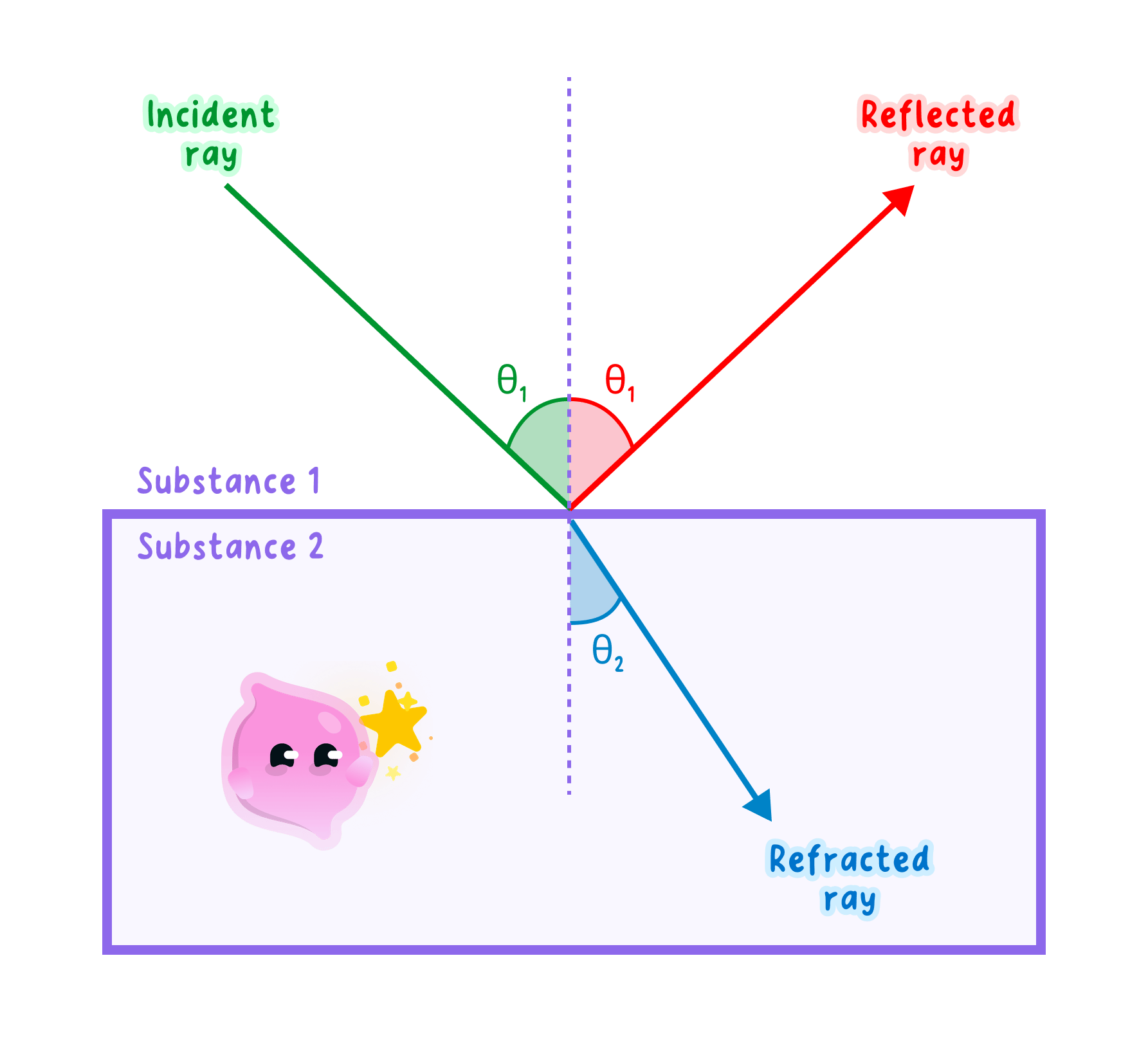
The normal is a line drawn at 90∘90^\circ90∘ to the surface at the point where the ray meets it.
- A ray is an arrowed line showing a wave's direction.
- The incident ray travels towards the surface and the reflected ray travels away from it.
- The angle of incidence, iii, is measured between the incident ray and the normal; the angle of reflection, rrr, between the reflected ray and the normal.
- The law of reflection states the angle of incidence equals the angle of reflection. i=ri = ri=r.
- A smooth surface gives a clear reflection, while a rough surface scatters the rays.
A light ray strikes a mirror at an angle of incidence of 35∘35^\circ35∘. State the angle of reflection and how to complete the ray diagram.
- Apply i=ri = ri=r, so r=35∘r = 35^\circr=35∘.
- Draw the normal at 90∘90^\circ90∘ to the mirror where the ray lands.
- Measure 35∘35^\circ35∘ from the normal, not the mirror, and draw the reflected ray on the opposite side.
- Add an arrow pointing away from the mirror.
Refraction
Refraction
Refraction is the change in direction of a wave as it crosses into a new material, caused by a change in its speed.
- Refraction is an effect of transmission: the wave crosses the boundary but bends because its speed changes.
- Light passing from air into glass slows and bends towards the normal; from glass into air it speeds up and bends away from the normal.
- The two materials have different densities, so the wave travels at a different speed in each, and this change in speed is what makes it change direction.
- Going from air into the denser glass, the wave slows down, and this change in speed makes it bend towards the normal.
- Going from glass into the less dense air, the wave speeds up, and this change in speed makes it bend away from the normal.
- The greater the difference in density between the two materials, the more the wave's speed changes and the more it bends.
Investigation: reflection and refraction of light
You trace how light is reflected from and refracted through transparent blocks, comparing different materials.
- Place a rectangular transparent block (glass) on A3 paper and draw around its outline.
- Mark where the ray enters and use a protractor to draw the normal at 90∘90^\circ90∘, labelling it NNN.
- Fit the slit and lens to the ray box for one narrow ray, and work in a darkened room so faint rays show.
- Replace the block and aim the ray where the normal meets it, ray box at an angle to the normal.
- Mark the incident ray, reflected ray and refracted ray with small crosses.
- Switch off, remove the block, use a ruler to join the crosses, draw the ray through the block, and label all three rays.
- Use a protractor to measure the angle of incidence, angle of reflection and angle of refraction, all from the normal.
- Repeat for different angles, then with a different material (Perspex), keeping the angle of incidence the same.
Variables and safety
- The independent variable is the block material, the dependent variable is the angle of refraction, and the angle of incidence and light colour are control variables.
- The results show the angle of reflection equals the angle of incidence, and different materials refract by different amounts.
- The ray box lamp gets hot: switch off when unused, let it cool, and never look into the beam.
- Angles are always measured from the normal, never from the surface.
- Absorption does not destroy energy; it is transferred to the material.
- A rough surface still reflects light, but the rays travel in different directions.
- For a ray diagram, use a ruler, add arrowheads, label the normal, and measure both angles from it.
- In a method question, give the independent, dependent and control variables, say how each is measured, and include repeats.
- What is the difference between reflection, transmission and absorption at a boundary?
- What is the law of reflection?
- From which line are the angles measured?
- What causes refraction when a wave crosses into a new material?
- In the light investigation, what are the independent, dependent and control variables?
