Definition
Transverse wave
A transverse wave is one in which the oscillations are perpendicular to the direction of energy transfer.
Definition
Longitudinal wave
A longitudinal wave is one in which the oscillations are parallel to the direction of energy transfer.
- All waves transfer energy from one place to another without transferring matter overall.
- Waves are classified as transverse or longitudinal by the direction of oscillation compared with the direction of energy transfer.
- Ripples on a water surface are transverse: the surface moves up and down while energy travels sideways across the water.
- In a longitudinal wave, each particle vibrates backwards and forwards about a fixed position, in the same line as the wave travels.
Crests and troughs
- A transverse wave shows a repeating pattern of high points called crests and low points called troughs.
- A crest is the highest point of the wave above the undisturbed (rest) position, and a trough is the lowest point below it.
- Examples of transverse waves include ripples on a water surface, waves on a rope or string and all electromagnetic waves, such as light.
- Mechanical waves, such as water ripples, need a medium to travel through, whereas electromagnetic waves are also transverse but can travel through a vacuum, so they need no medium.
Compressions and rarefactions
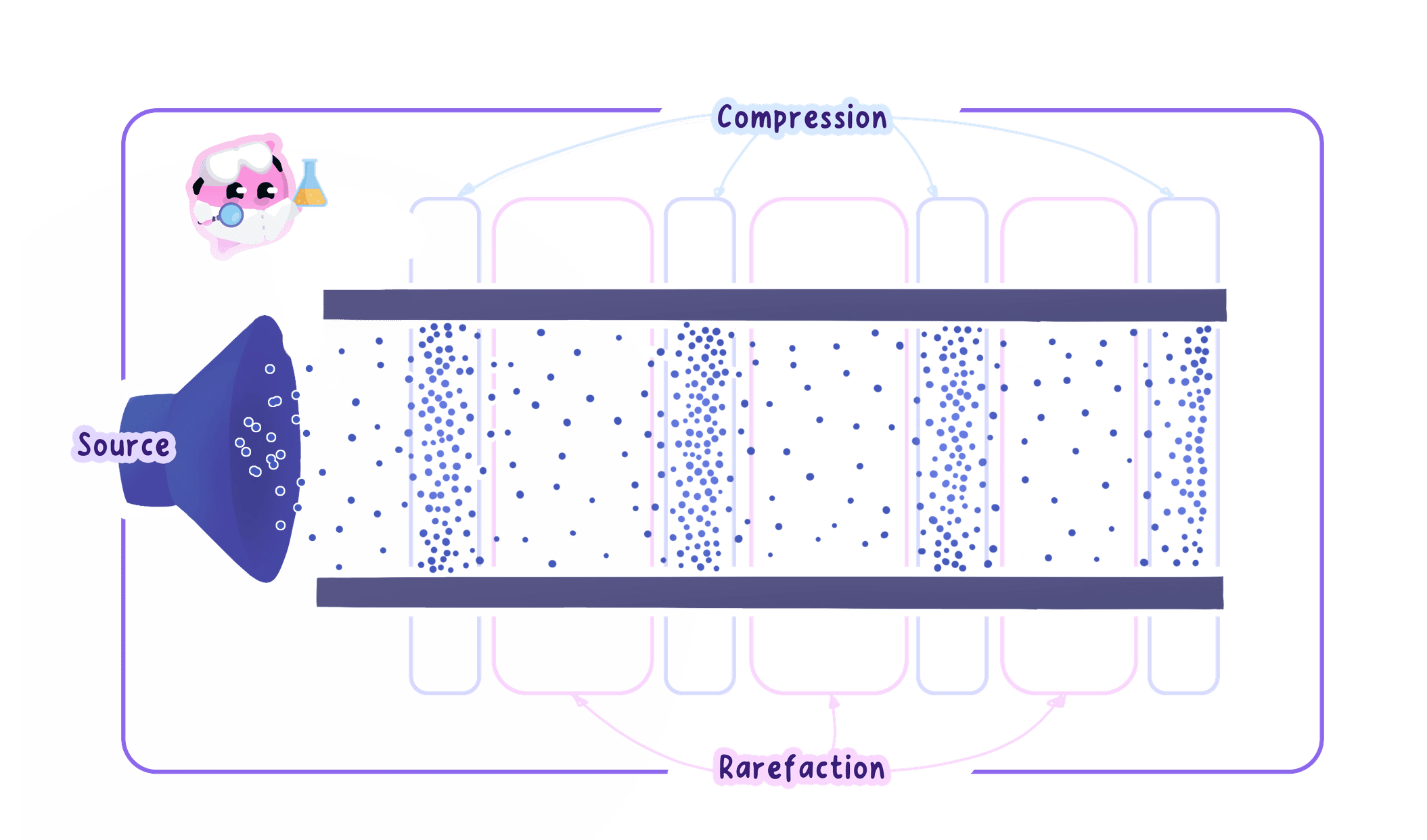
- A longitudinal wave shows alternating regions called compressions and rarefactions.
- A compression is a region where the particles are pushed closer together.
- A rarefaction is a region where the particles are further apart.
- Sound waves travelling through air are longitudinal.
- A vibrating loudspeaker cone pushes air particles together and then pulls back, sending a train of compressions and rarefactions through the air.
Key Idea
In a sound wave, the air particles oscillate parallel to the direction in which the sound energy travels.
The wave travels, not the material
- A wave transfers energy but does not carry the material it passes through along with it.
- A floating cork on water only bobs up and down as a ripple passes, showing the water does not travel across the surface with the wave.
- Sound crosses a room without any steady flow of air across it, because the air particles only vibrate about their positions while the compressions and rarefactions travel to the listener.
Common Mistake
- Do not say the particles travel with the wave; they oscillate about fixed positions while the energy moves through the material.
- Do not confuse the direction of oscillation with the direction of wave travel: they are perpendicular for a transverse wave and parallel for a longitudinal wave.
Exam technique
- When comparing the two wave types, always refer to both the direction of oscillation and the direction of energy transfer.
- Vague phrases such as "up and down" are not enough on their own, because the wave may be travelling in a different direction.
- For evidence that matter is not carried along, state what is observed and then say what it shows.
Self review
- How are the oscillations arranged in a transverse wave compared with the energy transfer?
- How are the oscillations arranged in a longitudinal wave?
- Which type of wave is a ripple on water, and which is a sound wave in air?
- What is a compression and what is a rarefaction?
- How does a floating cork show that water does not travel across the surface with a ripple?
