Following a localized earthquake, geophysicists monitor the propagation of a primary seismic wave (P-wave) through a section of the Earth's crust. The distance-time graph below shows how the distance travelled by the P-wave changes with time.
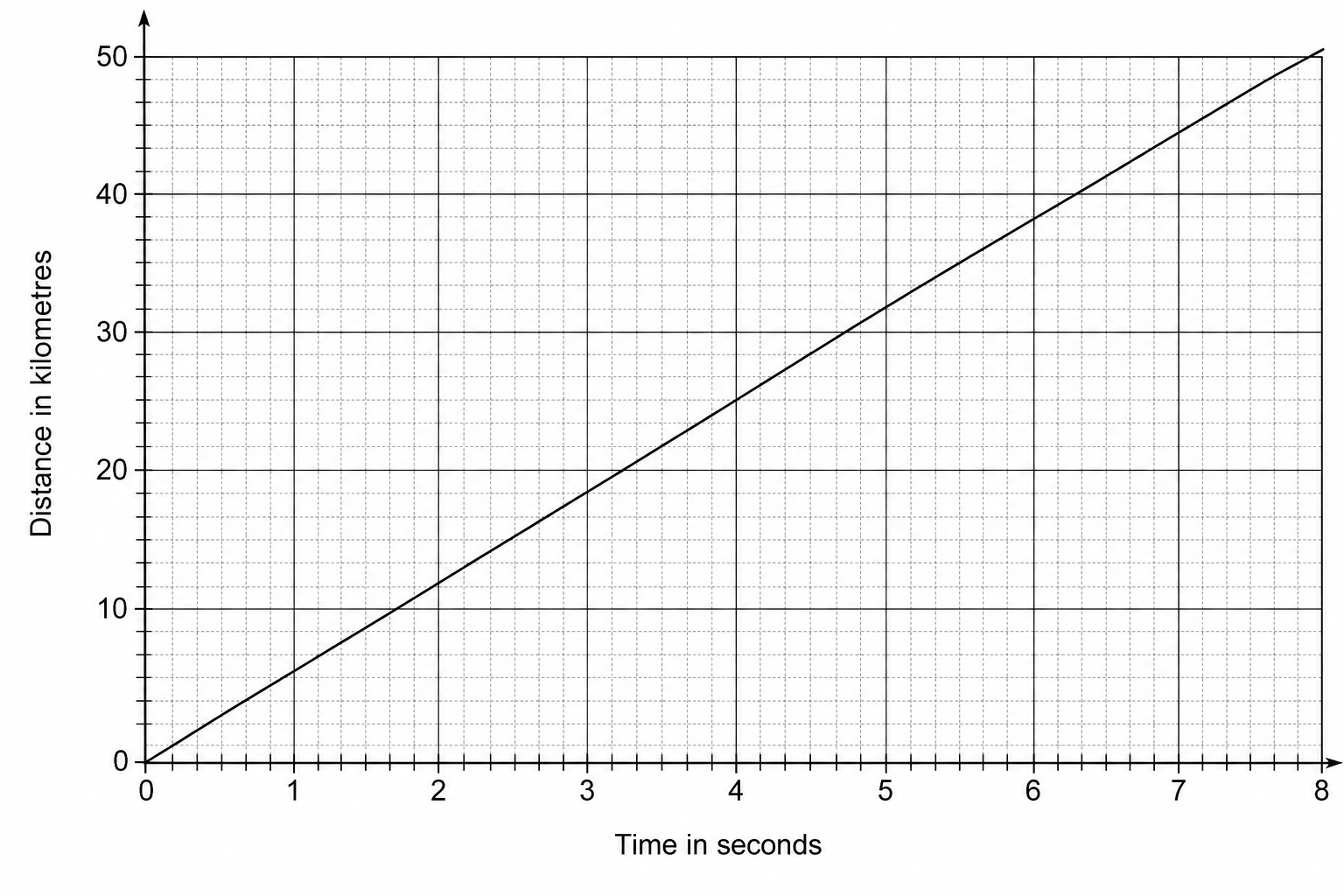
The gradient of this line gives the propagation speed of the P-wave.
Determine the speed of the P-wave. Give your answer in km/s\text{km/s}km/s.
Forces and motion Questions
Practise AQA GCSE Physics Forces and motion with exam-style questions for Foundation and Higher tier. 83 questions covering Describing motion along a line, Forces, accelerations and Newton's Laws of motion, and Forces and braking, matched to the AQA GCSE Physics (8463) specification and written in Paper 1 and Paper 2 style. Every question includes a full worked solution and mark scheme, so you can see where marks are awarded rather than just whether you got the answer right.