What you'll learn
- Why fitness testing is useful for performers and coaches.
- How to choose the correct fitness test for a specific component of fitness.
- The key protocols for the GCSE PE fitness tests.
- How to compare results with normative data and evaluate what they mean.
The big picture: what fitness testing is
A fitness test measures one specific part of fitness, such as speed, agility, flexibility, or cardiovascular fitness. The result gives you data you can use to understand performance and plan training.
A component of fitness is a measurable quality that affects performance. For example, a football winger needs speed for sprinting past defenders, while a gymnast needs flexibility for shapes and balances.
Test protocol
A test protocol is the exact method used to carry out a fitness test, including the equipment, instructions, timings, distances, units recorded, and how the result is calculated.
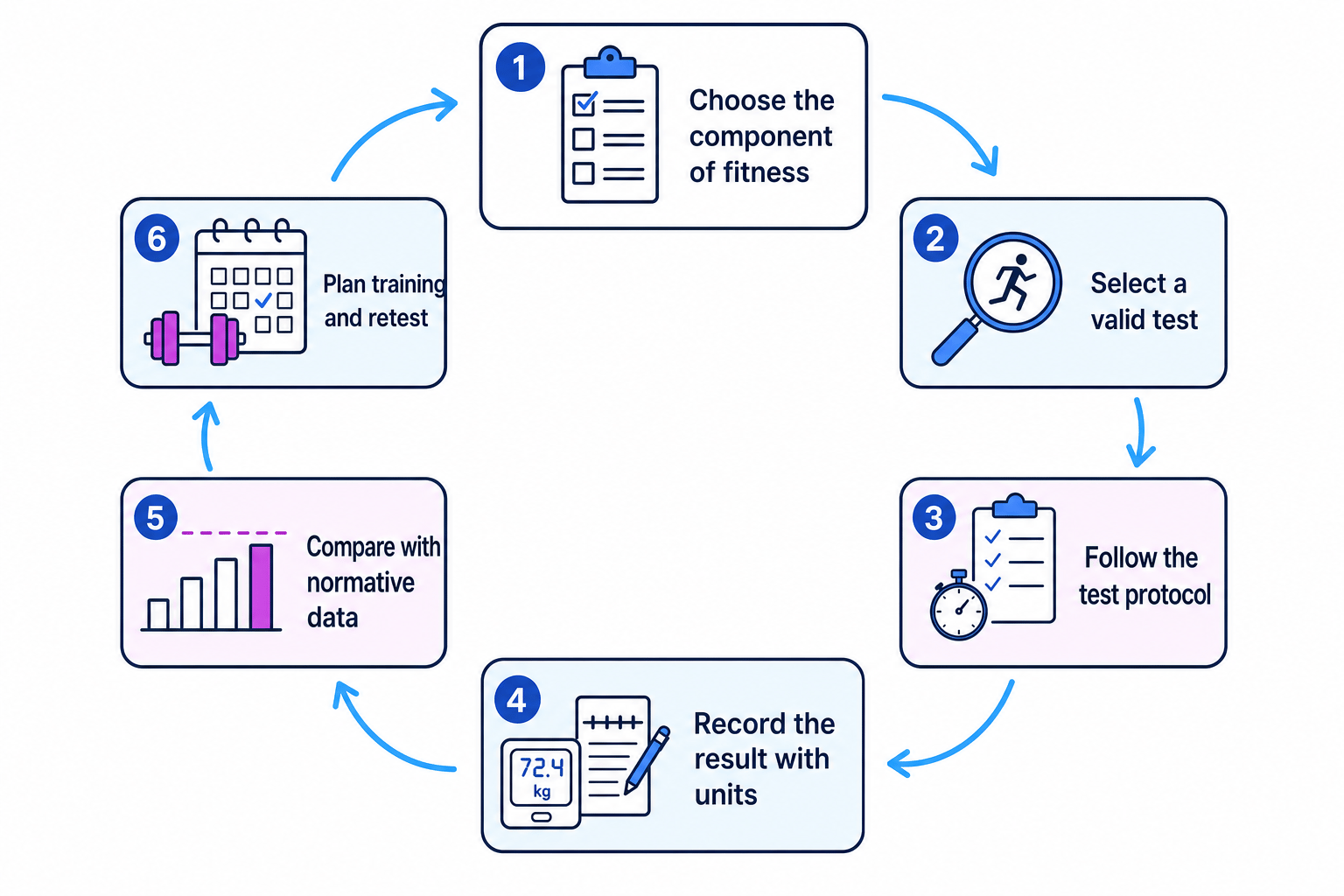
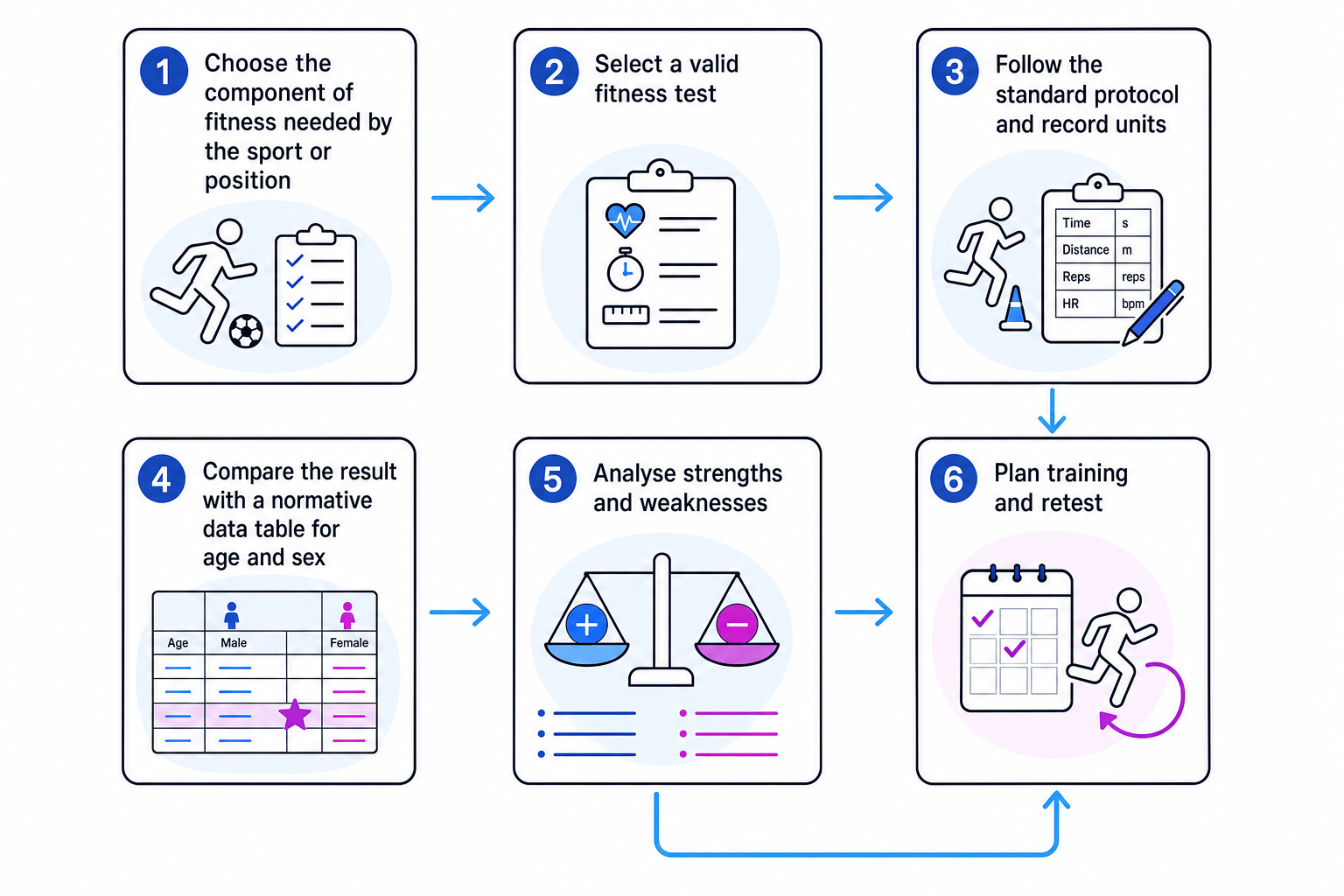
A good fitness-testing process is a cycle: choose the component, select a valid test, follow the protocol, record data, compare with norms, then plan training and retest.
The main purpose
Fitness testing helps you identify strengths and weaknesses, compare results with others, monitor improvement over time, and make training more specific to the performer’s sport or position.
Validity and reliability
Two words are especially important when judging whether a fitness test is useful.
Validity and reliability
- Validity means the test measures what it is supposed to measure. A 30 m sprint test is valid for speed, but not for flexibility.
- Reliability means the test gives consistent results when repeated under the same conditions.
For example, if a rugby winger completes a 30 m sprint on a dry track one week and a wet grass pitch the next, the results may not be reliable because the surface has changed.
Testing the wrong component
Do not choose a test just because it looks hard. A Cooper 12-minute run may be tiring, but it measures cardiovascular fitness, not sprint speed.
Choosing the right fitness test
The correct test depends on the component of fitness you want to measure and the demands of the sport.
This is linked to specificity, which means training or testing should match the activity as closely as possible. A swimmer’s cardiovascular fitness may be better tested with the Cooper 12-minute swim than the Cooper 12-minute run, because swimming is more specific to their sport.
Choosing tests for a netball player
A netball goal attack wants to identify fitness strengths and weaknesses.
- The performer needs agility to dodge defenders and change direction quickly, so the Illinois agility run is a suitable test.
- They need power to jump for rebounds and shooting opportunities, so the vertical jump test is appropriate.
- They also need cardiovascular fitness to keep moving across four quarters, so a Cooper 12-minute run or Harvard Step Test could be used.
- A grip dynamometer would be less relevant because hand-grip strength is not usually the main limiting factor in netball performance.
Fitness tests you need to know
The table below summarises the main GCSE PE tests, what they measure, and when they are useful.
| Component of fitness | Fitness test | Basic protocol | Result recorded | Sporting rationale |
|---|---|---|---|---|
| Cardiovascular fitness | Cooper 12-minute run | Run or walk as far as possible in 12 minutes on a measured course | Distance in metres | Useful for games players, runners, and performers who need sustained effort |
| Cardiovascular fitness | Cooper 12-minute swim | Swim as far as possible in 12 minutes, counting completed lengths | Distance in metres | More specific for swimmers or water polo players |
| Cardiovascular fitness | Harvard Step Test | Step on and off a fixed-height bench for up to 5 minutes at a set rhythm, then record recovery pulse counts | Fitness Index score | Measures how well the heart recovers after exercise |
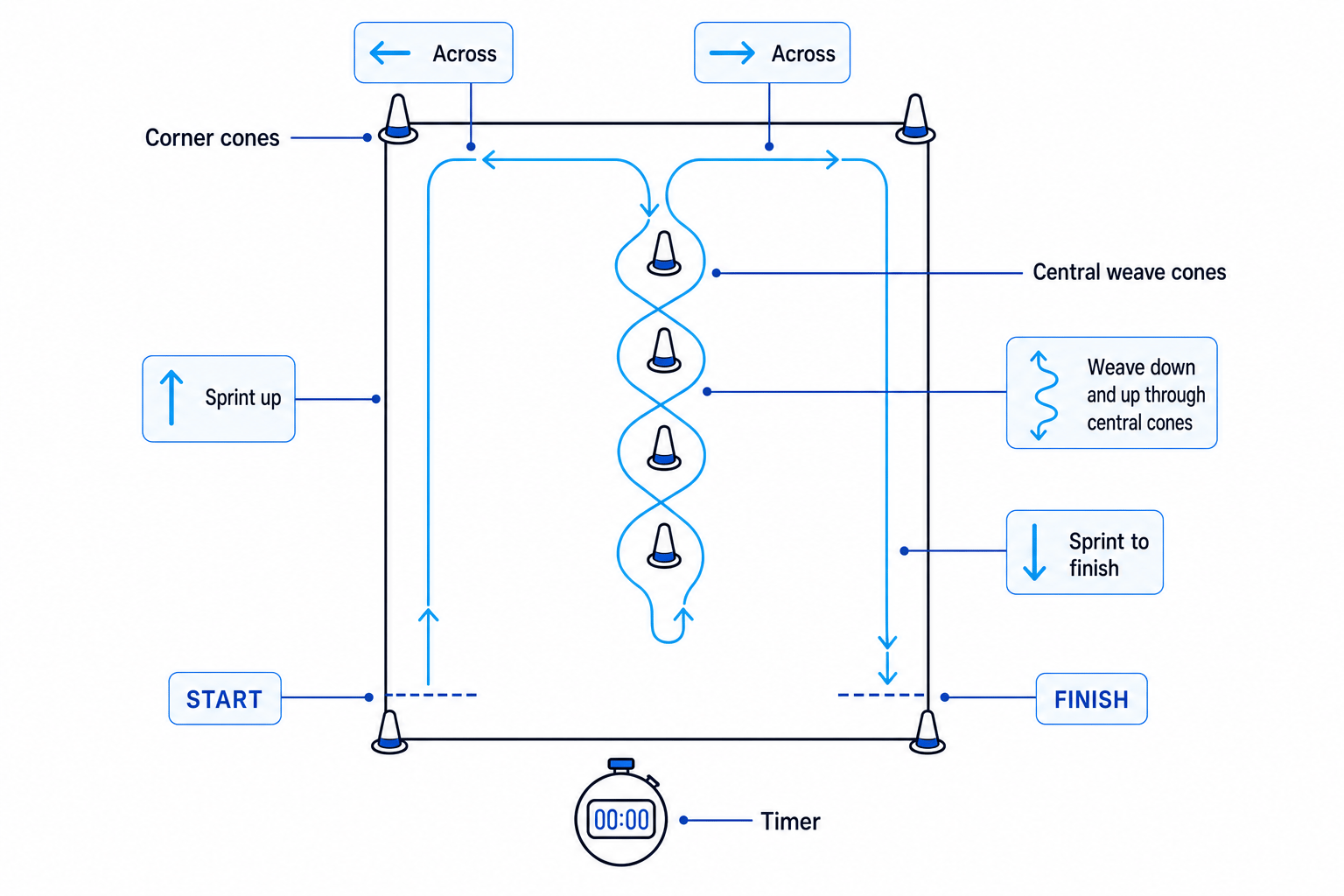
| Agility | Illinois agility run | Follow the cone course as quickly as possible, including sprints and weaving | Time in seconds | Useful for performers who change direction, such as footballers and netballers |
| Strength | Grip dynamometer | Adjust the dynamometer, hold it correctly, and squeeze as hard as possible | Grip strength, often in kg | Useful for climbers, judo players, racket-sport players |
| Muscular endurance | One-minute sit-up test | Complete as many correct sit-ups as possible in one minute | Number of correct reps | Tests abdominal muscular endurance |
| Muscular endurance | One-minute press-up test | Complete as many correct press-ups as possible in one minute | Number of correct reps | Tests upper-body muscular endurance |
| Speed | 30 m sprint | Sprint 30 m from a standing start; timing starts at the start and stops at the finish | Time in seconds | Useful for short bursts, such as chasing a through ball |
| Power | Vertical jump test | Measure standing reach and jumping reach; the difference is the score | Jump height in cm | Useful for explosive movements, such as basketball rebounds |
| Flexibility | Sit and reach test | Sit with legs straight and reach forward along a measuring box | Distance reached in cm | Measures hamstring and lower-back flexibility |
The Illinois agility run is easier to remember if you picture the layout: sprint, turn, weave through the middle cones, then sprint to the finish.
Direction of improvement
For timed tests, such as the 30 m sprint and Illinois agility run, a lower score is better. For distance, reps, jump height, grip strength, and Harvard Step Test index, a higher score is usually better.
Harvard Step Test calculation
The Harvard Step Test measures cardiovascular fitness by looking at recovery heart rate after exercise. A fitter performer usually recovers more quickly, so their recovery pulse counts are lower and their Fitness Index is higher.
The formula is:
Fitness Index=duration of exercise in seconds×1002×sum of the three 30-second recovery pulse counts\text{Fitness Index}=\frac{\text{duration of exercise in seconds} \times 100}{2 \times \text{sum of the three 30-second recovery pulse counts}}Fitness Index=2×sum of the three 30-second recovery pulse countsduration of exercise in seconds×100Calculating the Harvard Step Test index
A hockey player completes the full 5 minutes of stepping. Their three 30-second recovery pulse counts are 82, 74, and 68 beats.
- Convert the completed exercise time into seconds: 5 minutes is 300 seconds.
- Add the three recovery pulse counts: 82 plus 74 plus 68 gives 224 beats.
- Substitute into the formula:
- Interpret the result: a higher index suggests better cardiovascular fitness, because the performer recovered more quickly after stepping.
Collecting fitness test data fairly
To make results useful, you must control the testing conditions as much as possible.
Use the same equipment, surface, warm-up, instructions, rest periods, and timing method each time. If a sprinter is tested with timing gates in one test and a handheld stopwatch in the retest, the comparison may be less reliable.
You should also record the correct units. For example, a vertical jump is usually recorded in cm, a 30 m sprint in seconds, and the Cooper tests in metres.
Before maximal tests, the performer should be healthy, warmed up, and not carrying an injury. This matters because fitness testing can be physically demanding.
Interpreting results using normative data
Normative data
Normative data is a set of typical results collected from a large group of people. Normative tables often sort results by age and sex, then place scores into categories such as excellent, good, average, or poor.
When you interpret fitness data, do more than just name the category. Link the result to the performer’s sport.
For example, if a football winger scores “below average” in the 30 m sprint, this may limit their ability to beat defenders in short races to the ball. However, if they score highly in the Illinois agility run, they may still be effective at quick changes of direction.
Norms are only a guide
Normative tables vary between sources, so use the table given in the question. Also, a “good” result compared with the general population may still be low for an elite performer in that sport.
Interpreting a 30 m sprint result
A 15-year-old female hockey winger runs 30 m in 5.1 seconds. The table supplied in the question says: excellent is under 4.7 s, good is 4.7–5.0 s, average is 5.1–5.4 s, and poor is 5.5 s or slower.
- Use the correct normative table for the performer’s age and sex, because comparing her with a different group would be unfair.
- Check the direction of the test: for sprint times, a lower time is better.
- Place 5.1 seconds into the correct category: it falls in the average range.
- Apply this to hockey: average speed may be acceptable, but improving acceleration could help her reach loose balls before defenders.
- Evaluate the data: if the test was done on wet grass with a handheld stopwatch, you should be cautious about judging her speed too strongly from one result.
Analysing and evaluating fitness data
Analysis means explaining what the data shows. You might compare two results, identify a strength, or spot a weakness.
Evaluation means making a judgement about how useful or important the result is. You should consider the performer’s sport, position, reliability of the test, and whether the test was specific.
For example, a basketball player with an excellent vertical jump but poor sit and reach score shows strong leg power but weaker flexibility. The coach might prioritise flexibility work if tight hamstrings are affecting movement quality or injury risk.
In the exam
- Match the fitness test to the correct component of fitness, then give a sporting reason for your choice.
- Include protocol details such as time, distance, equipment, units, and how the score is recorded.
- When using normative data, compare with the correct age and sex category and state whether higher or lower is better.
- Evaluate the result by linking it to the performer’s sport, position, and possible limitations of the test.
Check yourself
- Which fitness test would you choose for agility, and why is it valid for a games player?
- Why must the same protocol be used when retesting a performer after a training programme?
- A performer’s 30 m sprint time improves from 5.2 s to 4.9 s. What does this show, and how could it affect performance?