

What you'll learn
- How training improves fitness by making the body adapt.
- The key principles of training: individual needs, specificity, progressive overload, FITT, overtraining and reversibility.
- How to calculate aerobic and anaerobic training zones using maximum heart rate.
- How to choose suitable training methods and intensities for different sports and performers.
How fitness is improved
Fitness improves when you train at the right level often enough for your body to adapt. An adaptation is a long-term change that helps the body cope better with exercise.
For example, if a cross-country runner trains regularly in their aerobic zone, their heart can become better at pumping blood and their muscles become better at using oxygen. This helps them maintain pace for longer.
Fitness improvement
Fitness improves when training places a suitable demand on the body, followed by enough recovery for the body to adapt and perform better next time.
Training must be challenging — but not random. GCSE PE focuses on planning training using clear principles so that improvement is safe, relevant and measurable.
The big idea
Good training is planned stress plus recovery. Too little stress gives no improvement; too much stress without recovery can cause fatigue, illness or injury.
Individual needs
Individual needs means training should match the performer, not just the sport.
Different people need different training because they may have different:
- ages
- current fitness levels
- strengths and weaknesses
- experience
- goals
- injury history
- access to facilities
- available training time
A beginner rugby player should not copy an elite rugby player’s weights programme. The elite player may cope with heavy loads and high frequency; the beginner may need lighter resistance, better technique and more recovery.
Individual needs
Individual needs means adapting a training programme to suit the performer’s personal characteristics, fitness level and goals.
Applying individual needs
A netball goal shooter returning from an ankle injury may need lower-impact work first, such as cycling or controlled strength exercises, before high-impact jumping and landing drills.
Adapting training to individual needs
A 15-year-old footballer wants to improve stamina but has low current fitness.
- Choose a method that develops stamina without being too intense immediately: continuous training, such as steady jogging or cycling, is more suitable than repeated maximal sprints.
- Set a manageable starting intensity: working near the lower aerobic zone is safer than starting in the anaerobic zone.
- Progress gradually: increase the duration or frequency over several weeks, so the performer adapts without becoming overloaded.
Specificity
Specificity means training should be matched to the demands of the sport or activity. The body adapts to the type of training it actually does.
A marathon runner needs aerobic endurance, so long continuous runs are specific. A 100 m sprinter needs speed and power, so sprint intervals and plyometric training are more specific.
Specificity
Specificity means training must be relevant to the sport, activity, position or fitness component being improved.
Specificity can include:
- the muscles used
- the energy system used
- the movement patterns used
- the speed of movement
- the fitness component being trained
Training the wrong fitness component
Do not say “they should train harder” without saying what fitness component they need. A badminton player may need agility and speed, while a marathon runner mainly needs cardiovascular endurance.
Progressive overload
Progressive overload means gradually making training harder so the body continues to adapt.
If training stays exactly the same for too long, the performer may stop improving because the body has already adapted to that workload.
Progressive overload
Progressive overload is the gradual increase of training demand so the body is challenged enough to improve.
You can overload training by increasing:
- frequency — train more often
- intensity — train harder
- time — train for longer
- type — make the activity more demanding or more specific
A swimmer might begin with 20-minute aerobic swims and gradually progress to 30 minutes, then add interval sets at a higher intensity.
Using progressive overload safely
A hockey player wants to improve cardiovascular endurance over four weeks.
- Start with a realistic workload: three 20-minute runs per week in the aerobic zone.
- Increase one main variable first: raise the running time to 25 minutes rather than increasing time, speed and frequency all at once.
- Check the overload is still sport-relevant: include some changes of pace later because hockey involves repeated movement and recovery, not just steady running.
FITT: the four ways to plan training
FITT is a simple way to remember how to adjust training.
FITT
FITT stands for frequency, intensity, time and type — four variables used to plan and adapt a training programme.
Frequency
Frequency means how often training happens, usually measured in sessions per week.
Example: a basketball player may complete fitness training three times per week alongside skills practice and matches.
Intensity
Intensity means how hard the training is.
It can be measured using:
- heart rate in bpm
- percentage of maximum heart rate
- weight lifted as a percentage of one-rep max
- speed, resistance or work rate
- perceived effort
For weight training, intensity often links to one-rep max, which is the maximum weight a performer can lift once with correct technique.
Time
Time means how long each training session or exercise bout lasts.
Example: a 30-minute continuous run develops aerobic endurance more than a 5-minute jog.
Type
Type means the training method used.
Examples include:
- continuous training for aerobic endurance
- interval training for speed or anaerobic endurance
- circuit training for muscular endurance or whole-body fitness
- weight training for strength or power
- plyometric training for explosive power
- flexibility training for range of movement
Remember FITT with a question
Ask: How often? How hard? How long? What kind? That gives you frequency, intensity, time and type.
Training thresholds and target zones
A training threshold is the minimum intensity needed to cause fitness improvement. If you work too easily, your body may not need to adapt.
Heart-rate zones are used to plan intensity. Heart rate is measured in beats per minute, written as bpm.
Maximum heart rate
Maximum heart rate, or MaxHR, is an estimate of the highest number of times the heart can beat per minute during maximal exercise.
For GCSE PE, use the simplified formula:
MaxHR=220−age\text{MaxHR} = 220 - \text{age}MaxHR=220−ageThe two key target zones are:
- Aerobic target zone: 60% to 80% of MaxHR
- Anaerobic target zone: 80% to 90% of MaxHR
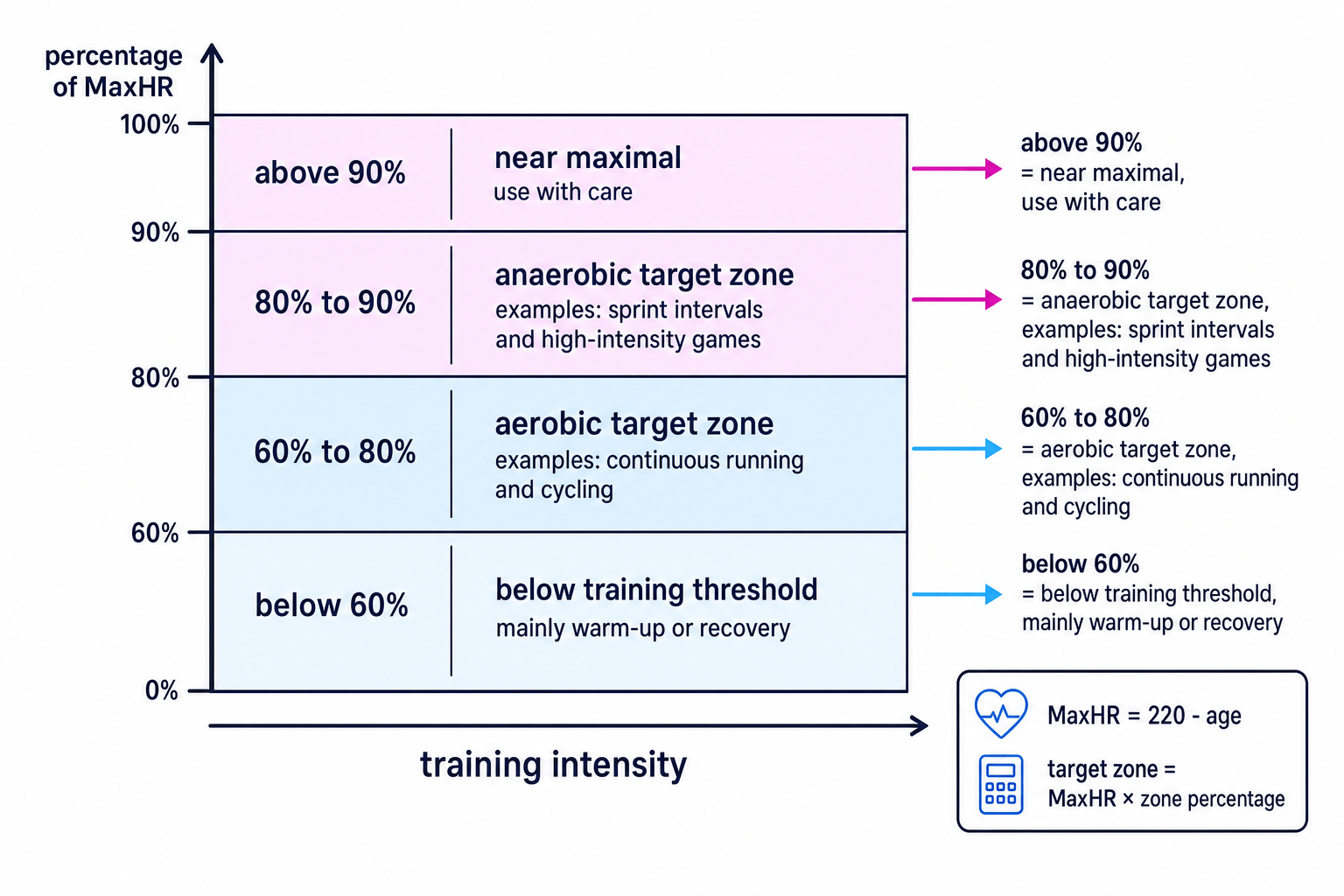
Aerobic target zone: 60% to 80%
Aerobic exercise uses oxygen to release energy. It is important for endurance activities such as long-distance running, cycling, swimming and football midfield play.
A performer training at 60% to 80% of MaxHR is usually working hard enough to improve cardiovascular endurance, but not so hard that they fatigue very quickly.
Anaerobic target zone: 80% to 90%
Anaerobic exercise releases energy without using oxygen as the main supply. It supports short, high-intensity efforts such as sprinting, repeated attacks in basketball, or a fast break in football.
Training at 80% to 90% of MaxHR is useful for sports requiring bursts of speed and power.
Calculating heart-rate training zones
A 16-year-old netball player wants to improve fitness using heart-rate zones.
-
Calculate maximum heart rate using the GCSE formula:
MaxHR=220−16=204 bpm\text{MaxHR} = 220 - 16 = 204 \text{ bpm}MaxHR=220−16=204 bpm -
Calculate the aerobic zone by finding 60% to 80% of 204 bpm:
204×0.60=122.4 bpm204×0.80=163.2 bpm\begin{aligned} 204 \times 0.60 &= 122.4 \text{ bpm} \\ 204 \times 0.80 &= 163.2 \text{ bpm} \end{aligned}204×0.60204×0.80=122.4 bpm=163.2 bpmSo the aerobic zone is about 122 to 163 bpm.
-
Calculate the anaerobic zone by finding 80% to 90% of 204 bpm:
204×0.80=163.2 bpm204×0.90=183.6 bpm\begin{aligned} 204 \times 0.80 &= 163.2 \text{ bpm} \\ 204 \times 0.90 &= 183.6 \text{ bpm} \end{aligned}204×0.80204×0.90=163.2 bpm=183.6 bpmSo the anaerobic zone is about 163 to 184 bpm.
-
Apply it to netball: steady off-court conditioning could use the aerobic zone, while repeated sprint drills would use the anaerobic zone.
Forgetting the age step
Always calculate MaxHR first using 220−age220 - \text{age}220−age. Do not multiply the percentages by 220 unless the performer’s age is zero.
Overtraining
Overtraining happens when a performer trains too hard, too often, or with too little recovery.
Possible signs include:
- constant tiredness
- reduced performance
- increased injury risk
- poor motivation
- illness due to stress on the body
A gymnast who adds extra strength sessions every day without rest may become fatigued, making technique worse and increasing the risk of injury on landings.
Overtraining
Overtraining is excessive training without enough recovery, leading to decreased performance and possible injury or illness.
More is not always better
Training only improves fitness if the body has time to recover and adapt. Rest days are part of the programme, not a sign of laziness.
Reversibility
Reversibility means fitness can be lost when training stops or is greatly reduced.
This might happen because of injury, illness, holidays, exam periods, or the off-season. For example, a swimmer who stops training for several weeks may lose cardiovascular endurance and muscular endurance, so race times may get slower.
Reversibility
Reversibility is the loss of fitness adaptations when training is stopped or reduced.
To reduce reversibility, performers can maintain some training where possible. An injured runner might use swimming or cycling to keep aerobic fitness while reducing impact on the injured leg.
Choosing the right training method and intensity
When choosing training, you need to match the programme to the performer and the sport. Three big factors are especially important.
Fitness and sport requirements
Different sports need different fitness components.
A long-distance runner needs cardiovascular endurance, so continuous training in the aerobic zone is suitable. A shot putter needs power and strength, so weight training and plyometric training are more suitable.
Facilities available
Training must be realistic. A performer cannot plan a swimming programme if they cannot access a pool. A school footballer may use circuit training on the playground if a gym is unavailable.
Current level of fitness
Beginners need lower intensity and more gradual overload. Fitter performers can usually cope with higher intensity, more complex sessions and shorter rest periods.
Choosing a suitable training method
A 100 m sprinter wants to improve performance but only has access to a school field and basic cones.
- Identify the main sport requirement: the 100 m sprint needs speed, power and anaerobic energy, not long-duration endurance.
- Match the method to the requirement: interval training is suitable because the sprinter can complete short, fast sprints with planned rest.
- Match intensity to the performer: if they are experienced, they may work close to the anaerobic zone during sprint repetitions; if they are a beginner, they should use fewer repetitions and longer rests.
- Check facilities: a field and cones are enough to mark sprint distances, so the method is practical.
Best training choice
The best training method is the one that matches the sport, the performer and the resources available.
Pulling the principles together
A strong training plan uses all the principles together.
For example, imagine a 15-year-old midfielder in football:
- Individual needs: they may lack stamina late in matches.
- Specificity: training should include running patterns similar to football, not only slow jogging.
- Progressive overload: increase intensity or duration gradually.
- FITT: train three times per week, at the correct heart-rate intensity, for suitable time, using interval and continuous training.
- Thresholds: use aerobic work for endurance and anaerobic intervals for repeated sprints.
- Avoid overtraining: include rest and avoid adding too many sessions.
- Avoid reversibility: maintain fitness during school holidays or injury where possible.
In the exam
- Link every principle to a sporting example: say how it would help a named performer, such as a winger, swimmer or netball shooter.
- For heart-rate zones, show the calculation in order: MaxHR first, then multiply by the correct percentages, and include bpm.
- When choosing a method, justify it using the sport’s fitness requirements, the performer’s current fitness and the facilities available.
Check yourself
- What is the difference between progressive overload and overtraining?
- A 15-year-old performer wants to train aerobically. What heart-rate range should they work in?
- Why might interval training suit a games player more than only continuous training?
