

What you'll learn
- How the world’s main ecosystems are distributed at a global scale.
- How climate helps explain where ecosystems are found.
- The typical plants and animals found in polar regions, coral reefs, grasslands, temperate forests, tropical rainforests and hot deserts.
- How to use location, climate and adaptations together in exam answers.
1. The big idea: ecosystems are not randomly spread out
At GCSE, you need to recognise that ecosystems have patterns. They are not scattered randomly across the world. Instead, they are strongly linked to climate, which means the long-term pattern of weather in a place, usually averaged over about 30 years.
At this point, you are thinking at the global scale: broad world patterns such as “near the Equator”, “around the tropics” or “close to the poles”.
Ecosystem, biome and distribution
- An ecosystem is a community of living things, such as plants and animals, interacting with each other and with their physical environment.
- A biome is a very large-scale ecosystem, such as tropical rainforest or hot desert, with similar climate, plants and animals across large areas.
- Distribution means where something is found and the pattern it forms across space.
The main control
Climate is the biggest reason why major ecosystems have distinct global distributions: temperature and rainfall affect what plants can grow, and plants then influence which animals can survive.
2. Why climate creates global ecosystem patterns
Latitude matters
Latitude means distance north or south of the Equator, measured in degrees. Places near the Equator usually receive more direct sunlight, so they are warmer all year. Places near the poles receive less direct sunlight, so they are much colder.
This helps explain why:
- Tropical rainforests are found near the Equator.
- Hot deserts often occur around the Tropics of Cancer and Capricorn.
- Polar regions are found in the Arctic and Antarctic.
Rainfall matters too
Warm air near the Equator rises, cools and often produces heavy rainfall. Around 30° north and south, sinking air creates dry conditions, which helps form many hot deserts. In the mid-latitudes, rainfall and temperatures are more moderate, supporting temperate forests and grasslands.
Coral reefs are a little different because they are marine ecosystems, meaning they are found in the sea rather than on land. They need warm, shallow, clear water with enough sunlight.
Using latitude and climate to infer an ecosystem
A location is 2°S in the Congo Basin. Average temperature is about 26°C all year and annual rainfall is over 2000 mm, with no long dry season. Which ecosystem is most likely?
- Use the latitude: 2°S is very close to the Equator, so the place is likely to be hot all year.
- Use the rainfall: over 2000 mm of rain with no long dry season points to very wet conditions, not desert or grassland.
- Link climate to ecosystem: the most likely ecosystem is tropical rainforest, so you would expect dense evergreen vegetation and high biodiversity.
3. Global distribution of the main ecosystems
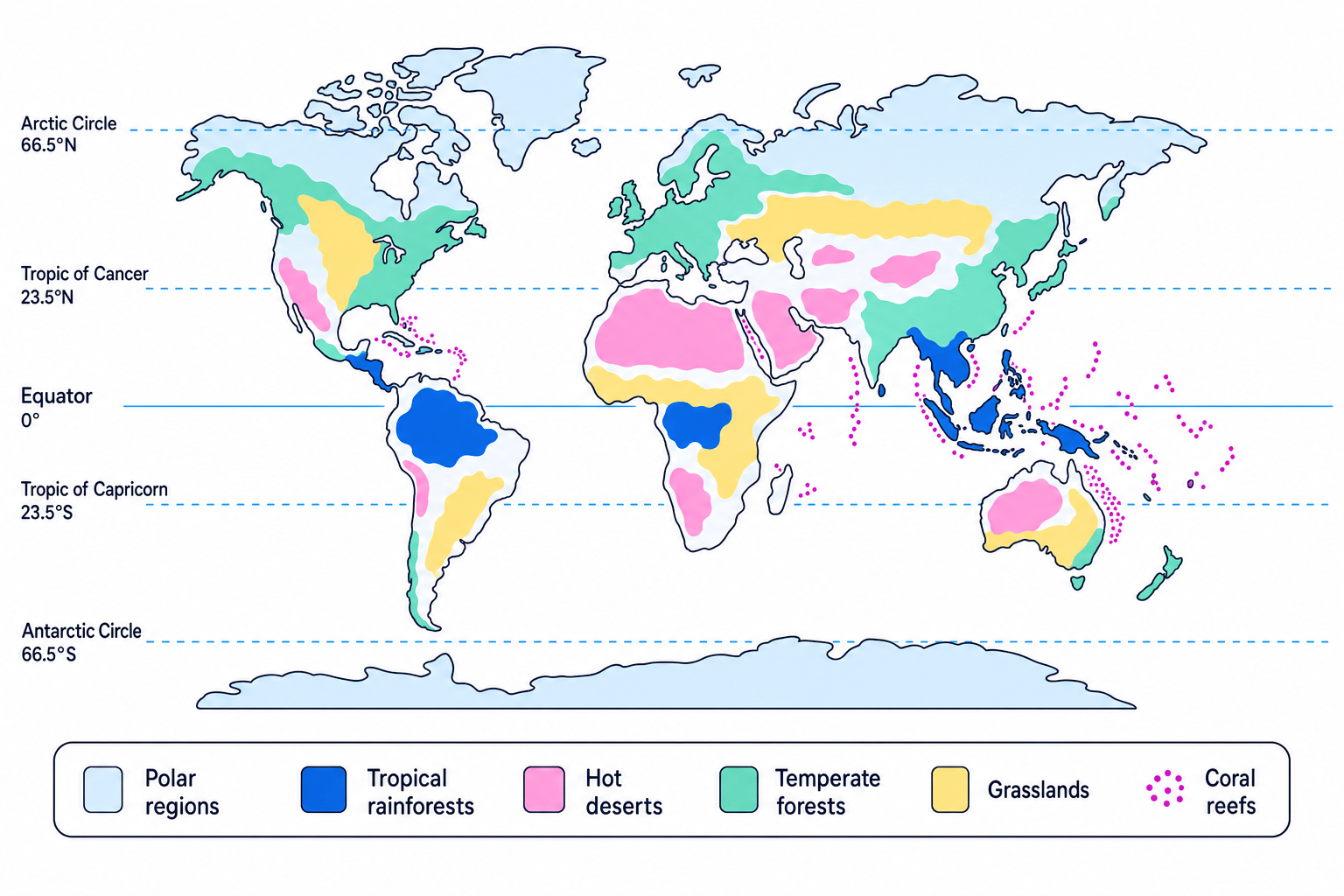
The map below shows the broad global pattern. Real ecosystem boundaries are gradual, not perfectly neat lines, but the pattern is clear enough for GCSE map interpretation.
Patterns to notice
- Polar regions are found around the Arctic and Antarctica.
- Tropical rainforests cluster around the Equator, especially in the Amazon Basin, Congo Basin and Southeast Asia.
- Hot deserts are often found around 15° to 30° north and south, such as the Sahara, Arabian Desert, Australian deserts and Atacama Desert.
- Grasslands are found in large continental areas, including the African savanna, North American prairies, South American pampas and Eurasian steppe.
- Temperate forests are found in mid-latitudes, including western and central Europe, eastern North America and eastern Asia.
- Coral reefs are found in warm tropical seas, including the Caribbean, Red Sea, Indian Ocean, Southeast Asia and the Great Barrier Reef.
Distribution is not the same as characteristics
“Distribution” means where it is found. “Characteristics” means what it is like, such as climate, plants and animals. Strong answers cover both.
4. Characteristics of each major ecosystem
Polar regions
Polar regions include the Arctic, around the North Pole, and Antarctica, around the South Pole. Some nearby land has tundra, a cold, treeless ecosystem with low-growing vegetation.
The climate is extremely cold, with long winters and short summers. Precipitation is low, often falling as snow, so polar areas can be described as cold deserts. Permafrost, which means permanently frozen ground, limits plant growth.
Plants are limited to mosses, grasses, low shrubs and lichens, which are small slow-growing organisms made from fungus and algae living together. Animals include polar bears and Arctic foxes in the Arctic, penguins in Antarctica, and seals and whales in polar oceans. Many animals have thick fat or fur for insulation.
Polar animals are not interchangeable
Polar bears live in the Arctic, not Antarctica. Penguins are mainly found in the Southern Hemisphere, including Antarctica, not with polar bears.
Coral reefs
Coral reefs are found in shallow tropical seas, usually between about 30°N and 30°S. They need warm water, commonly around 23°C to 29°C, as well as clear water so sunlight can reach them.
Corals are tiny animals that build hard limestone skeletons. They live with microscopic algae that make food using sunlight. This relationship helps explain why reefs need shallow, clear water.
Plants and producers include algae and seagrasses. Animals include reef fish, turtles, sharks, rays, molluscs and crustaceans. Coral reefs have very high biodiversity, meaning a wide variety of living organisms.
Coral is not a plant
Coral may look like rock or vegetation, but it is made by animals. The algae living with coral help provide energy through photosynthesis.
Grasslands
Grasslands are areas where grasses dominate because rainfall is enough for grasses but often not enough for dense forest.
There are two main types:
- Tropical grasslands, such as African savanna, have a hot climate with a wet season and a dry season.
- Temperate grasslands, such as the prairies, pampas and steppe, have warm summers, colder winters and moderate rainfall.
Plants include grasses with deep roots, which help them survive drought and regrow after fire or grazing. In savanna areas, scattered trees such as acacia and baobab may grow.
Animals include large grazers such as zebra, antelope and bison, plus predators such as lions, cheetahs and wolves depending on the region.
Temperate forests
Temperate forests are found in mid-latitude areas such as the UK, much of Europe, eastern North America, eastern China, Japan and New Zealand.
The climate is moderate, with four seasons and rainfall spread through the year. Temperatures are not as extreme as polar regions or hot deserts.
Many temperate forests are deciduous, meaning trees lose their leaves in autumn or winter. Common trees include oak, beech, ash and maple. Forests often have layers, including a tree canopy, shrubs and ground plants.
Animals include deer, foxes, badgers, squirrels, birds and insects. Many animals store food, migrate or become less active in winter.
Tropical rainforests
Tropical rainforests are found close to the Equator, especially in the Amazon Basin in South America, the Congo Basin in Africa and parts of Southeast Asia.
The climate is hot and wet all year. Temperatures are usually high and steady, while rainfall is heavy, often over 2000 mm per year.
Plants are dense and grow in layers. Many trees are evergreen, meaning they keep their leaves all year. Common plant adaptations include:
- Drip tips, which are pointed leaf ends that help rainwater run off.
- Buttress roots, which are large roots that help support tall trees in shallow soils.
- Lianas, which are woody climbing plants.
- Epiphytes, which are plants that grow on other plants to reach sunlight.
Animals include monkeys, sloths, jaguars, snakes, frogs, parrots and huge numbers of insects. Rainforests have very high biodiversity because the warm, wet climate supports life all year.
Hot deserts
Hot deserts are found mainly around the Tropics of Cancer and Capricorn, including the Sahara, Arabian Desert, Australian deserts, Kalahari and Atacama.
The climate is very dry, usually with less than 250 mm of rain per year. Daytime temperatures can be very high, but nights may be much cooler because there is little cloud cover to trap heat.
Plants are adapted to water shortage. A succulent is a plant that stores water in fleshy stems or leaves. Cacti and other desert plants may have waxy surfaces, spines instead of broad leaves, and deep or wide roots.
Animals include camels, fennec foxes, lizards, snakes, scorpions and insects. Many are nocturnal, meaning they are active at night to avoid the hottest part of the day.
Matching adaptations to an ecosystem
A place has under 250 mm of rainfall per year. Plants have waxy surfaces and spines, and many animals are active at night. Identify the ecosystem.
- Use the rainfall: under 250 mm per year is extremely dry, which strongly suggests a desert environment.
- Use the plant clues: waxy surfaces and spines reduce water loss, which are typical adaptations to drought.
- Use the animal clues: nocturnal behaviour helps animals avoid extreme daytime heat, so the ecosystem is most likely a hot desert.
5. A quick way to revise them
For each ecosystem, practise the same four headings:
- Location — Where is it found globally?
- Climate or conditions — What are temperature and rainfall like?
- Plants — What grows there, and how is it adapted?
- Animals — What lives there, and how is it adapted?
Simple memory hook
Think L-C-P-A: Location, Climate, Plants, Animals. If you can cover those four points, you can usually build a clear GCSE answer.
In the exam
- Start with the global distribution: use latitude bands and named regions such as the Amazon Basin, Sahara, Arctic or Great Barrier Reef.
- Link characteristics to climate: do not just list animals; explain how temperature and rainfall affect plants and animals.
- Be precise with examples: avoid vague phrases like “near hot places” when you could write “near the Equator” or “around 30° north and south”.
Check yourself
- Which ecosystems are mainly found near the Equator, around the tropics, and near the poles?
- How do plant adaptations differ between tropical rainforests and hot deserts?
- Why are coral reefs found in warm, shallow, clear seas rather than deep or cold water?
