What you'll learn
- What an ecosystem is, from a local pond to a regional woodland.
- The difference between abiotic and biotic components.
- How weather, climate and soil affect living things.
- How to explain interdependence using clear cause-and-effect chains.
The big idea: what is an ecosystem?
An ecosystem is not just “nature” or “wildlife”. It includes both the living things in an area and the non-living environment around them.
A small ecosystem might be a local pond, hedgerow or school field. A larger regional ecosystem might be a temperate deciduous woodland such as Epping Forest in north-east London and Essex.
Ecosystem
An ecosystem is a community of living organisms interacting with each other and with the non-living environment in a particular place.
A few useful building blocks:
- A habitat is the place where an organism lives, such as woodland floor, pond edge or tree canopy.
- A population is all the organisms of one species in an area, such as all the oak trees in a woodland.
- A community is all the different populations living together in an area.
Abiotic and biotic components
Every ecosystem has two main types of component: abiotic and biotic.
Abiotic and biotic components
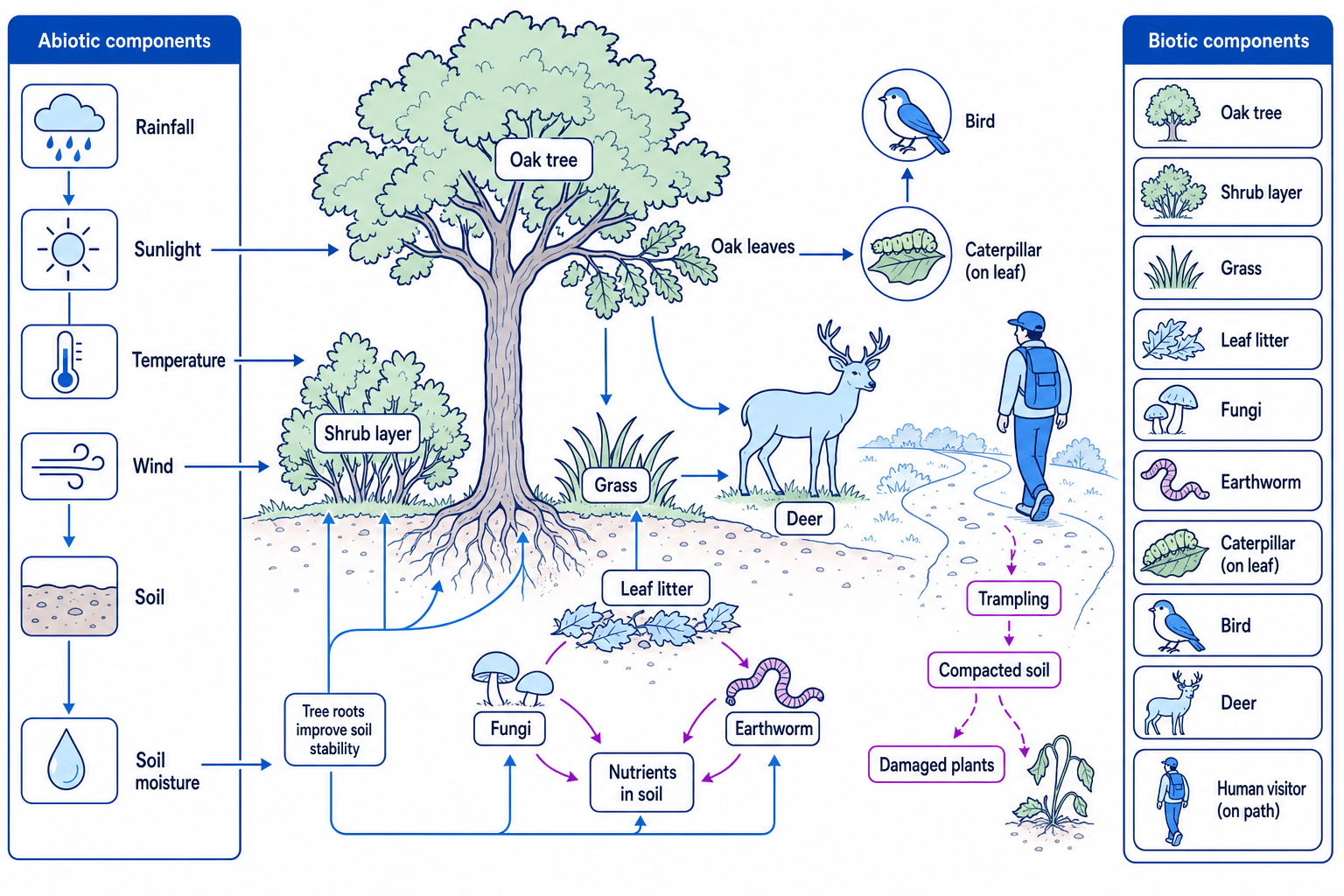
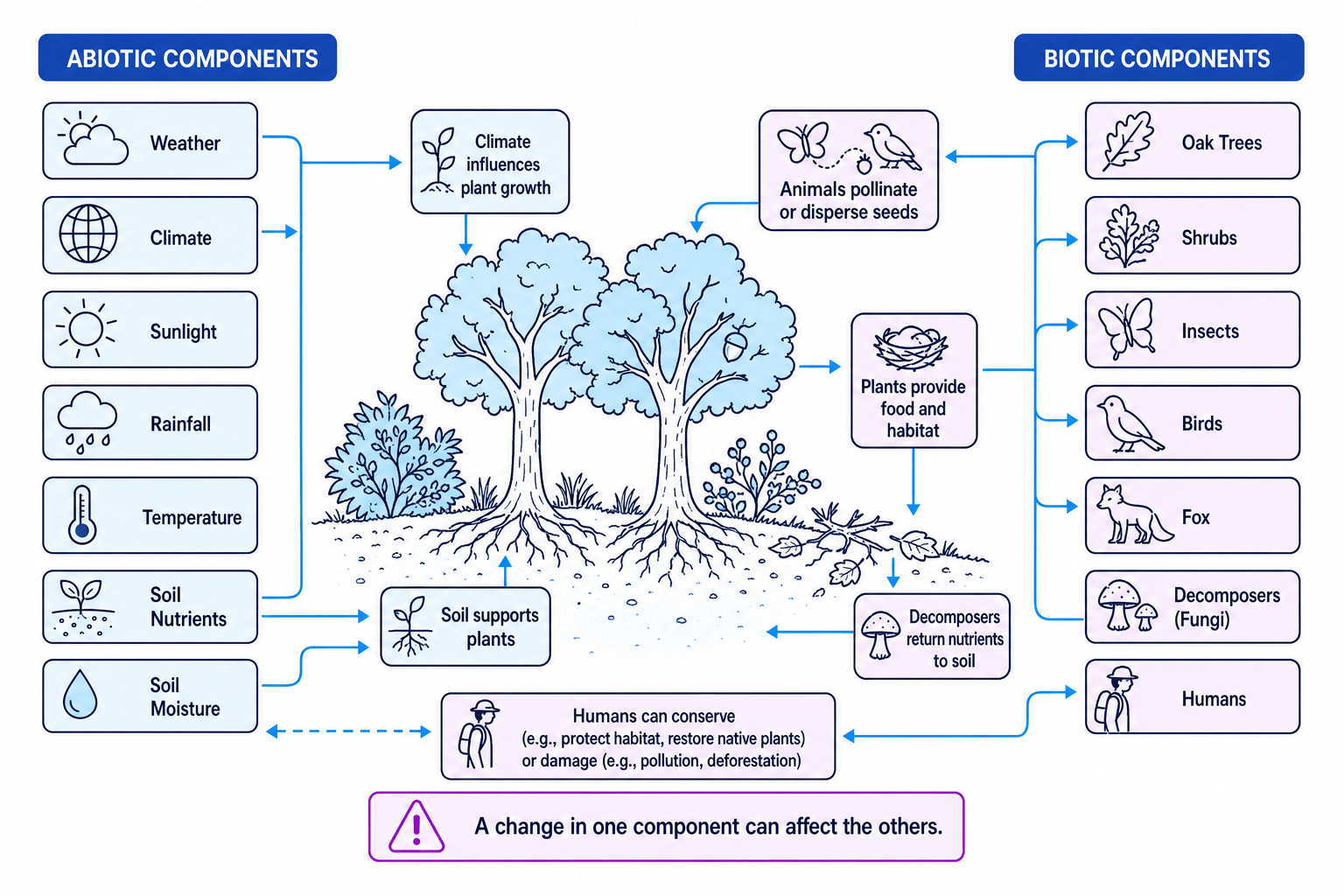
- Abiotic components are the non-living parts of an ecosystem, such as weather, climate and soil.
- Biotic components are the living parts of an ecosystem, including plants, animals, microorganisms and humans.
The OCR specification names three important abiotic components:
- Weather: the day-to-day conditions in the atmosphere, such as temperature, rainfall, sunshine and wind.
- Climate: the average weather conditions of a place, usually measured over about 30 years.
- Soil: the upper layer of the ground containing mineral particles, organic matter, air and water; it supports plant growth.
Biotic components include:
- Plants, such as grasses, shrubs, algae and trees.
- Animals, such as insects, birds, mammals, reptiles and fish.
- Humans, because people are living organisms and can strongly affect ecosystems through farming, building, conservation, pollution or recreation.
Humans are not separate from ecosystems
Do not treat humans as “outside” the ecosystem. In GCSE Geography, humans are a biotic component because they are living organisms, but they can also change abiotic conditions, for example by compacting soil, draining land or increasing pollution.
Classifying components in a local pond
Imagine you are describing a local pond ecosystem with reeds, frogs, pond water, rainfall, soil moisture, dragonflies and dog walkers.
- Decide whether each component is living or non-living. Reeds, frogs, dragonflies and dog walkers are living, so they are biotic components.
- Identify the physical conditions and materials. Pond water, rainfall and soil moisture are non-living, so they are abiotic components.
- Check any awkward examples. Dog walkers are humans, so they are biotic, but their actions can alter abiotic conditions by trampling vegetation and compacting muddy soil.
- Link the categories together. Rainfall affects pond water levels, which affects reeds and frogs, showing that abiotic and biotic components interact.
Weather, climate and soil: why abiotic components matter
Abiotic components create the conditions in which living things survive. They help explain why different ecosystems form in different places.
Weather: short-term conditions
Weather can change quickly. A week of heavy rain may flood burrows or raise pond levels. A hot, dry spell may reduce soil moisture and stress plants. Frost can damage young leaves and flowers.
Weather often affects ecosystems over hours, days or weeks.
Climate: long-term pattern
Climate affects the broad type of ecosystem that can develop. For example, the UK’s cool temperate climate supports temperate deciduous woodland, where many trees lose their leaves in autumn.
In contrast, a much hotter and wetter climate can support tropical rainforest, while a very dry climate may support desert scrub. You do not need those global ecosystems in detail for this exact section, but they show why climate matters.
Weather and climate are not the same
Weather is short-term and changes from day to day. Climate is the long-term average pattern. If an answer says “the climate was rainy yesterday”, it is using the wrong term.
Soil: the foundation for plant growth
Soil affects which plants can grow because it controls:
- Nutrient availability, such as nitrogen and minerals.
- Soil moisture, meaning how much water the soil holds.
- Drainage, meaning how easily water moves through it.
- Soil depth, which affects how much space roots have.
- pH, meaning how acidic or alkaline the soil is.
Plants also affect soil. Leaves fall, decay and add organic matter. Roots bind soil together, reducing erosion. This means soil is not just a background condition; it is part of a two-way relationship.
Abiotic conditions set limits
Abiotic components such as climate, weather and soil influence what can live in an ecosystem, how well it grows and how populations change over time.
Biotic components: living things and their roles
Biotic components depend on one another for food, shelter, reproduction and nutrient cycling.
A producer is a plant or algae that makes its own food using sunlight. In a woodland, oak trees, grasses and shrubs are producers.
A consumer is an animal that gets energy by eating plants or other animals. For example, a caterpillar may eat leaves, and a bird may eat the caterpillar.
A decomposer is an organism, usually bacteria or fungi, that breaks down dead plants and animals. Decomposers return nutrients to the soil, helping new plants grow.
These roles matter because they show that ecosystems are connected rather than random collections of organisms.
Interdependence: the key relationship
Interdependence
Interdependence means the components of an ecosystem depend on and influence each other, so a change in one component can affect several others.
Interdependence can happen in several directions:
- Abiotic to biotic: rainfall affects soil moisture, which affects plant growth.
- Biotic to abiotic: tree roots stabilise soil, and leaf litter adds nutrients.
- Biotic to biotic: plants provide food and habitat for animals; animals may pollinate flowers or disperse seeds.
- Humans to ecosystem: people may damage habitats through trampling and pollution, or protect them through conservation.
Think in chains, not lists
A strong geography answer does not just list components. It explains how one component affects another, then gives a knock-on effect for the wider ecosystem.
Tracing a dry spring through a woodland ecosystem
A temperate woodland has a much drier spring than usual.
- Begin with the abiotic change: lower rainfall reduces soil moisture, especially in shallow or freely draining soils.
- Apply the direct effect on producers: trees, shrubs and ground plants may grow more slowly because they have less water for growth.
- Link to consumers: if plants produce fewer leaves, flowers or seeds, herbivores such as caterpillars, deer or small mammals may have less food.
- Add a further knock-on effect: birds that feed on insects may find less prey, which can affect nesting success.
- Close the cycle: reduced plant growth can also mean less leaf litter, so decomposers may return fewer nutrients to the soil, making future plant growth harder.
Local and regional examples
You should be able to apply these ideas to real places at local and regional scales.
Local example: a pond or school grounds ecosystem
In a pond ecosystem, abiotic components include water depth, light, temperature, oxygen levels, rainfall and muddy soil. Biotic components include algae, reeds, water insects, fish, frogs, birds and people using the area.
If rainfall decreases, the pond may become shallower. That can warm the water and reduce oxygen levels. Fish and aquatic insects may struggle, while some plants may become exposed and die. This shows interdependence between weather, water conditions and living organisms.
Regional example: Epping Forest, London and Essex
Epping Forest is a large area of ancient woodland on the north-eastern edge of London. It is a useful example of a regional temperate deciduous woodland ecosystem.
Abiotic components include the UK’s temperate climate, seasonal rainfall, soils, slopes and drainage. Biotic components include oak, beech, holly, fungi, insects, birds, mammals and visitors.
The woodland shows many links:
- Trees provide habitats for birds, insects and fungi.
- Leaf litter is broken down by decomposers, returning nutrients to the soil.
- Roots bind soil and help reduce erosion.
- Visitors can cause trampling, which damages plants and compacts soil.
- Conservation management can protect habitats and reduce pressure on sensitive areas.
Use named places carefully
If your school uses a different local ecosystem, use that one in the exam. The key is to name the place and link its abiotic and biotic components, rather than giving vague statements about “plants and animals”.
How to write about interdependence
A simple structure for an exam paragraph is:
- Name the component that changes.
- Say whether it is abiotic or biotic.
- Explain the direct effect on another component.
- Explain one knock-on effect.
- Link back to the whole ecosystem.
For example: “A decrease in rainfall is an abiotic change. It reduces soil moisture, so plants grow less successfully. This reduces food and habitat for insects, which can then reduce food available for birds. This shows interdependence because a change in weather affects plants, animals and soil processes.”
Only describing one link
A weak answer often says, “Rain helps plants grow.” That is true, but it is not enough. Develop it by explaining what happens next to animals, decomposers, soil or humans.
Mini summary
- Ecosystems contain abiotic and biotic components.
- Abiotic components include weather, climate and soil.
- Biotic components include plants, animals, decomposers and humans.
- Components are interdependent, meaning a change in one part can affect other parts.
- Strong answers use named examples and clear cause-and-effect chains.
In the exam
- Use the terms abiotic, biotic and interdependence accurately, especially when defining or explaining.
- Develop your answer as a chain: component changed → direct effect → knock-on effect → impact on the ecosystem.
- Use a named local or regional example, such as a pond, school grounds ecosystem or Epping Forest, and avoid vague “plants and animals” statements.
Check yourself
- What is the difference between an abiotic component and a biotic component?
- Why is soil important in a woodland ecosystem?
- How could a decrease in rainfall affect both plants and animals in a local pond or woodland?