

What you'll learn
- What a tropical rainforest is and what “tropical” tells you about location.
- How to describe the global distribution of tropical rainforests using latitude and named regions.
- Where the major rainforest regions are: Amazon, Central American, Congo River Basin, Madagascan, South East Asian and Australasian.
- How to write a clear GCSE-style location description from a world map.
Start with the basics: what is a tropical rainforest?
A forest is a large area dominated by trees. A rainforest is a forest with very high rainfall across the year. A tropical rainforest is found in hot, wet parts of the world, usually close to the Equator.
Tropical rainforest
A tropical rainforest is a dense, evergreen forest found in hot and wet low-latitude areas, with very high biodiversity and rainfall throughout much of the year.
The word tropical is a location clue. It means the area is in or near the tropics, the zone between the Tropic of Cancer at 23.5° N and the Tropic of Capricorn at 23.5° S.
The tropics
The tropics are the belt of Earth between 23.5° N and 23.5° S. The Equator lies in the middle at 0° latitude.
Using latitude to understand rainforest location
Latitude measures how far north or south a place is from the Equator. Lines of latitude run east–west around the Earth.
Most major tropical rainforests are found:
- close to the Equator
- mostly between the Tropic of Cancer and Tropic of Capricorn
- in parts of South America, Central America, Africa, South East Asia and Australasia
This is a global-scale pattern because you are looking across the whole world, not just one country or region.
The main global pattern
Tropical rainforests form a broken belt around the world near the Equator, mainly between 23.5° N and 23.5° S.
The map below shows the major tropical rainforest regions you need to know.
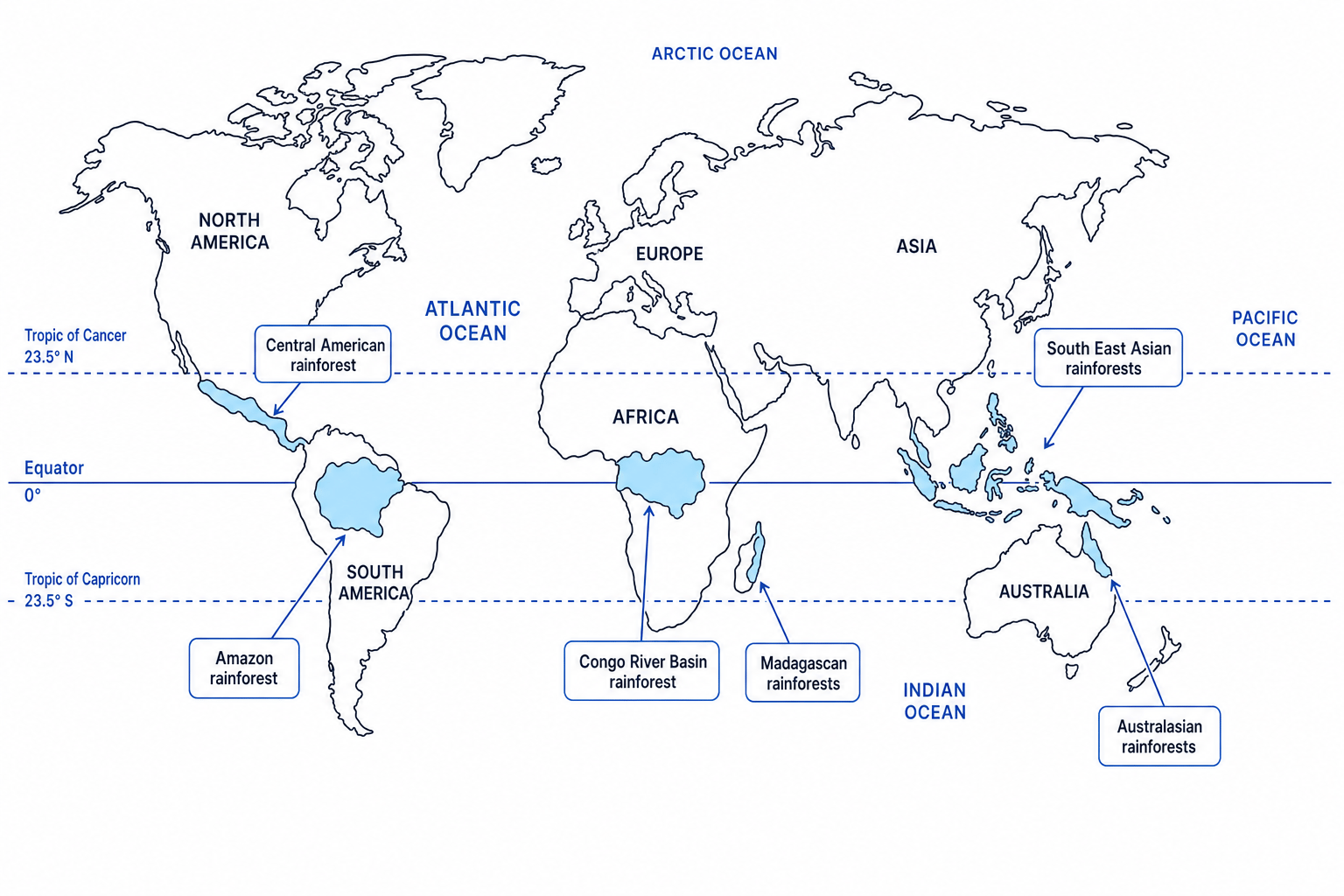
The major tropical rainforest regions
1. The Amazon rainforest
The Amazon rainforest is in northern South America. It covers a very large area of the Amazon Basin, especially in Brazil, but it also extends into countries such as Peru, Colombia, Bolivia, Ecuador, Venezuela, Guyana, Suriname and French Guiana.
Basin
A basin is an area of land drained by a river and its tributaries. The Amazon Basin is drained by the Amazon River system.
The Amazon is the world’s largest tropical rainforest region. In an exam, it is not enough to say “it is in Brazil” because it spreads across several countries. A stronger answer places it in northern South America, around the Equator, mainly in the Amazon Basin.
2. Central American rainforests
The Central American rainforests are found between North America and South America, from southern Mexico through countries such as Belize, Guatemala, Honduras, Nicaragua, Costa Rica and Panama.
This rainforest region is much smaller than the Amazon, but it is still important because it forms part of the tropical rainforest belt north of the Equator.
Be precise with Central America
Central America is not the same as the whole of South America. It is the narrow land bridge between southern Mexico and Panama.
3. Congo River Basin rainforest
The Congo River Basin rainforest is in central Africa, around the Equator. It is the second largest tropical rainforest region after the Amazon.
It includes large areas of the Democratic Republic of the Congo, plus parts of countries such as the Republic of the Congo, Gabon, Cameroon, Central African Republic and Equatorial Guinea.
Like the Amazon, the word basin matters: this rainforest is linked to the Congo River and the land drained by it.
4. Madagascan rainforests
The Madagascan rainforests are found on Madagascar, a large island in the Indian Ocean, off the east coast of southern Africa.
Rainforest is especially associated with the eastern side of Madagascar, where moist air from the Indian Ocean brings high rainfall. For this location topic, you mainly need to know that Madagascar is separate from mainland Africa and lies in the tropics.
5. South East Asian rainforests
The South East Asian rainforests are spread across mainland and island areas of South East Asia. Important areas include Malaysia, Indonesia, Brunei, and parts of nearby countries and islands.
This region includes major rainforest areas on islands such as Borneo, Sumatra and New Guinea. It lies close to the Equator and stretches across many islands between the Indian Ocean and the Pacific Ocean.
Forgetting island rainforests
Do not only look for rainforests on large continents. Some major tropical rainforests are on islands, especially in South East Asia and Madagascar.
6. Australasian rainforests
Australasia is the region including Australia, New Zealand, Papua New Guinea and nearby Pacific islands. The main tropical rainforest areas in this spec are in Papua New Guinea and north-east Australia, especially parts of Queensland.
Australia is mostly dry, so rainforest is not spread across the whole continent. The tropical rainforest is concentrated in the wetter north-east.
Australasia
Australasia is a world region including Australia, New Zealand, Papua New Guinea and nearby islands. For tropical rainforests, the key areas are Papua New Guinea and north-east Australia.
Describing distribution properly
In Geography, distribution means the way something is spread out across space. When you describe the distribution of tropical rainforests, you should identify the overall pattern, then support it with named places.
Distribution
Distribution means where something is found and how it is spread across an area or across the world.
A weak description might say:
“Rainforests are near the Equator.”
That is true, but it is too brief. A stronger GCSE answer adds:
- latitude: mostly between 23.5° N and 23.5° S
- continents or regions: South America, Africa, South East Asia and Australasia
- named rainforest areas: Amazon, Congo River Basin, Madagascar and others
- pattern detail: they are not continuous; they are separated by oceans and drier areas
Describing the global pattern
-
Start with the widest pattern: tropical rainforests are found mainly in a belt around the Equator, mostly between the Tropic of Cancer and the Tropic of Capricorn.
-
Add named continental regions: they occur in northern South America, Central America, central Africa, Madagascar, South East Asia and Australasia.
-
Use specific examples to prove the pattern: the Amazon is in northern South America, the Congo River Basin is in central Africa, and South East Asian rainforests include parts of Indonesia and Malaysia.
-
Add a detail that shows map-reading skill: the belt is broken rather than continuous because rainforests are separated by oceans and by areas with different climates, such as deserts or temperate regions.
What you must be able to locate
For this section, you should be able to name and locate these six rainforest regions:
| Rainforest region | Where it is found |
|---|---|
| Amazon | Northern South America, mainly the Amazon Basin, especially Brazil |
| Central American | Southern Mexico through Central America to Panama |
| Congo River Basin | Central Africa, around the Congo River and close to the Equator |
| Madagascan | Madagascar, an island in the Indian Ocean off east Africa |
| South East Asian | Malaysia, Indonesia, Brunei and nearby islands such as Borneo and Sumatra |
| Australasian | Papua New Guinea and north-east Australia |
Six names to remember
The six major tropical rainforest regions for this topic are Amazon, Central American, Congo River Basin, Madagascan, South East Asian and Australasian.
How to avoid vague location answers
At GCSE, “where?” questions reward accurate geographical language. Try to avoid answers that are too vague.
Instead of saying:
- “in hot countries”
- “near Africa”
- “in Brazil”
- “around the middle of the world”
Say:
- “mainly between the Tropic of Cancer and Tropic of Capricorn”
- “in central Africa, around the Congo River Basin”
- “in northern South America, especially the Amazon Basin”
- “close to the Equator, but in separate regions rather than one continuous forest”
Only naming one country
The Amazon is often associated with Brazil, but it extends into several South American countries. If you only write “Brazil”, your location is less accurate.
Linking this topic to the bigger ecosystems unit
This section is mainly about where tropical rainforests are found. Later, you may connect this to why they are found there: the tropics receive strong solar energy, and many equatorial areas have warm, wet conditions all year.
For now, focus on being able to describe the global distribution using clear map language and named rainforest regions.
In the exam
-
Use latitude language first: say tropical rainforests are mainly close to the Equator and between 23.5° N and 23.5° S.
-
Support the pattern with at least two named examples, such as the Amazon in northern South America and the Congo River Basin in central Africa.
-
Add precision by naming regions, countries or oceans where helpful, but avoid claiming rainforests cover whole continents or whole countries.
Check yourself
- Can you name all six major tropical rainforest regions in the OCR spec?
- Which two rainforest regions are found in Africa or just off Africa?
- How would you describe the global distribution of tropical rainforests in two clear sentences?

