What you'll learn
- What the main geomorphic processes are and how they shape UK landscapes.
- How to tell apart weathering, mass movement, erosion, transport and deposition.
- The different types of weathering, erosion and sediment transport.
- How to use precise process vocabulary in GCSE answers.
The big picture: landscapes are made by processes
A landscape is the visible shape and character of an area, such as a river valley in the Yorkshire Dales, the chalk cliffs of Dorset, or a coastal spit on the Holderness coast.
A geomorphic process is a natural process that shapes the Earth’s surface. These processes break rock down, move material, wear surfaces away, and build new landforms.
Geomorphic process
A geomorphic process is a natural action that changes the shape of the land, usually by breaking down, moving, eroding or depositing rock and sediment.
Geomorphic processes often work in a sequence. Rock is broken up, moved, carried away, and eventually laid down somewhere else.
The process sequence
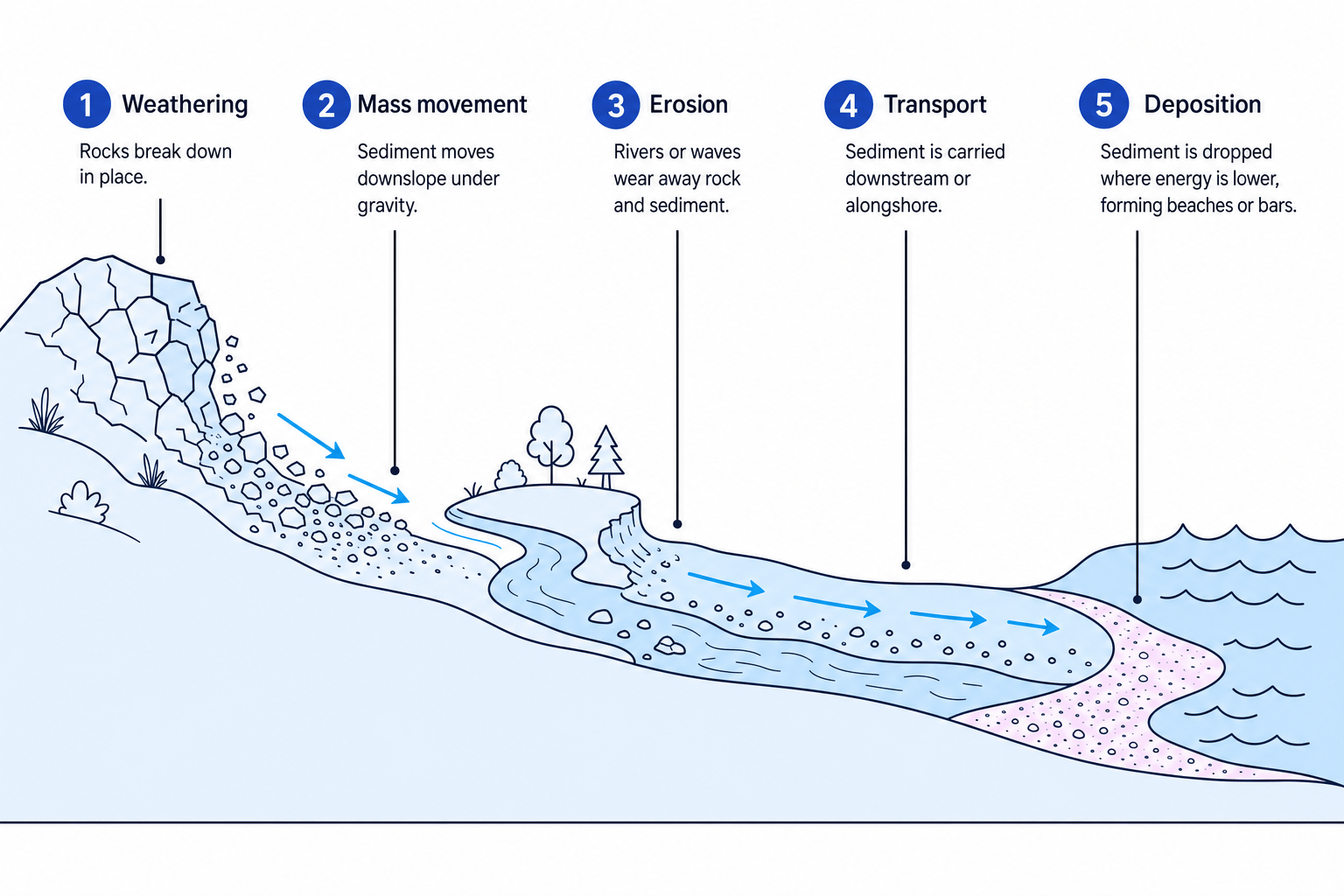
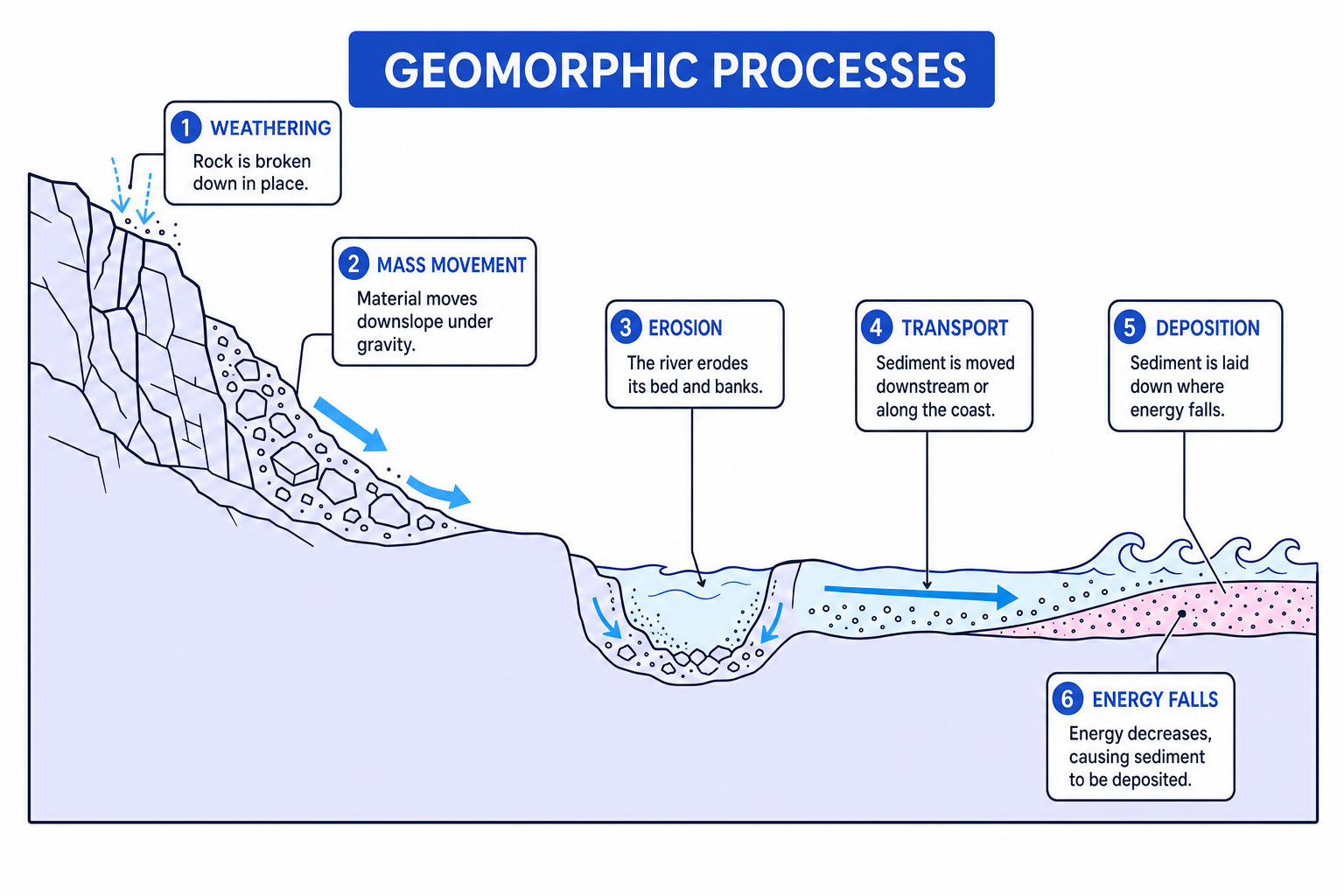
A simple way to remember the order is: weathering breaks material up, mass movement moves it downslope, erosion wears surfaces away, transport carries material, and deposition drops it when energy falls.
Weathering: breaking down rock in place
Weathering is the breakdown of rock where it is. The important phrase is in place: the material is not being carried away at that moment.
Weathering
Weathering is the breakdown or decay of rock in situ, meaning in its original place, by physical, chemical or biological processes.
Weathering is especially important on exposed upland slopes, cliffs, river valleys and limestone landscapes such as the Yorkshire Dales.
Mechanical weathering
Mechanical weathering breaks rock into smaller pieces without changing the chemical composition of the rock. The rock is physically broken apart.
A common type in the UK is freeze-thaw weathering. Water enters cracks in rock, freezes and expands. This puts pressure on the rock. Repeated freezing and thawing widens the cracks until pieces break off.
Mechanical weathering
Mechanical weathering is the physical breakdown of rock into smaller pieces without changing the rock’s chemical make-up.
Chemical weathering
Chemical weathering changes the minerals in rock through chemical reactions. It is common where water is present.
One important example is solution or carbonation in limestone areas. Rainwater absorbs carbon dioxide from the air and soil, forming weak carbonic acid. This slowly dissolves limestone, helping form features such as limestone pavements and caves.
Chemical weathering
Chemical weathering is the breakdown or decay of rock through chemical reactions, often involving water and weak acids.
Biological weathering
Biological weathering is caused by living things. Plant roots can grow into cracks and force them wider. Burrowing animals can loosen soil and rock. Organic acids from decaying plants can also help break down rock chemically.
Biological weathering
Biological weathering is the breakdown of rock caused by living organisms, such as plant roots, animals or organic acids.
Weathering is not the same as erosion
Weathering breaks rock down where it is. Erosion involves rock or sediment being removed by a moving force such as water, waves, wind or ice.
Classifying types of weathering
A limestone cliff has cracks. Rainwater reacts with the limestone and slowly dissolves it. Grass roots also grow into the cracks.
- The reaction between rainwater and limestone changes the rock chemically, so this is chemical weathering.
- The grass roots physically widen the cracks as they grow, so this is biological weathering.
- Because the rock is being broken down in place rather than carried away, both processes are forms of weathering, not erosion.
Mass movement: material moves downslope
Once rock has been weakened by weathering, it can move downhill under the force of gravity. This is called mass movement.
Mass movement
Mass movement is the downslope movement of rock, soil or sediment under the force of gravity.
Mass movement is common on steep slopes, especially where material has become saturated after heavy rainfall. You may see it on coastal cliffs, such as parts of the Holderness coast in East Yorkshire, or on steep river valley sides.
Sliding
Sliding happens when material moves downslope along a fairly straight slip plane. It can involve blocks of rock or soil moving suddenly.
Sliding
Sliding is a type of mass movement where rock, soil or sediment moves downslope along a relatively straight surface.
Slumping
Slumping is a type of mass movement where material moves downslope along a curved surface. The movement often leaves a rotated, stepped shape in the cliff or slope.
Slumping is common in weak, soft rock or clay cliffs. At Holderness, boulder clay cliffs can become saturated, making them heavier and less stable.
Slumping
Slumping is a type of mass movement where saturated rock or soil moves downslope along a curved slip surface, often rotating as it moves.
Spotting slump clues
In a diagram or photo, look for a curved slip surface, a rotated block, and a stepped or terraced slope. These are strong clues for slumping.
Identifying mass movement from evidence
A coastal cliff is made of soft clay. After heavy rain, a large section moves downwards and outwards, leaving a curved scar near the top and tilted blocks below.
- Heavy rain suggests the clay has become saturated, increasing its weight and reducing stability.
- The curved scar shows movement along a curved slip surface, not a straight one.
- Tilted or rotated blocks are typical of slumping, so this is mass movement by slumping rather than sliding.
Erosion: wearing away and removing material
Erosion happens when moving water, waves, wind or ice wear away rock and sediment, then remove it from its original position.
Erosion
Erosion is the wearing away and removal of rock, soil or sediment by moving forces such as rivers, waves, wind or ice.
In GCSE Geography, you need to know four key erosion processes: abrasion, hydraulic action, attrition and solution.
Abrasion
Abrasion is like natural sandpapering. Sediment carried by a river or waves is thrown against rock surfaces, scraping and wearing them away.
In a river, abrasion can deepen or widen the channel. At the coast, waves can hurl pebbles at cliffs, helping form notches and caves.
Abrasion
Abrasion is erosion caused when rock fragments carried by water, waves, wind or ice scrape and wear away a surface.
Hydraulic action
Hydraulic action is erosion caused by the force of water itself. In rivers and at the coast, water is forced into cracks. The pressure can widen cracks and break pieces away.
At the coast, waves trap air in cracks in cliffs. When the wave retreats, pressure is released. Repeated compression and release weakens the rock.
Hydraulic action
Hydraulic action is erosion caused by the force of water hitting rock and compressing air in cracks, weakening and breaking the rock apart.
Attrition
Attrition happens during transport. Rock fragments collide with each other, becoming smaller, smoother and rounder.
This is why pebbles on a beach or in a river often become rounded over time.
Attrition
Attrition is erosion where rock fragments carried by water collide with each other and become smaller, smoother and rounder.
Solution
Solution as an erosion process means rock is dissolved by water. It is most important in rocks such as limestone and chalk, which can dissolve in weakly acidic water.
Solution erosion
Solution is erosion where soluble minerals are dissolved and removed in water.
Two meanings of solution
Solution can mean an erosion process, where rock is dissolved, or a transport process, where dissolved minerals are carried in water. Use the sentence context to decide which one is meant.
Choosing the correct erosion process
A river carries pebbles during a flood. The pebbles scrape along the bed, and over time the channel becomes deeper.
- The moving pebbles are being used as tools against the river bed, so the key action is scraping.
- Scraping and wearing away a surface is abrasion.
- This is not attrition, because attrition is mainly about the pebbles hitting each other and becoming smaller and rounder.
Transport: carrying sediment from one place to another
After erosion, material often gets carried away. This is called transport.
Transport
Transport is the movement of eroded material from one place to another by rivers, waves, wind or ice.
The type of transport depends mainly on the size of the material and the energy of the moving water, wave, wind or ice. Larger material needs more energy to move.
Traction
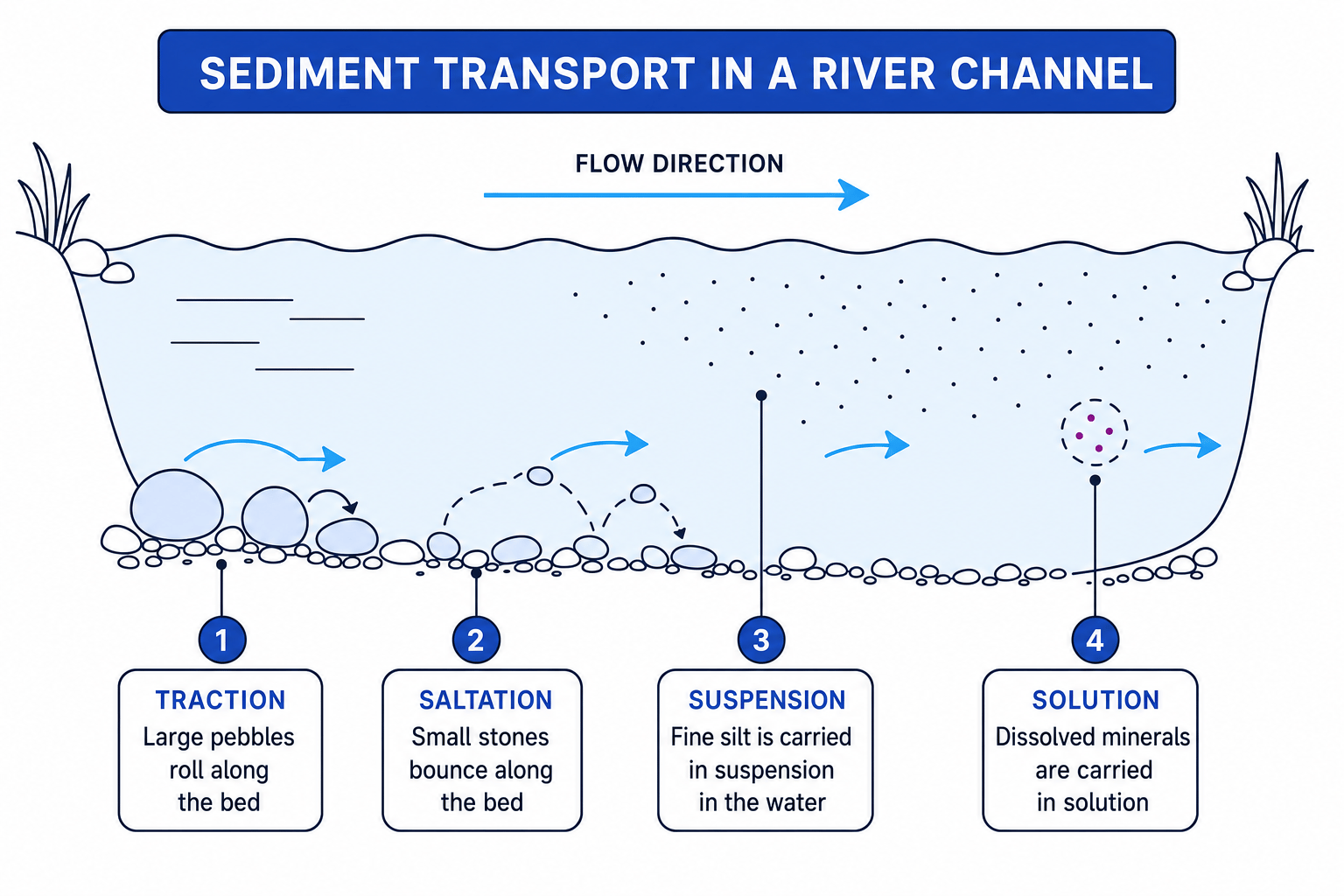
Traction is when large rocks or pebbles are rolled along the bed of a river or sea floor. It needs high energy.
Traction
Traction is the transport of large sediment by rolling it along the bed.
Saltation
Saltation is when small stones or gravel bounce along the bed. The particles are briefly lifted, then dropped, then lifted again.
Saltation
Saltation is the transport of small sediment by bouncing it along the bed.
Suspension
Suspension is when fine particles such as silt and clay are carried within the water. The water may look cloudy or brown after heavy rainfall because lots of sediment is in suspension.
Suspension
Suspension is the transport of fine sediment carried within the flow of water or air.
Solution
Solution as a transport process means dissolved minerals are carried in the water. You usually cannot see this load because it is dissolved.
Solution transport
Solution is the transport of dissolved minerals within water.
Particle size and energy
High-energy flows can move larger material by traction and saltation. Lower-energy flows usually carry fine material by suspension, while dissolved material moves by solution.
Selecting the transport process
A river in flood is moving boulders along its bed, while the water also looks brown because it contains fine silt.
- Boulders are large and heavy, so they need high energy and are most likely moved by traction along the bed.
- Fine silt is much smaller and can be held within the moving water, so it is carried in suspension.
- The flood can therefore transport different sizes of sediment at the same time, using more than one process.
Deposition: laying material down
Deposition happens when material being transported is dropped. This usually happens when energy decreases.
Deposition
Deposition is the laying down of sediment when the transporting force loses energy.
A river may deposit sediment when it slows down on the inside of a meander, enters a lake, or reaches its mouth. Waves may deposit sediment in sheltered bays, helping form beaches. Longshore drift can move sediment along the coast and deposition can build spits, such as Spurn Head at the mouth of the Humber Estuary.
Energy can fall because:
- river discharge decreases after a flood
- a river enters a flatter area or wider channel
- waves enter a sheltered bay
- wind speed drops
- ice melts and releases material
Deposition trigger phrase
If you are explaining deposition, include the phrase “when energy falls”. It links the cause directly to the process.
Explaining why deposition occurs
A river leaves a steep upland valley and enters a wider, flatter valley. It begins to deposit gravel and sand.
- Moving from a steep valley to a flatter valley reduces the river’s gradient, so the river usually loses speed.
- A slower river has less energy, so it can no longer carry the same size and amount of sediment.
- The heavier material is dropped first, so gravel and sand are deposited on the river bed or banks.
How the processes work together in real landscapes
Distinctive landscapes are created because processes operate together over time.
On a coastal cliff, such as parts of the Dorset coast:
- weathering weakens the cliff face
- waves erode the base by hydraulic action and abrasion
- material may slump or slide down the cliff
- waves transport sediment along the coast
- deposition can form beaches or spits where wave energy decreases
In a river valley, such as the River Tees in northern England:
- weathering breaks down valley-side rock
- mass movement moves material into the river
- the river erodes its bed and banks
- sediment is transported downstream by traction, saltation, suspension and solution
- deposition occurs where the river loses energy
Mixing up process and landform
A process is an action, such as abrasion or deposition. A landform is a feature created by processes, such as a beach, waterfall, meander, cliff, cave or spit.
Using precise geography language
For this section, examiners want you to use the correct process term and explain how it works. A strong answer does not just name a process; it describes the action.
Instead of writing:
- “The cliff is eroded.”
Write:
- “The cliff is eroded by hydraulic action, when waves force air into cracks, increasing pressure and weakening the rock.”
Instead of writing:
- “The river carries stones.”
Write:
- “The river transports large stones by traction, rolling them along the river bed.”
In the exam
- Name the process accurately: for example, abrasion, slumping, saltation or deposition.
- Add the mechanism: explain what is actually happening, such as scraping, rolling, dissolving, bouncing or pressure in cracks.
- Link the process to landscape change: say how it helps create or change a landform, such as a cliff, valley, beach, meander or river channel.
Check yourself
- What is the difference between weathering and erosion?
- How are sliding and slumping different types of mass movement?
- Which transport process moves fine silt within the water, and which moves large pebbles along the bed?