

What you'll learn
- How economic development is different from simple economic growth.
- How one LIDC case study — Ethiopia — has changed over time.
- How environment, politics, trade, investment, population, education, healthcare, technology and aid interact.
- How to use Rostow’s model to judge a country’s development pathway.
Start here: what does “development” mean?
A country’s development is not just about money. A country can become richer but still have poor healthcare, unequal access to education, or large regional differences.
Economic development
Economic development means long-term improvement in people’s quality of life, including income, health, education, jobs, housing, security and access to services. Economic growth is narrower: it means the economy is producing more goods and services, usually shown by rising income or output.
Geographers often use indicators such as GNI per capita in US$, life expectancy, literacy rate, infant mortality, access to clean water, and the Human Development Index. You should be ready to explain that no single indicator tells the whole story.
LIDC and EDC
An LIDC is a low-income developing country, usually with low average income and lower levels of industrialisation. An EDC is an emerging and developing country, where industry and services are growing and incomes are rising, but development is still uneven.
Case study focus: Ethiopia, an LIDC
We will use Ethiopia, a landlocked country in the Horn of Africa, as the case study. It is useful because its development has changed quickly in some ways, but progress remains uneven between cities and rural areas, highlands and lowlands, and different social groups.
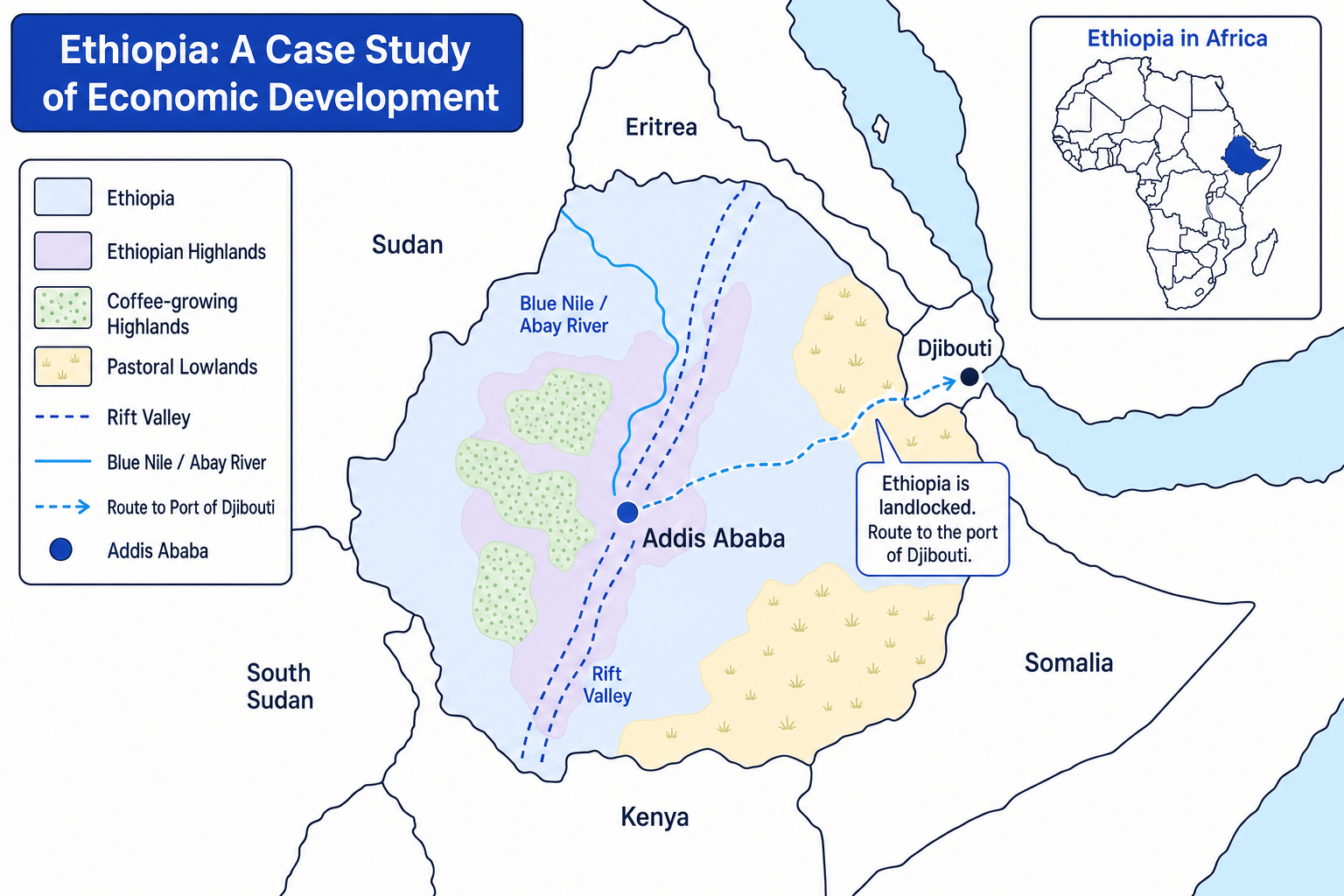
Ethiopia’s population is now over 120 million, making it one of Africa’s most populous countries. Since the early 2000s it has experienced periods of rapid economic growth, major infrastructure building, and improvements in health and education. However, drought, debt, conflict, food insecurity and low average income still limit development. Exact statistics change by source and year, so use the most recent figures your teacher gives you.
Measuring changing development
When you are given data, do more than say “it went up”. Say how much it changed and what that means for people.
Calculating percentage change in income
If a data set shows Ethiopia’s GNI per capita rising from US470toUS470 to US470toUS1,020, you can calculate the percentage increase.
percentage increase=new value−old valueold value×100\text{percentage increase} = \frac{\text{new value} - \text{old value}}{\text{old value}} \times 100percentage increase=old valuenew value−old value×100- Subtract the old value from the new value: US1,020minusUS1,020 minus US1,020minusUS470 gives an increase of US$550.
- Divide the increase by the old value, then multiply by 100:
- Interpret the result: income per person has more than doubled, but this does not prove everyone is better off, because income may be unevenly shared.
Factor 1: geographical location and environmental context
Ethiopia’s location matters. Since Eritrea became independent in 1993, Ethiopia has been landlocked, so it relies heavily on the port of Djibouti for imports and exports. This can raise transport costs and makes good regional relationships essential.
Its landscape is varied. The Ethiopian Highlands are cooler and wetter, supporting farming such as coffee production. The lowlands are hotter and drier, with pastoral farming and greater drought risk. The Rift Valley provides geothermal potential, while rivers such as the Blue Nile / Abay create opportunities for hydropower.
Natural resources include coffee, gold, potash, some natural gas, fertile highland soils, and major hydropower potential. But rainfall variability, drought and land degradation can reduce harvests and increase food insecurity.
Factor 2: political development and relationships with other states
Political stability affects whether businesses invest, whether schools and hospitals function, and whether infrastructure can be built safely.
Ethiopia has had major political changes: imperial rule, the socialist Derg regime from 1974 to 1991, then a federal system with strong state-led development policies. In the 2000s and 2010s the government invested heavily in roads, dams, railways and education. More recently, conflict, including the Tigray conflict from 2020 to 2022, and internal unrest have disrupted development.
International relationships also matter. Ethiopia depends on cooperation with Djibouti for sea trade, has received loans and investment from China, works with international donors such as the World Bank, and has tensions with Egypt and Sudan over the Grand Ethiopian Renaissance Dam on the Blue Nile.
Factor 3: imports, exports and trade
Trade means buying and selling goods and services between countries. It can bring in foreign currency, create jobs and encourage investment. But if a country mostly exports low-value raw materials and imports expensive manufactured goods, development can be limited.
| Ethiopia’s main exports | Ethiopia’s main imports | Why this matters |
|---|---|---|
| Coffee, oilseeds, pulses, cut flowers, gold, leather goods, textiles, and services such as Ethiopian Airlines | Fuel, machinery, vehicles, fertiliser, medicines, manufactured goods, and sometimes food | Exports earn foreign currency, but imports are often costly, so Ethiopia can run a trade deficit |
Coffee is especially important because it supports farmers and earns export income. However, reliance on agricultural exports can be risky because prices and harvests can change quickly.
Factor 4: international investment
International investment includes money from foreign companies, governments or institutions used to build factories, infrastructure or services. In Ethiopia, investment has supported roads, railways, industrial parks, power projects and manufacturing.
For example, the Addis Ababa–Djibouti railway improved access to the coast, and industrial parks such as Hawassa Industrial Park aimed to attract textile and garment companies. These can create jobs, build skills and increase exports.
However, investment can also create risks. Loans must be repaid, profits may leave the country, and jobs may be low paid. So investment helps most when it builds long-term skills, infrastructure and local business links.
Factor 5: population and employment structure
Employment structure
Employment structure means the proportion of people working in the primary sector such as farming and mining, the secondary sector such as manufacturing, and the tertiary sector such as services, transport, finance, education and healthcare.
Ethiopia’s population is large and youthful. This can be an opportunity because there is a big workforce and growing market. It can also be a challenge because the country needs enough schools, jobs, housing, healthcare and food.
Agriculture still employs a large share of the workforce, often around two-thirds depending on the data source. Over time, industry and services have grown, especially around Addis Ababa and transport corridors. This shift from primary work into manufacturing and services is called structural change, and it is usually linked to rising incomes.
Factor 6: social factors — education and healthcare
Education affects development because a literate, skilled workforce can use technology, start businesses and move into higher-paid jobs. Ethiopia has expanded primary education and improved literacy, but quality and attendance can vary, especially in rural areas and for girls.
Healthcare also matters. Ethiopia expanded community healthcare through its Health Extension Programme, helping improve vaccination, maternal health and disease prevention. Life expectancy has risen since the 1990s, although conflict, malnutrition, drought and rural access problems remain serious barriers.
Factor 7: technology and communications
Communications technology can speed up development. Mobile phones help farmers check market prices, families receive remittances, businesses contact customers, and people access online banking or information.
Ethiopia’s telecoms sector has historically been tightly controlled, but recent liberalisation has increased competition. Mobile money and internet access are growing, but there is still a digital divide between urban and rural areas, and between people with reliable electricity and those without it.
Factor 8: one aid project — the Productive Safety Net Programme
A useful aid example is Ethiopia’s Productive Safety Net Programme, often called the PSNP. It began in 2005 and is supported by the Ethiopian government and international donors.
Rather than only giving emergency food aid after a crisis, the PSNP provides food or cash to food-insecure households, often in return for public works such as soil conservation, terracing, rural roads and water projects. In many years it has supported millions of people, though the exact number varies.
This links aid to long-term development because it can reduce hunger, protect families from selling assets during drought, and improve local infrastructure.
How the factors interact
The key to this topic is interrelationships. In geography, the best answers explain how one factor affects another, instead of writing a disconnected list.
Building a development chain
- Start with an environmental factor: drought in the lowlands reduces crop yields and livestock health.
- Link it to the economy: lower farm output reduces household income and may reduce exports or increase food imports.
- Link it to social development: families may struggle to pay for transport, healthcare or school materials, so education and health outcomes can worsen.
- Add a balancing factor: aid such as the PSNP or investment in irrigation can reduce the impact, but it may not remove the long-term problem of rainfall variability.
Writing a list instead of an explanation
Avoid answers like “Ethiopia is landlocked, has coffee and gets aid.” Instead, use linking language: because, this means, which leads to, however, and therefore.
Using Rostow’s model
Rostow’s model is a way of thinking about how countries may move from low levels of development towards industrialisation and mass consumption. It is a model, so it simplifies reality.
Rostow's model
Rostow’s model of economic development suggests that countries pass through five stages: traditional society, preconditions for take-off, take-off, drive to maturity, and age of high mass consumption.
Rostow’s model is often drawn as a staircase, with each stage representing a higher level of industrialisation, income and consumption.
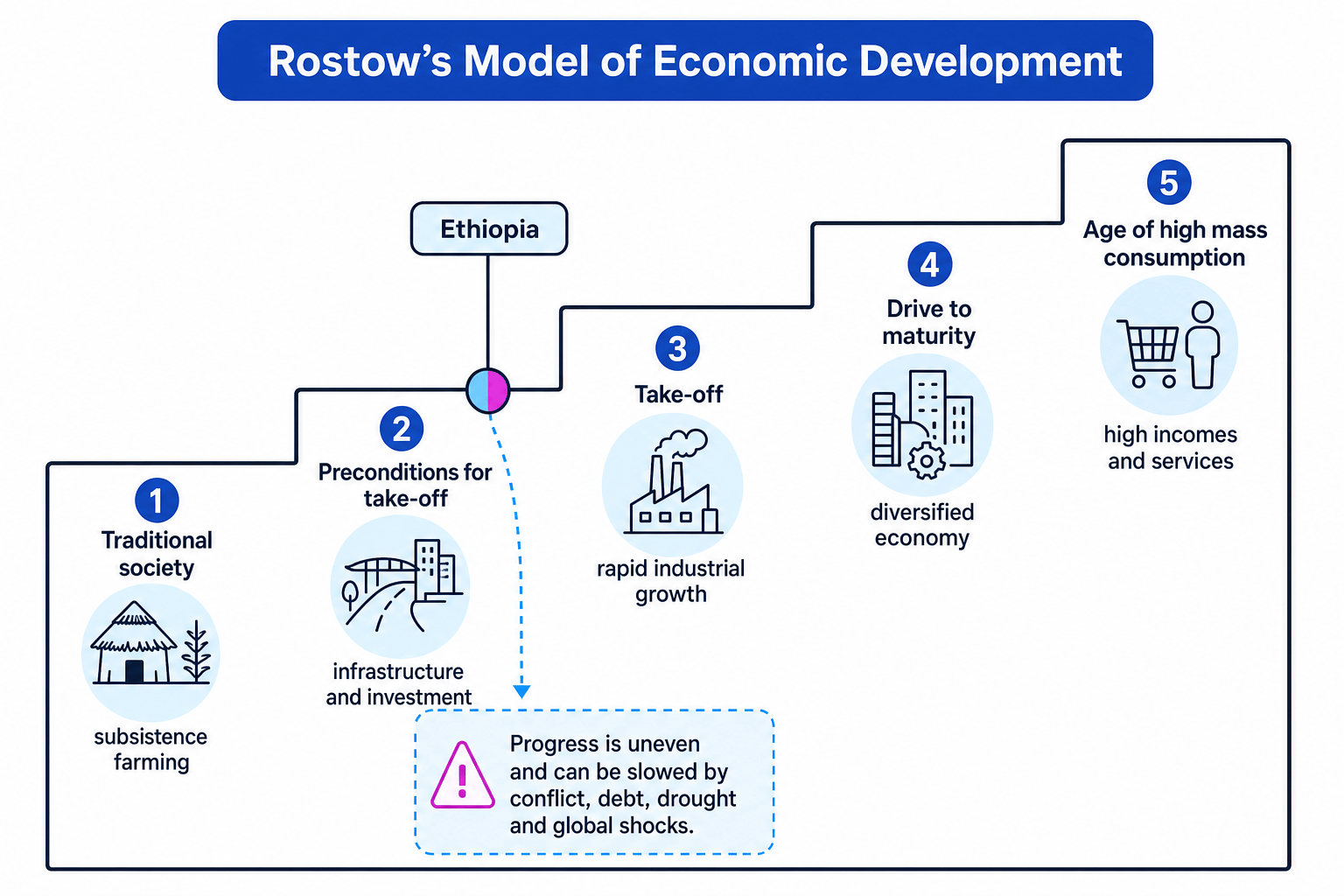
For Ethiopia, a sensible judgement is that it is between preconditions for take-off and take-off, but with uneven progress. It has built infrastructure, attracted investment and grown some manufacturing, but agriculture still dominates employment and shocks such as conflict and drought can slow development.
Placing Ethiopia on Rostow's model
- Identify evidence for preconditions for take-off: Ethiopia has invested in roads, railways, dams, education and industrial parks, showing preparation for wider industrial growth.
- Identify evidence for take-off: manufacturing, construction, aviation and services have expanded, and foreign investment has supported export industries.
- Identify evidence against full take-off: many people still work in low-income agriculture, exports remain partly dependent on primary products, and conflict, debt and drought can interrupt growth.
- Make a balanced judgement: Ethiopia is not simply “traditional” or fully industrialised; it is best placed at the boundary between preconditions and take-off, with development varying by region and social group.
Treating Rostow as automatic
Do not write as if every country must climb Rostow’s staircase smoothly. Real development can move backwards or sideways because of war, disease, debt, climate change, global price changes or political decisions.
A strong case-study sentence
Use this pattern: named place + specific factor + development link + limitation. For example: “Ethiopia’s landlocked location increases reliance on Djibouti for trade, which can raise transport costs; however, the Addis Ababa–Djibouti railway helps reduce this barrier.”
In the exam
- Use Ethiopia-specific evidence: name places such as Addis Ababa, Djibouti, the Highlands, the Blue Nile / Abay, Hawassa Industrial Park or the PSNP.
- Explain links between factors rather than listing them: show how environment, politics, trade, investment, social services and technology affect each other.
- Make a judgement when using Rostow’s model: place Ethiopia on the model, support it with evidence, and mention why the model is limited.
Check yourself
- Why does being landlocked affect Ethiopia’s trade and development?
- How can international investment create both benefits and risks for an LIDC?
- Where would you place Ethiopia on Rostow’s model, and what evidence supports your judgement?
