Confusing world cities with megacities
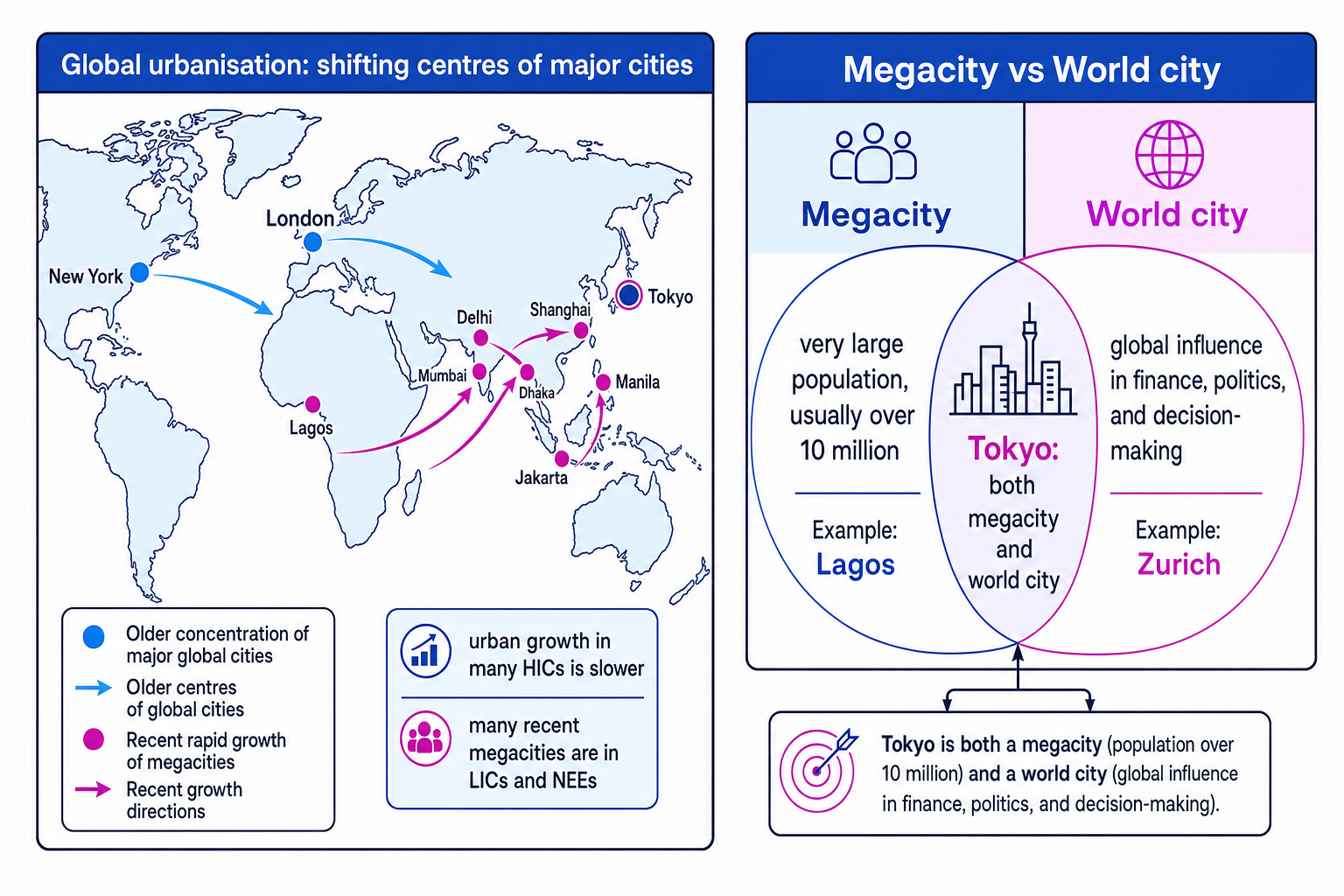
Do not assume a megacity is automatically a world city. Tokyo is both. Lagos is a megacity (over 15 million people) but is not yet considered a major world city because it lacks global financial and political dominance. Conversely, Zurich is a world city due to its global financial influence, but its population is well under 1 million.
3. How Urban Growth Rates Vary
The rate at which urban areas grow is highly uneven across the globe. We can split these trends cleanly by a country's level of economic development:
High-Income Countries (HICs)
- Trend: Very slow urban growth, and in some areas, urban populations are plateauing or declining.
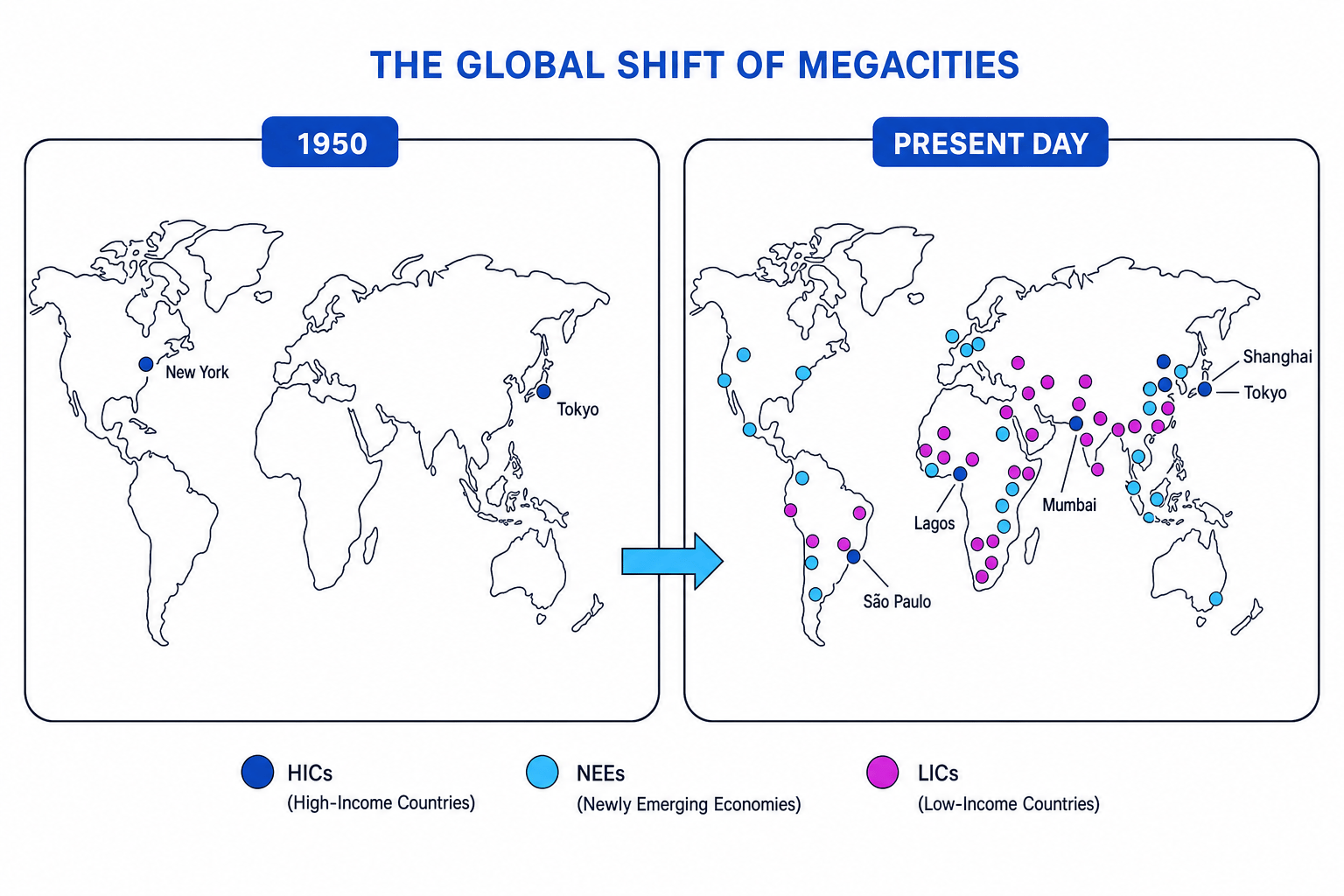
- Why?: HICs underwent rapid urbanisation during the Industrial Revolution (18th and 19th centuries) as steam-powered factories drew millions from the countryside. Today, the vast majority of people in HICs already live in cities (often 80% or more).
- Current Movement: Many HICs are experiencing counter-urbanisation, where people leave crowded cities to move to rural villages or smaller towns, commuting back using modern transport and digital technology.
Newly Emerging Economies (NEEs) and Low-Income Countries (LICs)
- Trend: Exceptionally rapid urban growth.
- Why?: These countries are undergoing their own economic transitions right now. People are moving from agricultural rural areas to manufacturing and service-dominated cities.
- Drivers of Rapid Growth:
- Rural-to-urban migration: Driven by push factors (reasons to leave the countryside, e.g., crop failure, mechanisation of farming replacing jobs, lack of healthcare) and pull factors (reasons to move to the city, e.g., higher-paying jobs, better access to schools, medical facilities).
- Natural Increase: The majority of migrants moving to cities are young adults (aged 18–35) seeking work. When they settle in the city, they often have children. This results in high birth rates. At the same time, urban areas usually have better access to hospitals, which lowers death rates. Therefore, births greatly exceed deaths.
The dual engine of urbanisation
Urban growth in LICs and NEEs is not just caused by people moving from the countryside. It is heavily accelerated by natural increase—the excess of births over deaths among the young migrant population already living in the city.
Worked Example: Calculating Percentage Change in Urban Growth
In GCSE exams, you will often be given data tables or graphs showing urban population figures and asked to calculate mathematical changes, such as the percentage growth of an urban area over time. This tests your AO4 (geographical skills) capacity.
Calculating the percentage growth of an urban area
Scenario: The population of Lagos, Nigeria (an NEE), grew from approximately 7.2 million in the year 2000 to approximately 14.8 million in the year 2021.
Calculate the percentage increase in the population of Lagos between 2000 and 2021. Show your working and round your answer to one decimal place.
- Calculate the absolute increase in population
Subtract the original population (from the year 2000) from the new population (from 2021):
- Divide the increase by the original value
Take the absolute increase (7.6 million7.6\text{ million}7.6 million) and divide it by the starting population in 2000 (7.2 million7.2\text{ million}7.2 million):
- Convert to a percentage and round
Multiply the result by 100 to get the percentage value, then round to one decimal place as requested:
Final Answer: The population of Lagos grew by 105.6% between 2000 and 2021.
In the exam
- Compare, don't just list: If a question asks you to "compare the rate of urbanisation in HICs and LICs", use comparative language. Don't write two separate paragraphs. Instead, write: "While urban growth rates in HICs are very slow or plateauing, the rate of urbanisation in LICs remains rapid."
- Be specific with your factors: When explaining rural-to-urban migration, always classify your points clearly into push and pull factors. Do not mix them up.
- Use the definitions carefully: If asked to define a world city, do not focus on population. Focus on terms like global influence, hub of finance, and command centre of the global economy.
Check yourself
- Can you explain why London is classified as a world city, whereas Dhaka is classified primarily as a megacity?
- Why does natural increase play such a significant role in the growth of cities in LICs compared to HICs?
- What is the difference between counter-urbanisation and urbanisation?