

What you'll learn
- What uneven development means at global and regional scales.
- How physical, historical, economic, political and social factors combine to create development gaps.
- Why colonialism affected trade patterns and the exploitation of natural resources.
- How different types of aid can both promote and hinder development.
Start point: what is uneven development?
Development means the progress of a place in improving people’s quality of life. It includes wealth, health, education, safety, political freedom, access to services and environmental quality.
Uneven development means development is not spread equally between places. You can see it at the global scale, such as differences between the UK, Brazil and Mali, but also at a regional scale, such as differences between richer coastal cities and poorer inland regions within the same country.
Uneven development
Uneven development is the unequal level of social, economic and political progress between places or groups of people.
Geographers measure development using indicators. An indicator is a piece of data that shows something about a place. Common examples include GNI per capita in US$, life expectancy, literacy rates, access to clean water and the Human Development Index (HDI), which combines health, education and income.
Development is more than money
A country can have a growing economy but still have uneven development if poorer regions, rural areas or minority groups do not benefit equally.
Causes usually work together
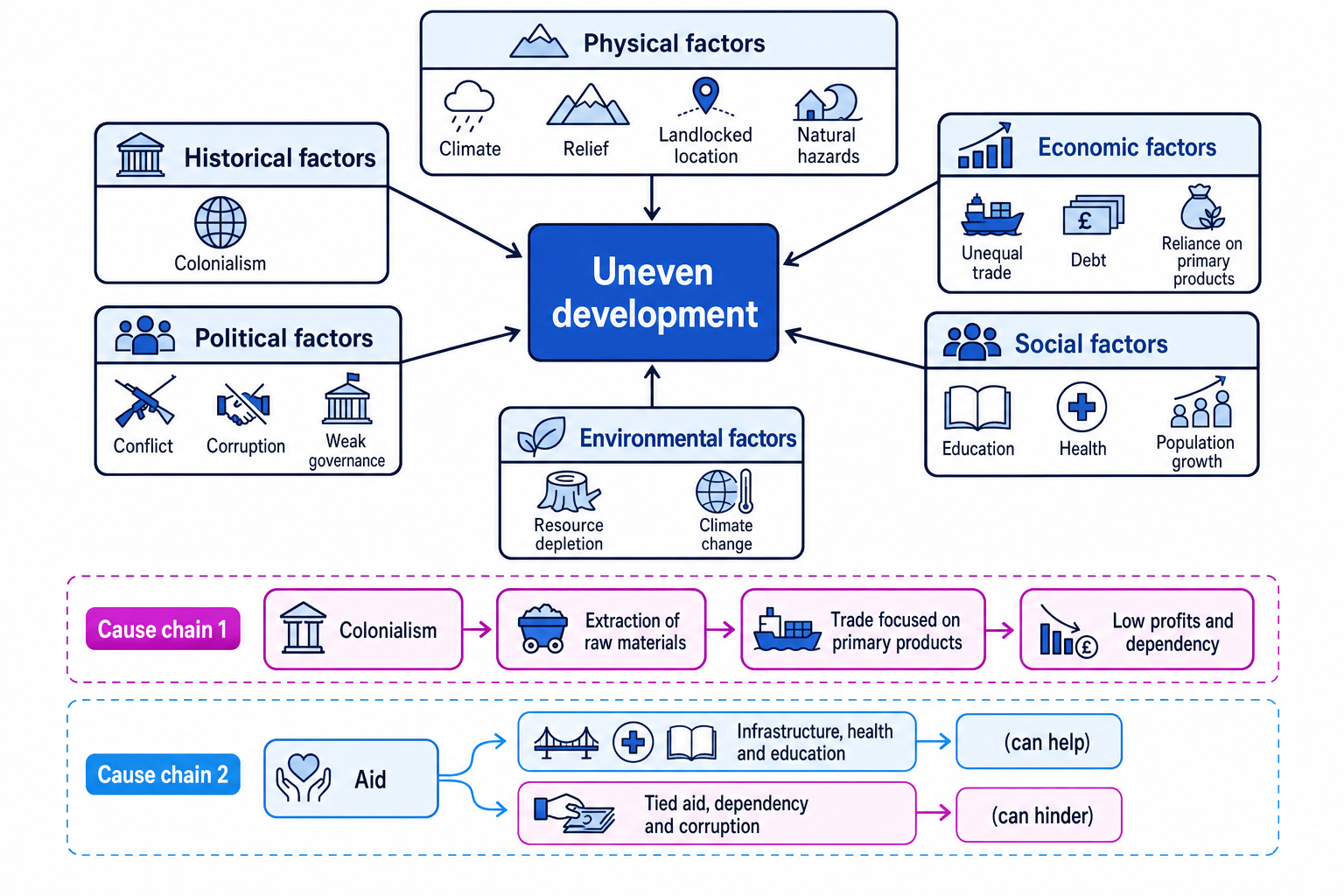
Uneven development is rarely caused by just one thing. Physical geography may make farming or transport harder; history may have shaped trade routes; politics may affect how money is spent; and global trade may influence who makes the biggest profits.
The diagram below shows how several causes can link together rather than acting separately.
Build a cause chain
For strong explanations, use a chain: factor → process → impact on people → named place. This helps you move beyond listing causes.
Physical and environmental causes
Physical factors are natural features of a place, such as climate, relief, soils, water supply and hazards. They do not determine development on their own, but they can make development easier or harder.
- Climate affects farming, water supply and disease risk. For example, drought in parts of the Sahel can reduce crop yields and incomes.
- Relief means the height and shape of the land. Mountainous areas can be expensive to build roads through.
- A landlocked country has no coastline, so it may rely on neighbouring countries’ ports for trade.
- Natural hazards such as earthquakes, floods and tropical storms can destroy homes, crops and infrastructure.
- Climate change can increase risk through sea-level rise, heatwaves and more unreliable rainfall.
Linking a physical factor to development in Nepal
- Nepal has very mountainous relief, especially in the Himalayas, so building roads, power lines and communications networks is difficult and expensive.
- If rural communities are poorly connected, it takes longer to reach schools, hospitals and markets, which limits access to services and income opportunities.
- This creates regional uneven development: places closer to cities such as Kathmandu usually have better services than remote mountain communities.
Physical factors are not destiny
Do not write that a country is poor “because it has mountains” or “because it is hot”. Physical factors influence development, but government decisions, trade, technology and investment also matter.
Historical causes: colonialism
One of the most important historical causes of uneven development is colonialism.
Colonialism
Colonialism is when one country controls another territory politically and economically, often using its land, labour and resources for the benefit of the colonial power.
Many countries in Africa, Asia and the Caribbean were ruled by European powers. Colonial rule often changed economies so they served the needs of the colonising country. This affected development long after independence.
A key impact was on trade. Colonies were often encouraged or forced to export primary products, such as minerals, timber, cotton, rubber, sugar or cocoa, rather than develop a wide range of industries.
Primary products and value added
A primary product is a raw material or food product before major processing. Value added is the extra worth created when a product is processed, manufactured, branded or sold.
This matters because raw materials often earn less profit than manufactured goods. For example, cocoa beans are worth much less than branded chocolate bars. If most processing happens overseas, more profit and skilled jobs are created outside the producing country.
Colonialism also affected development by:
- building railways and ports mainly to export resources, not to connect local communities
- creating economies dependent on one or two cash crops or minerals
- removing profits from colonies instead of reinvesting them locally
- drawing political borders that sometimes grouped rival communities or split ethnic groups
- creating long-term inequalities in land ownership and education
Tracing colonialism to trade dependency in Ghana
- Under British colonial rule, the Gold Coast, now Ghana, became strongly linked to cocoa production and export through ports and trade networks.
- Cocoa beans are a primary product, while chocolate manufacturing, branding and retail create more value added. Much of that higher-value activity has historically taken place in richer countries.
- If Ghana relies heavily on cocoa exports, its income can be affected by changing world prices and by decisions made by international buyers.
- This helps explain why colonial trade patterns can continue to shape development, although Ghana’s development today is also influenced by education, governance, investment and global markets.
Trade and natural resources
Natural resources can help a country develop, but they can also be exploited. In geography, exploitation means using a resource; it often suggests that the benefits are unfairly taken by powerful groups, companies or countries.
Some countries export valuable minerals, oil or agricultural products but still experience low levels of development. This can happen when profits are taken by transnational corporations, lost through corruption, or used to fund conflict rather than public services.
Resource curse
The resource curse is when a country with valuable natural resources experiences slower or more uneven development because wealth from those resources is poorly managed, causes conflict, or benefits only a small elite.
The Democratic Republic of the Congo is often used as an example. It has major reserves of minerals such as copper, cobalt and coltan, which are important for electronics and batteries. However, colonial exploitation, conflict, weak governance and global demand for minerals have all contributed to uneven development. Exact figures vary by source and year, but the key point is the contrast between resource wealth and widespread poverty.
Unequal trade can also reinforce the development gap. If poorer countries mainly export low-value primary products and import expensive manufactured goods, they may struggle to earn enough to invest in schools, healthcare, infrastructure and industry.
Resources do not automatically mean wealth
Avoid saying “the country has oil, so it must be rich”. Ask who controls the resource, where profits go, whether jobs are skilled and secure, and whether tax money is spent on development.
Political and social causes
Governance means the way a country is run, including how decisions are made and how public money is used. Good governance can support development by investing in education, healthcare, transport and law and order.
Political factors that can cause uneven development include:
- conflict, which destroys infrastructure, disrupts farming and forces people to migrate
- corruption, where public money is used dishonestly for private gain
- weak institutions, meaning courts, police, tax systems or local councils may not work effectively
- debt repayments, which can reduce the money available for services
Social factors also matter. Human capital means the skills, education, health and knowledge of a population. If people have poor access to schools or healthcare, it is harder to build a skilled workforce and attract investment. Rapid population growth can also stretch housing, water supplies and schools, although a youthful population can become an advantage if there are enough jobs and training.
Uneven development is interconnected
Conflict, weak governance, poor health, low education and limited trade opportunities often reinforce each other, creating a cycle that is difficult to break.
Aid: what it is
Aid is support given to a country or community to help reduce suffering or promote development. It can come from governments, international organisations, charities, non-governmental organisations and individuals.
Aid
Aid is the transfer of money, goods, services, skills or technology from one place to another to help people meet needs or support development.
Different types of aid include:
- Emergency aid: short-term help after a disaster, such as food, water, shelter and medical care.
- Development aid: long-term support for projects such as schools, clinics, clean water, farming or roads.
- Bilateral aid: aid from one government directly to another.
- Multilateral aid: aid given through international organisations, such as the United Nations or World Bank.
- NGO aid: aid from non-governmental organisations, such as Oxfam, Save the Children or WaterAid.
- Tied aid: aid given with conditions, such as requiring the receiving country to buy goods or services from the donor country.
- Debt relief: cancelling or reducing debt so a country can spend more on development.
How aid can promote development
Aid can promote development when it meets real needs and supports long-term independence. Emergency aid can save lives after hazards, such as shelter and medical care after the 2015 Nepal earthquake. Development aid can improve education, healthcare, clean water and transport.
Aid may also create a multiplier effect. This means one improvement leads to further benefits. For example, a clean water project can reduce disease, improve school attendance, increase working time and help families earn more.
How aid can hinder development
Aid can hinder development if it is poorly planned or creates dependency. If a project uses technology that local people cannot repair, it may fail after donors leave. Food aid can sometimes reduce demand for local farmers’ produce. Loans can increase debt, and tied aid may benefit the donor country more than the receiving country.
Aid can also be lost through corruption or targeted at places that are politically useful rather than places with the greatest need.
Judging an aid project in Malawi
- An NGO project providing village water pumps, toilets and hygiene education would be classed as long-term development aid because it aims to improve health and services over time.
- Cleaner water can reduce waterborne disease, so children miss fewer school days and adults lose fewer working days.
- The project is more likely to promote development if local people are trained to repair pumps and can access spare parts.
- It could hinder development if the community becomes dependent on outside technicians or if the technology is too expensive to maintain locally.
In the exam
- Do not just list causes. Explain the chain from cause to impact, such as colonialism shaping trade, which affects income and investment.
- Use named examples at different scales: a country, a region within a country, or a specific resource such as cocoa in Ghana or minerals in the DRC.
- For aid, give a balanced judgement: explain how it can promote development, then explain how it can hinder development if poorly managed.
Check yourself
- How can colonialism affect a country’s trade patterns after independence?
- Why might a country with valuable natural resources still have low levels of development?
- What is the difference between emergency aid and long-term development aid?
