

What you'll learn
- What a drought is, and why it is more than “no rain”.
- How El Niño and La Niña develop and can shift rainfall patterns around the world.
- A named case study: the 2015–16 El Niño drought in Ethiopia.
- How drought affects people and ecosystems, and how communities can adapt.
What counts as a drought?
Weather is the day-to-day condition of the atmosphere, such as today’s temperature or rainfall. Climate is the average pattern of weather over a longer period, usually about 30 years. A drought is identified by comparing rainfall and water availability with what is normal for that place and season.
Drought
A drought is a long period of unusually low water availability, often caused by below-average rainfall, high temperatures, or both. It becomes serious when water supply is not enough for people, farming, industry and ecosystems.
A drought is a slow-onset hazard, meaning it develops over weeks, months or even years. Unlike a tropical storm or earthquake, the damage builds gradually.
A key idea is water balance: the relationship between water coming in, mainly through precipitation, and water going out through use, runoff and evapotranspiration. Evapotranspiration means water loss from the ground and plants into the atmosphere.
Types of drought
- Meteorological drought: rainfall is well below the long-term average.
- Agricultural drought: soil moisture is too low for crops or pasture.
- Hydrological drought: rivers, reservoirs, lakes or groundwater stores fall below normal levels.
- Socio-economic drought: water shortage starts to affect people’s lives, jobs, food prices and services.
These types often happen in a sequence. First the rain fails, then crops suffer, then rivers and reservoirs may decline, and finally people’s livelihoods are hit.
Classifying a drought from evidence
A region normally receives 600 mm of rain in its main growing season, but this year it receives 360 mm. Crops are wilting, but reservoir levels are still close to normal.
- Calculate the rainfall deficit: 600−360600×100=40%\frac{600 - 360}{600} \times 100 = 40\%600600−360×100=40%. Rainfall is 40% below the long-term average, so this is evidence of meteorological drought.
- Apply the evidence to farming. Crops are wilting because soil moisture is too low, so agricultural drought is also occurring.
- Check the water stores. Reservoirs are still close to normal, so hydrological drought has not fully developed yet.
Drought risk
Drought becomes a disaster when the physical hazard combines with exposure and vulnerability. Exposure means people, farms or ecosystems are in the affected area. Vulnerability means they are likely to be harmed, for example because they rely on rain-fed farming or have limited savings.
How El Niño and La Niña can lead to drought
ENSO
ENSO stands for the El Niño-Southern Oscillation. It is a natural ocean-atmosphere cycle in the tropical Pacific Ocean. It has a warm phase called El Niño and a cool phase called La Niña.
Under normal Pacific conditions, trade winds blow from east to west. These are steady tropical winds. They push warm surface water towards Australia and Indonesia, where warm water helps air rise and produces heavy rainfall. Near Peru in South America, cold deep water rises to the surface; this is called upwelling.
During El Niño, the trade winds weaken. Warm water spreads eastwards across the Pacific, so the main rain belt also shifts east. Areas that normally receive moist rising air may instead experience sinking air, clearer skies, higher temperatures and reduced rainfall.
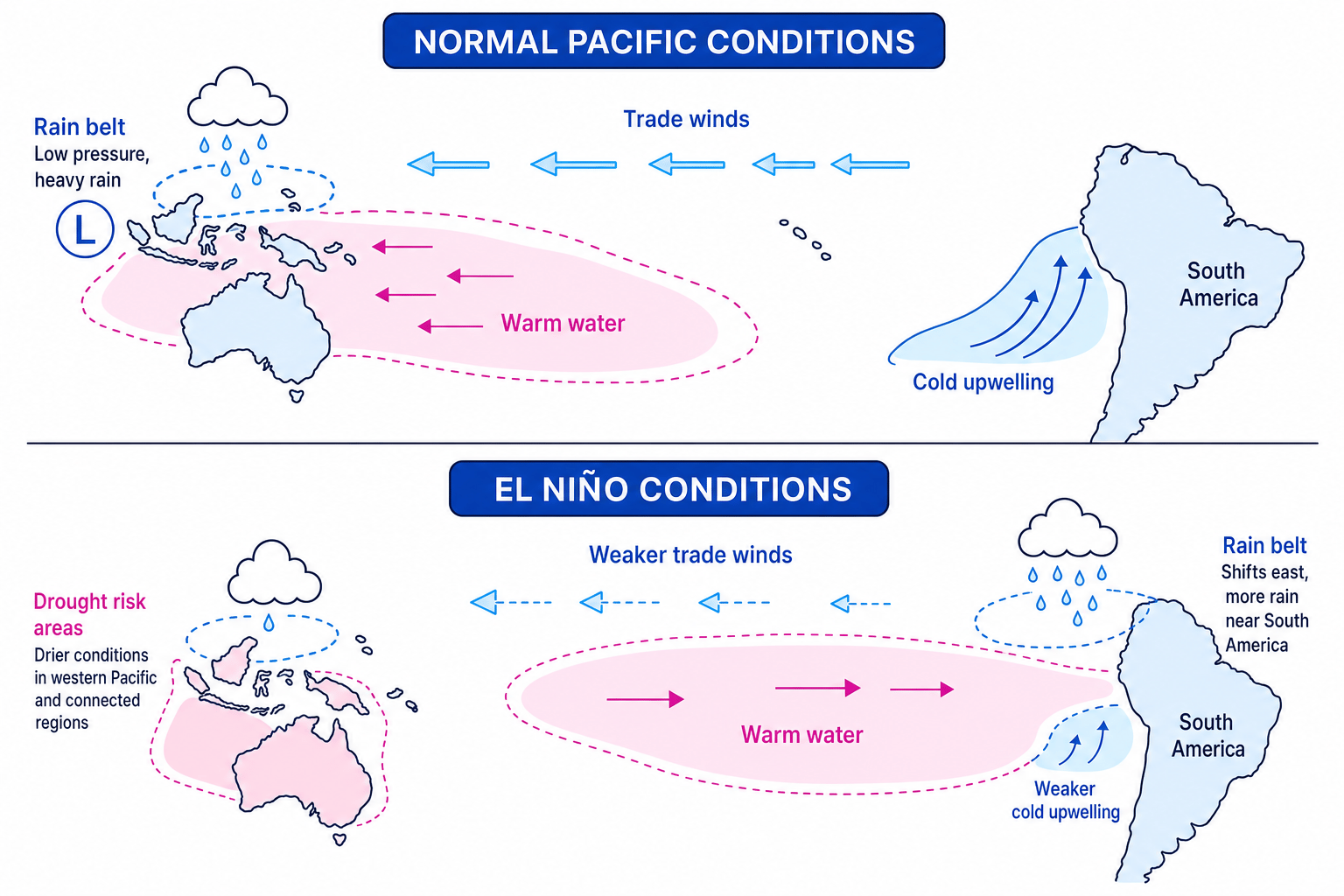
During La Niña, the trade winds are usually stronger than normal. Warm water piles up even more in the western Pacific, while the eastern Pacific becomes cooler. This can bring very wet conditions to some places and drought to others. The exact impact depends on the region and the season.
ENSO is not a simple switch
El Niño does not make everywhere dry, and La Niña does not make everywhere wet. ENSO shifts global rainfall patterns, so always link the named place to the season affected.
Linking El Niño to drought
- Start with the Pacific trigger: during El Niño, trade winds weaken and warm surface water moves eastwards.
- This shifts rising air and heavy rainfall towards the central and eastern Pacific.
- Some regions connected to this circulation pattern receive less moist air and more sinking air, so rainfall becomes lower and temperatures may be higher.
- If this happens during a main growing season, soil moisture falls, crops fail and drought impacts spread.
Case study: Ethiopia’s 2015–16 El Niño drought
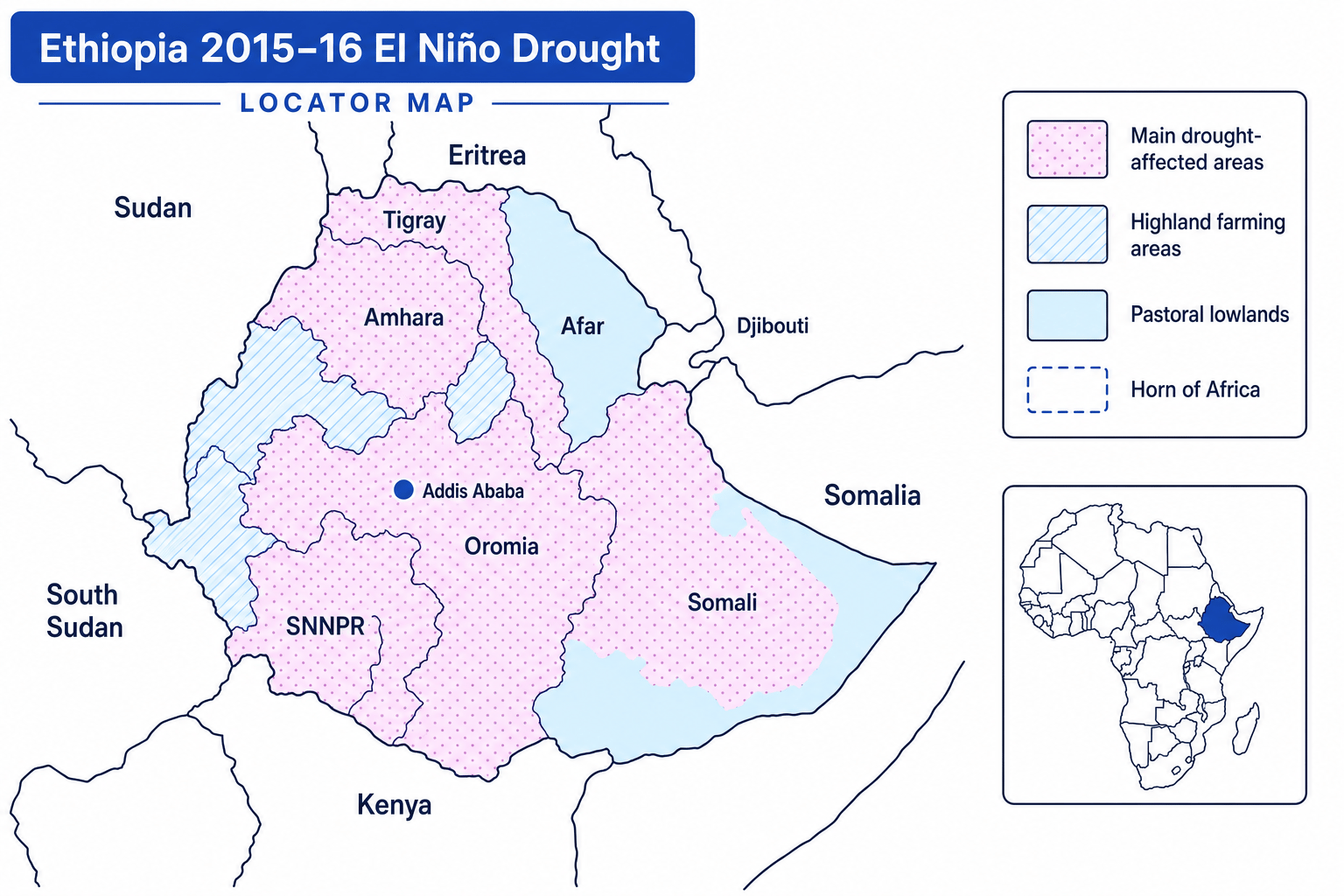
Our named case study is the 2015–16 drought in Ethiopia, in the Horn of Africa. Ethiopia is a large country in north-east Africa, and many rural communities depend on rain-fed farming, meaning crops and pasture rely on seasonal rainfall rather than irrigation.
The drought affected several regions, including Afar and Somali in the lowlands, and parts of Oromia, Amhara, Tigray and SNNPR, the Southern Nations, Nationalities and Peoples’ Region as named at the time. The impacts were felt nationally, but they were experienced locally through failed harvests, dry wells and livestock losses.
How the drought developed
The 2015–16 El Niño was one of the strongest on record. Globally, it began with warming in the tropical Pacific. Regionally, this disrupted rainfall patterns across parts of Africa.
In Ethiopia, many areas had poor belg rains, the shorter spring rains, and reduced or unreliable kiremt rains, the important summer rains. High temperatures increased evapotranspiration, so soils dried faster. This created extreme weather conditions: prolonged rainfall shortage, heat stress, dry pasture and falling water availability.
Scale sentence
A strong answer can link scales: a global El Niño altered regional Horn of Africa rainfall, causing national food insecurity in Ethiopia and local crop and livestock losses.
Effects on people
The drought caused serious food insecurity, meaning people did not have reliable access to enough safe and nutritious food. Exact figures vary by agency and date, but around 10 million people needed emergency food assistance in Ethiopia in early 2016.
Main human impacts included:
- Crop failure: maize, sorghum and other crops were damaged by low rainfall and dry soils.
- Livestock losses: pastoralists, people whose livelihoods depend on herding animals, lost cattle, goats, sheep or camels as pasture and water points dried.
- Malnutrition: reduced harvests and milk supplies affected children, pregnant women and poorer households especially.
- Water stress: some communities relied on water trucking or walked further to collect water.
- Economic pressure: food prices rose in some areas, while farmers and herders lost income and assets.
- Education and health impacts: children could miss school because of migration, hunger or time spent collecting water.
Effects on the environment
Drought also damages ecosystems. In Ethiopia, vegetation cover declined where pasture dried out. This exposed soil to wind erosion and later water erosion when rain returned. Rivers, springs and shallow wells could dry up, reducing habitats for wildlife and livestock.
There was also greater pressure on remaining grazing land. When animals concentrate around a few water points, overgrazing can remove vegetation faster than it can regrow. This can contribute to land degradation, meaning the land becomes less productive.
How people adapted in Ethiopia
Adaptation
Adaptation means changing behaviour, technology or planning to reduce harm from future hazards. For drought, it often means storing water, reducing reliance on rainfall, protecting livelihoods and improving early warning.
In Ethiopia, responses included both short-term coping measures and longer-term adaptations.
Short-term coping
- Emergency food aid and nutrition programmes helped reduce the risk of famine.
- Water trucking supplied some villages when wells and ponds dried.
- Livestock support included animal feed, veterinary care and sometimes destocking, where animals are sold or moved before they die.
Longer-term adaptation
- Early warning systems used rainfall data, crop monitoring and food-price information to identify risk earlier.
- The Productive Safety Net Programme gave food or cash support to vulnerable rural households, often linked to public works such as soil conservation.
- Farmers used drought-tolerant crops such as sorghum or millet in some areas.
- Water harvesting, small dams, ponds, boreholes and irrigation reduced dependence on rain.
- Soil bunds, terracing and tree planting helped conserve soil moisture and reduce erosion.
- Pastoral communities adapted by moving herds, diversifying animals and managing grazing areas more carefully.
Response vs adaptation
Do not just list “food aid” and call it adaptation. Food aid is mainly an emergency response. To gain stronger marks, explain how longer-term actions such as water harvesting, early warning or drought-tolerant crops reduce future vulnerability.
Choosing an adaptation for a pastoral area
A lowland district in Afar has dry water points, poor pasture and households that rely mainly on livestock.
- Identify the main vulnerability: livelihoods depend on animals, so the biggest risks are lack of water, lack of grazing and livestock death.
- Match the adaptation to the problem: boreholes, protected water points, fodder stores, destocking schemes and managed grazing routes directly protect livestock and income.
- Check the limitation: boreholes need maintenance, and extra water points can cause overgrazing unless grazing is managed too.
Bringing the case study together
For OCR GCSE Geography, try to explain drought as a chain, not a list. A strong chain might look like this:
El Niño changes Pacific Ocean temperatures → rainfall patterns shift → Ethiopia’s seasonal rains fail → soil moisture falls → crops and pasture fail → food insecurity, livestock deaths and environmental degradation increase → adaptations reduce but do not remove the risk.
In the exam
- Name the case study early: Ethiopia, 2015–16 El Niño drought.
- Link cause to effect clearly: do not stop at “El Niño happened”; explain how weakened trade winds and shifted rainfall contributed to drought.
- Use place detail at different scales: Horn of Africa, Ethiopia, Afar/Somali/Oromia, farms, wells and pastoral communities.
- Separate effects on people from effects on the environment.
- For adaptation questions, explain how each strategy reduces vulnerability, not just what was done.
Check yourself
- How does El Niño change normal Pacific Ocean conditions?
- Why might the same drought affect highland farmers and lowland pastoralists differently?
- Which Ethiopian adaptations are short-term coping responses, and which reduce future drought risk?
