

Welcome to this topic on one of the planet’s most vibrant and biologically diverse ecosystems: warm-water coral reefs. Often called the "rainforests of the sea," coral reefs cover less than 1% of the ocean floor but support over 25% of all marine life.
At a global scale, these ecosystems are not randomly scattered. They are confined to highly specific geographic areas due to their strict environmental requirements. In these notes, we will explore why they grow where they do and locate the six major coral reefs you must know for your OCR B GCSE Geography exam.
What you'll learn
- The exact environmental conditions needed for warm-water coral reefs to grow.
- The global distribution pattern of coral reefs.
- The precise locations of the six major coral reefs named in your specification.
What is a Warm-Water Coral Reef?
Before looking at where they are, we must understand what they are.
Coral Polyp
A coral polyp is a tiny, soft-bodied marine animal related to sea anemones. Polyps live in colonies and extract calcium carbonate from seawater to construct a hard, protective outer skeleton. Over thousands of years, these skeletons build up to form massive physical structures known as coral reefs.
Warm-water corals have a unique, cooperative relationship with microscopic algae that live inside their tissues.
Symbiotic Relationship
A symbiotic relationship (or symbiosis) is a close, mutually beneficial interaction between two different biological species.
The algae, called zooxanthellae (pronounced zo-oh-zan-thell-ee), perform photosynthesis to convert sunlight into energy, sharing up to 90% of this food with the coral host. In return, the coral polyp provides the algae with a safe home and the carbon dioxide needed for photosynthesis. It is the zooxanthellae that give corals their spectacular, bright colours.
The Recipe for Reefs: Essential Living Conditions
Because corals rely on their symbiotic algae to survive, warm-water reefs can only grow where the environment perfectly suits both the polyp and the algae. These conditions include:
- Warm Ocean Temperatures: Coral reefs require water temperatures between 20∘C20^\circ\text{C}20∘C and 30∘C30^\circ\text{C}30∘C (with 23∘C23^\circ\text{C}23∘C to 25∘C25^\circ\text{C}25∘C being the absolute sweet spot). If the water gets too hot, the corals get stressed and expel their algae, leading to coral bleaching, where the white skeleton is exposed.
- Shallow Water: Photosynthesis requires sunlight. Therefore, reefs are typically found in shallow waters shallower than 30 metres deep, where sunlight can easily penetrate.
- Clear, Clean Water: Sediment, mud, or heavy pollution blocks sunlight and can physically smother the delicate polyps.
- Saline (Salty) Water: Corals are marine organisms and require a steady salinity level of 32 to 40 practical salinity units (psu) to build their calcium carbonate skeletons. They cannot survive in freshwater, which is why reefs are rarely found near the mouths of major rivers.
The Tropical Coral Belt
Due to these strict environmental limits, warm-water coral reefs are almost exclusively found in a band around the equator, between the Tropic of Cancer (23.5∘ N23.5^\circ\text{ N}23.5∘ N) and the Tropic of Capricorn (23.5∘ S23.5^\circ\text{ S}23.5∘ S). Here, sea temperatures remain consistently warm and high levels of solar radiation penetrate the shallow waters year-round.
Global Distribution: The Six Key Reefs to Know
The OCR B specification requires you to be able to locate and describe six specific coral reef ecosystems around the globe. Use the map below to familiarise yourself with their positions.
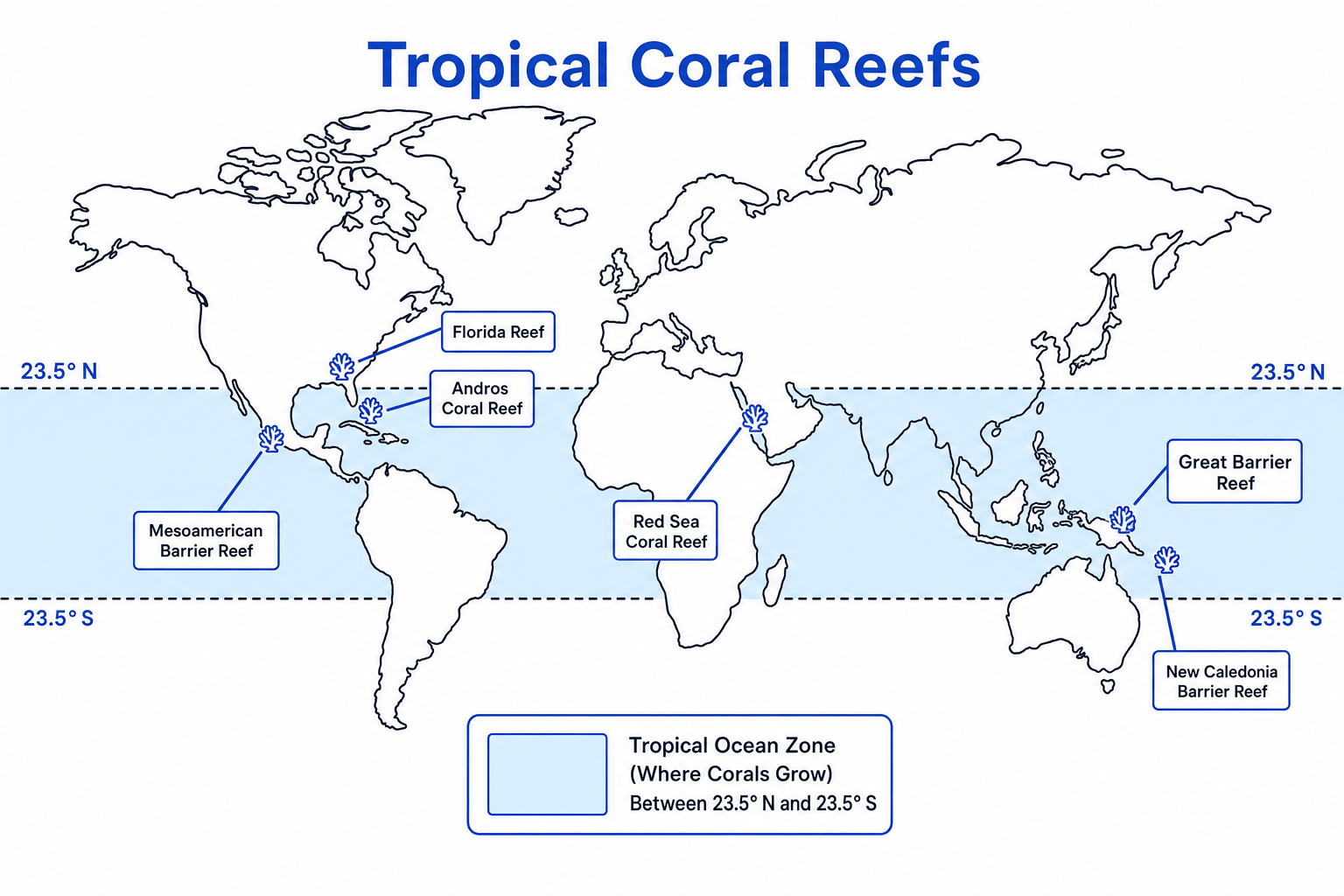
1. The Great Barrier Reef (Australia)
This is the largest coral reef system on Earth. Located in the Coral Sea off the north-east coast of Queensland, Australia, it stretches over 2,300 kilometres. It is so massive that it can be seen from space and consists of over 2,900 individual reefs and 900 islands.
2. The Red Sea Coral Reef (Middle East)
Located in the Red Sea, bordered by countries such as Egypt, Sudan, Saudi Arabia, and Eritrea. This reef system is unique because it is highly adapted to unusually warm temperatures and high salinity levels. It is highly valued by scientists studying how reefs might survive global climate change.
3. The New Caledonia Barrier Reef (Pacific Ocean)
Situated in the southwest Pacific Ocean, surrounding the French territory of New Caledonia. This is the second-longest double barrier reef in the world, enclosing a massive, diverse lagoon.
4. The Mesoamerican Barrier Reef (Central America)
This reef stretches over 1,000 kilometres along the Caribbean coast of Central America, touching Mexico, Belize, Guatemala, and Honduras. It is the largest barrier reef in the Western Hemisphere.
5. The Florida Reef (North America)
Located just off the southern tip of Florida, USA, extending through the Florida Keys into the Gulf of Mexico. It is the third-largest living coral barrier reef system in the world and the only state-side barrier reef in continental North America.
6. The Andros Coral Reef (The Bahamas)
Located in the Atlantic Ocean, running parallel to the east coast of Andros Island in the Bahamas. It is famous for its steep "drop-off" into a deep ocean trench known as the "Tongue of the Ocean," where the shallow shelf drops from a few metres deep to over 2,000 metres deep.
Shorthand Memorisation
To remember the location of the two North American/Caribbean reefs, use this quick geographical trick: Florida is the fingers of the USA pointing down, and Andros is the adjacent island group (the Bahamas) sitting right next to it!
Applying Your Skills: Coral Decline Calculations
In your exam, you may be asked to interpret data tables, charts, or maps showing changes in coral cover or reef health over time (AO4 skills). A common calculation task is finding the percentage change (increase or decrease) in coral cover.
Let's work through a practical mathematical example to ensure you are confident using this formula.
Calculating percentage decrease in coral cover
A monitoring station on a section of the Great Barrier Reef recorded an average healthy coral cover of 24% in 2016. Following a severe marine heatwave and subsequent bleaching event in 2017, the healthy coral cover dropped to 15%.
Calculate the percentage decrease in coral cover between 2016 and 2017. Show your workings and round your answer to 1 decimal place.
-
Identify the original (starting) value and the new (final) value.
- Original Value (V1V_1V1) = 24%
- New Value (V2V_2V2) = 15%
-
Calculate the absolute change (the difference between the two values) by subtracting the new value from the original value.
- Divide the absolute change by the original value to find the relative change.
- Multiply the result by 100 to convert the decimal into a percentage.
(Since the value is exactly 37.5%, no further rounding is needed to meet the "1 decimal place" instruction.)
Answer: There was a 37.5% decrease in coral cover.
Reef Area vs. Coral Cover Percentage
Be careful when reading exam data! A change from 24% coral cover to 15% coral cover is a drop of 9 percentage points, but it is a 37.5% decrease in the total amount of coral. Always read the question carefully to see if it asks for the absolute difference (in percentage points) or the percentage change.
Temperature Units and Scales
Ensure you do not confuse air temperature with sea surface temperature (SST). Corals respond specifically to sea temperatures. A global rise of just 1∘C1^\circ\text{C}1∘C to 2∘C2^\circ\text{C}2∘C in average ocean temperatures can trigger catastrophic, ecosystem-wide bleaching events.
In the exam
- Be precise with locations: When asked to describe the distribution of warm-water coral reefs, do not just say "in the sea." Instead, write: "They are located globally in shallow, tropical oceans between 23.5∘ N23.5^\circ\text{ N}23.5∘ N (Tropic of Cancer) and 23.5∘ S23.5^\circ\text{ S}23.5∘ S (Tropic of Capricorn) of the Equator."
- Link environment to distribution: If asked why reefs are located in specific regions, make direct, coupled points. For example: "Reefs are found in shallow tropical waters because these areas receive high light intensity, allowing the zooxanthellae inside the coral polyps to photosynthesise."
- Learn your map coordinates: Be prepared to identify the six named reefs on a global map outline. Practice locating the Red Sea (pinched between Africa and Asia) and New Caledonia (small island group east of Australia) as these are frequently missed.
Check yourself
- Which latitude lines mark the northern and southern limits of the global "coral belt"?
- Why are major coral reefs rarely found at the mouths of massive rivers like the Amazon or the Ganges?
- Can you name and locate the six reefs listed in your OCR B spec without looking at the map?

