

What you'll learn
- Where the world’s main large-scale ecosystems are found, and their key characteristics.
- How climate, soils and altitude influence which ecosystems develop in different places.
- Why the biosphere provides vital resources for people, but is increasingly exploited.
- How the UK’s land and marine ecosystems are distributed, used and degraded.
1. The big idea: ecosystems at different scales
An ecosystem can be tiny, like a pond, or huge, like a tropical rainforest belt. In GCSE Geography, you need to understand both global patterns and UK examples.
Ecosystem, biome and biosphere
An ecosystem is a community of living things interacting with each other and with the non-living environment, such as climate, water, rocks and soil. A biome is a very large-scale ecosystem with a distinctive climate, plants and animals. The biosphere is the global life-support system: all living organisms and the parts of Earth where life exists.
Biodiversity
Biodiversity means the variety of life. It includes the variety of ecosystems, the number of species, and the genetic variation within species.
2. The world’s large-scale ecosystems
Large-scale ecosystems are not randomly spread around the world. They form broad patterns, especially by latitude — distance north or south of the Equator — because latitude affects temperature and rainfall.
The map below is a simplified world biome map. Real boundaries are not sharp lines: they grade into each other and are also affected by mountains, oceans and human activity.
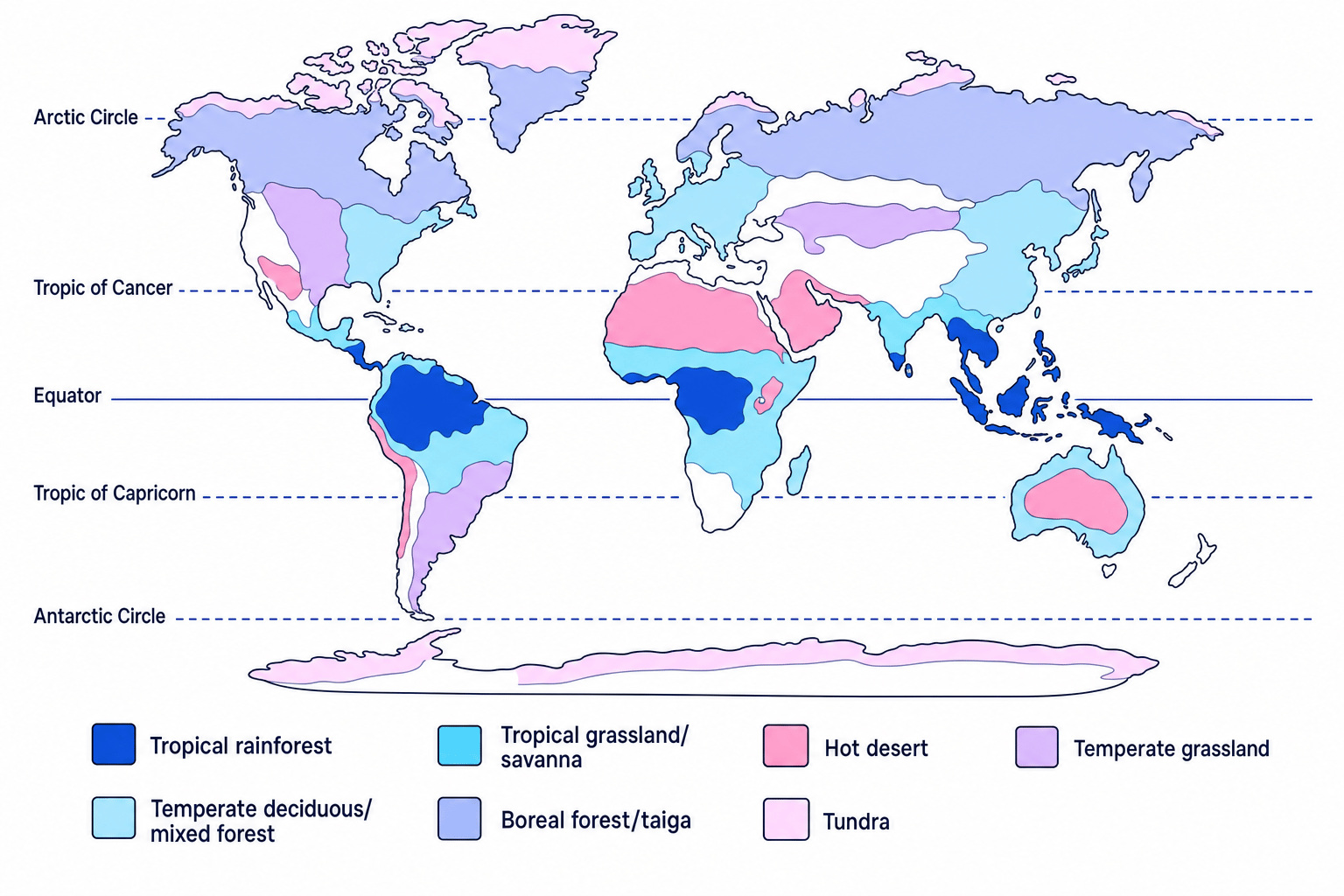
Key global ecosystems and their characteristics
| Large-scale ecosystem | Main distribution | Typical characteristics |
|---|---|---|
| Tropical rainforest | Near the Equator, including the Amazon Basin, Congo Basin and Southeast Asia | Hot and wet all year; very high biodiversity; tall layered forest; rapid nutrient cycling |
| Tropical grassland / savanna | Between rainforest and desert zones, especially East Africa, parts of Brazil and northern Australia | Hot all year; wet and dry seasons; grasses with scattered trees; fire- and drought-adapted plants |
| Hot desert | Often around 20–30° north and south of the Equator, such as the Sahara and Arabian Desert | Very low rainfall; sparse vegetation; plants and animals adapted to drought and temperature extremes |
| Temperate deciduous / mixed forest | Mid-latitudes, including western and central Europe, eastern North America and eastern Asia | Four seasons; moderate rainfall; broadleaf trees that often lose leaves in winter |
| Temperate grassland | Continental interiors, such as the North American Prairies, Eurasian Steppe and Pampas | Moderate to low rainfall; grasses dominate; often fertile soils; trees limited by dryness, fire or grazing |
| Boreal forest / taiga | High northern latitudes across Canada, Scandinavia and Siberia | Long cold winters; short growing season; coniferous trees; lower biodiversity than tropical forests |
| Tundra | Arctic margins, including northern Canada, Greenland edges and northern Siberia | Very cold; short growing season; few trees; mosses, lichens and low shrubs; often has permafrost |
Biomes follow broad climate belts
The warmest, wettest areas tend to support dense forests, while colder or drier areas support shorter vegetation such as grassland, tundra or desert scrub.
Describing distribution from a map
Use scale and place: say which continents, which latitudes, and whether the ecosystem is coastal, inland, equatorial, tropical, temperate or polar. Avoid vague phrases like “it is everywhere”.
3. Why climate matters so much
Climate
Climate is the average weather conditions of a place over a long period, usually at least 30 years. It includes temperature, rainfall, wind and seasonality.
Climate controls two big things for ecosystems:
- Temperature affects the length of the growing season. Warmer places usually allow faster plant growth.
- Rainfall affects how much water plants can use. Too little water limits trees and can create grassland or desert.
For example, tropical rainforests form where it is hot and wet all year. Deserts often form where air is dry and rainfall is very low, especially around subtropical high-pressure zones.
Matching climate to ecosystem
A place has an average temperature of about 27°C all year, receives over 2,000 mm of rainfall annually, and has no true dry season. Which large-scale ecosystem is most likely?
- Compare the temperature pattern: 27°C all year means the place is hot with very little seasonal temperature change, which suggests a tropical location.
- Compare the rainfall pattern: over 2,000 mm with no dry season means water is available throughout the year, so dense tree growth is possible.
- Match the evidence to a biome: hot and wet all year supports tropical rainforest, not savanna, because savanna has a clear dry season.
4. Local factors: soils and altitude
Climate sets the broad pattern, but local factors can change the ecosystem found in a particular place.
Soil
Soil is the thin layer of mineral particles, organic matter, water and air in which plants grow. Its nutrients, depth, drainage and acidity affect vegetation.
Soils influence ecosystems in several ways. Fertile grassland soils can support dense grasses and farming. Waterlogged soils can create wetlands. Thin, acidic or nutrient-poor soils may limit tree growth and favour heath or moorland vegetation.
Altitude
Altitude means height above sea level. As altitude increases, temperature usually decreases, so mountain environments can support colder ecosystems than nearby lowlands.
Altitude can create ecosystem zones. For example, in the Andes or Himalayas, vegetation may change from forest on lower slopes to grassland, then alpine tundra higher up. The average temperature drop is often around 6.5°C for every 1,000 m of height, although local conditions vary.
Latitude is not the only control
Do not explain every ecosystem only by distance from the Equator. Mountains, soils, ocean currents, drainage and human land use can all modify the pattern.
5. The biosphere as a resource for people
The biosphere is vital because it provides resources people rely on every day.
Resources from the biosphere
- Food: crops, livestock, wild foods, fish, shellfish, fruit, nuts and honey.
- Medicine: many drugs are developed from plants, fungi or animals. For example, compounds from the rosy periwinkle from Madagascar have been used in cancer treatments.
- Building materials: timber, bamboo, reeds, thatch and fibres.
- Fuel resources: firewood, charcoal, biofuels and, in some places, peat.
The biosphere also provides less obvious services, such as pollination, water filtration, carbon storage and soil formation.
The biosphere is a life-support system
People use the biosphere for materials and income, but they also depend on its natural processes, such as pollination, nutrient cycling and carbon storage.
6. Commercial exploitation of the biosphere
Commercial exploitation
Commercial exploitation means using natural environments and resources to make money, often on a large scale.
The biosphere is increasingly exploited for:
- Energy: timber fuel, biofuels, oil and gas extraction, coal mining, and land cleared for energy infrastructure.
- Water: reservoirs, dams, irrigation schemes and groundwater abstraction.
- Minerals: mining for resources such as copper, gold, iron ore, bauxite and lithium.
This can bring jobs, export income and infrastructure. However, it can also cause deforestation, habitat loss, pollution, soil erosion, falling water quality and conflict over land rights.
Calculating habitat loss
Suppose a wetland area is reduced from 120 hectares to 75 hectares after drainage and development. What is the percentage loss?
- Find the absolute loss: 120 hectares minus 75 hectares gives a loss of 45 hectares.
- Use the percentage-loss formula:
- Substitute the values:
So the wetland has decreased by 37.5%, which could reduce habitats, flood storage and carbon storage.
7. The UK’s main terrestrial ecosystems
Terrestrial ecosystem
A terrestrial ecosystem is a land-based ecosystem, rather than one based in the sea or freshwater.
The UK has a temperate climate, so its natural vegetation would mostly be woodland. However, centuries of farming, settlement, drainage, grazing and forestry have created a patchwork of ecosystems.
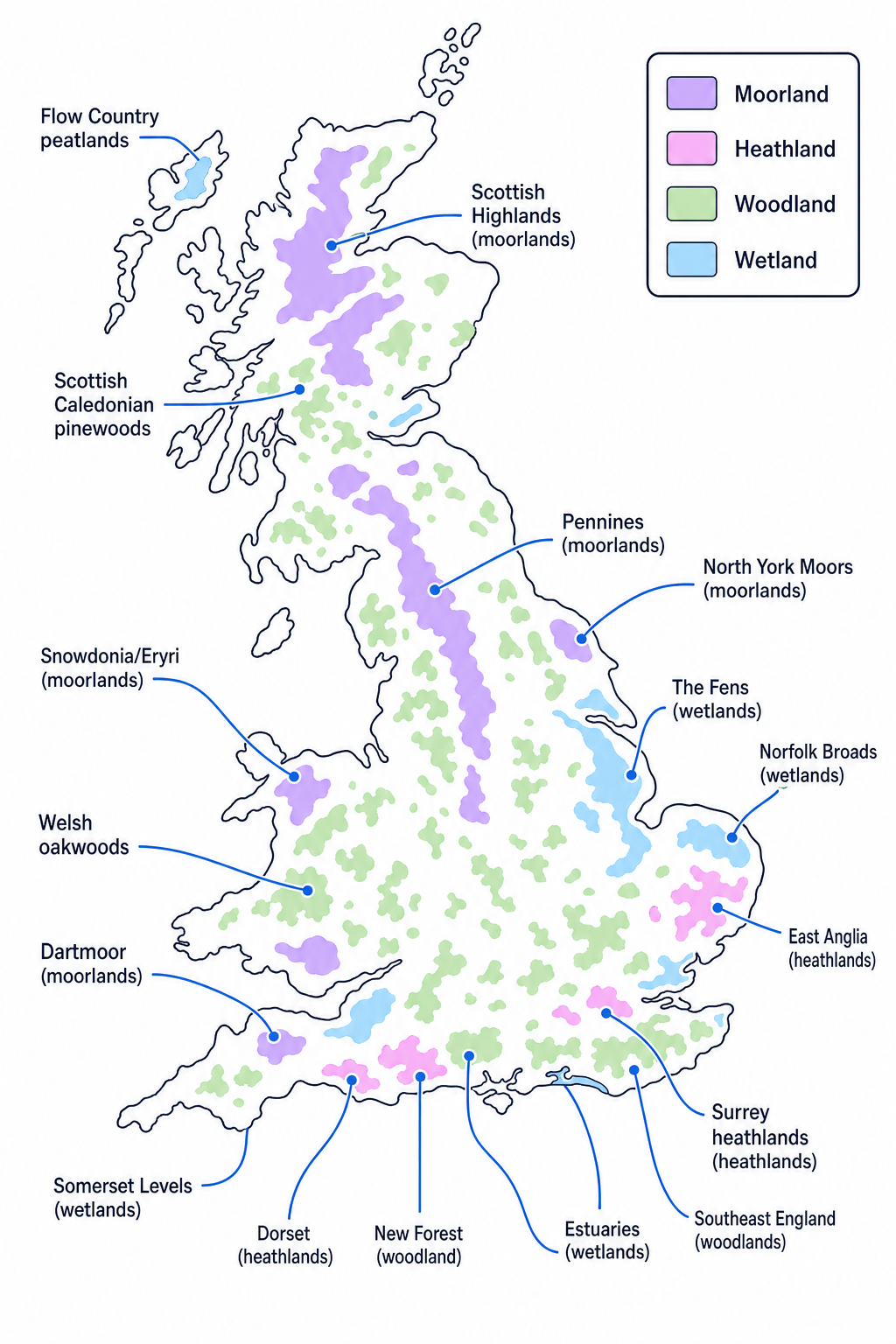
The map below shows examples of where the UK’s main terrestrial ecosystems are commonly found.
Moorlands
Moorlands are open, often upland areas with heather, rough grasses, peat bogs and low shrubs. They are common in the Scottish Highlands, Pennines, North York Moors, Snowdonia/Eryri and Dartmoor. Many have cool, wet climates and acidic soils.
Moorlands matter because peat stores carbon, uplands collect water for rivers and reservoirs, and they provide habitats for birds such as curlew and grouse.
Heathlands
Heathlands are usually found on lowland, sandy, acidic, nutrient-poor soils. They often contain heather, gorse and rough grasses. Important areas include Dorset, the New Forest, Surrey heathlands and parts of East Anglia.
Heathland is valuable because it supports specialist species, but it has declined due to farming, housing, roads, forestry and lack of traditional grazing.
Woodlands
Woodlands are ecosystems dominated by trees. UK woodlands may be deciduous, coniferous or mixed. Examples include Caledonian pinewoods in Scotland, Welsh oakwoods, the New Forest and woodland patches across southeast England.
Woodlands provide timber, recreation, wildlife habitats, carbon storage and flood regulation. Ancient woodland is especially valuable because it has developed over a long period and supports complex communities.
Wetlands
Wetlands are areas where land is saturated with water, either permanently or seasonally. UK examples include the Fens, Somerset Levels, Norfolk Broads, Flow Country peatlands and estuaries.
Wetlands are important for flood storage, water filtering, bird habitats, carbon storage and recreation. They are vulnerable to drainage, pollution, peat cutting, farming pressure and development.
8. UK marine ecosystems
Marine ecosystem
A marine ecosystem is a saltwater ecosystem, including seas, coasts, estuaries, rocky shores, seabeds, kelp forests, saltmarshes and seagrass meadows.
The UK is surrounded by the Atlantic Ocean, North Sea, Irish Sea, English Channel and Celtic Sea, so marine ecosystems are nationally important.
Why UK marine ecosystems matter
UK marine ecosystems provide:
- Food resources: fish and shellfish, such as mackerel, haddock, cod, crabs and scallops.
- Jobs and income: fishing, aquaculture, tourism and recreation.
- Coastal protection: saltmarshes, sand dunes and seagrass can reduce wave energy and erosion.
- Carbon storage: “blue carbon” habitats such as saltmarsh and seagrass store carbon in plants and sediments.
- Habitats and nurseries: shallow seas and estuaries are breeding and nursery areas for many species.
How human activities degrade them
Marine ecosystems are degraded by several human activities:
- Overfishing removes fish faster than populations can recover.
- Bottom trawling damages seabed habitats and can catch non-target species.
- Pollution from plastics, sewage, chemicals and agricultural runoff reduces water quality.
- Coastal development and dredging can destroy habitats such as saltmarsh and seagrass.
- Climate change warms seas, raises sea levels and increases ocean acidification, which can harm shell-forming organisms.
Explaining bottom-trawling impacts
How can bottom trawling degrade a UK marine ecosystem, such as parts of the North Sea seabed?
- Identify the physical process: heavy fishing gear is dragged along the seabed, disturbing sediments and damaging habitats such as reefs, seagrass or sponge communities.
- Link this to ecosystem change: fewer shelter and nursery areas means some fish, shellfish and invertebrates are less likely to survive and reproduce.
- Link this to people: lower biodiversity and weaker fish recruitment can reduce future catches, harming the fishing resource the UK relies on.
Saying only “humans pollute the sea”
Be specific: name the activity, such as sewage discharge, plastic waste or bottom trawling, then explain the effect on habitats, species or food webs.
In the exam
- When describing distribution, use named places and scale: for example, “boreal forest stretches across Canada, Scandinavia and Siberia at high northern latitudes.”
- When explaining ecosystem location, link climate plus local factors: temperature, rainfall, soils, altitude and drainage.
- For resource questions, balance benefits and costs: jobs, food and materials, but also habitat loss, pollution and reduced biodiversity.
Check yourself
- Why are tropical rainforests usually found near the Equator?
- How can altitude create colder ecosystems even in otherwise warm regions?
- Name two UK marine resources and two ways human activity can degrade them.
