

What you'll learn
- What makes tropical rainforests different from other ecosystems.
- How climate, soils, water, plants, animals and humans depend on each other.
- Why rainforests have extremely high biodiversity and specialised adaptations.
- How deforestation, climate change and management choices affect rainforest futures.
Starting point: what is an ecosystem?
A tropical rainforest is a hot, wet forest ecosystem found mainly close to the Equator, including the Amazon Basin in South America, the Congo Basin in Africa, and parts of South-East Asia such as Indonesia and Malaysia.
Ecosystem
An ecosystem is a community of living organisms interacting with each other and with the non-living physical environment in a particular place.
A large-scale ecosystem type, shaped mainly by climate, is called a biome. Tropical rainforest is one of the world’s major biomes.
Biotic and abiotic characteristics
Biotic characteristics are the living parts of an ecosystem. Abiotic characteristics are the non-living physical parts.
Climate
Tropical rainforests are hot and wet all year. Temperatures are usually around 26–28°C, with little seasonal change. Rainfall is often over 2000 mm per year.
Strong daily heating causes convectional rainfall: warm moist air rises, cools, condenses into clouds, and often produces heavy afternoon rain.
Soils
Rainforest soils are often thin and nutrient-poor, even though the forest above them is very lush. Heavy rainfall washes dissolved nutrients down through the soil in a process called leaching.
Rainforest soil is not automatically fertile
Do not write “rainforests have rich soils” without explaining where the nutrients are. In tropical rainforests, most nutrients are stored in the living plants, not in the soil.
Water
Rainforests have high humidity, frequent rainfall, and high evapotranspiration — water transferred to the atmosphere by evaporation from surfaces and transpiration from plant leaves.
Tree canopies intercept rainfall, roots take up water, and rivers are often fed by regular rainfall and runoff.
Plants, animals and humans
Rainforest plants are usually evergreen, meaning they keep leaves all year. They include tall trees, lianas, shrubs, ferns and epiphytes, which are plants that grow on other plants for support.
Animals include insects, birds, reptiles, amphibians, mammals and many specialised canopy species. Humans are also part of the ecosystem: Indigenous communities, farmers, loggers, miners, scientists, tourists and governments all influence how rainforests are used and managed.
Interdependence: everything is connected
Interdependence
Interdependence means that parts of an ecosystem rely on each other, so a change to one part can affect many others.
In a tropical rainforest, the hot wet climate supports rapid plant growth. Rapid plant growth creates dense habitats for animals. Animals pollinate flowers and disperse seeds. Dead leaves decompose quickly, returning nutrients for plants to use again.
The rainforest also affects its own climate. Trees release water vapour through transpiration, helping to maintain humidity and rainfall.
Tracing rainforest interdependence
- If trees are cleared, the biomass store — the mass of living plant and animal material — becomes much smaller.
- With fewer tree roots and less canopy cover, more rain reaches the soil directly, increasing surface runoff and leaching.
- Because rainforest soils store few nutrients, nutrients are quickly lost after clearance, so crop yields may fall after a few years unless fertilisers are added.
The nutrient cycle and the Gersmehl model
A nutrient cycle is the movement of nutrients between living things, dead organic matter and the soil.
The Gersmehl model shows nutrient stores as circles and nutrient flows as arrows. In a tropical rainforest:
- the biomass store is very large because there is dense vegetation;
- the litter store is small because dead leaves decompose quickly;
- the soil store is small because nutrients are rapidly taken up by roots or lost by leaching.
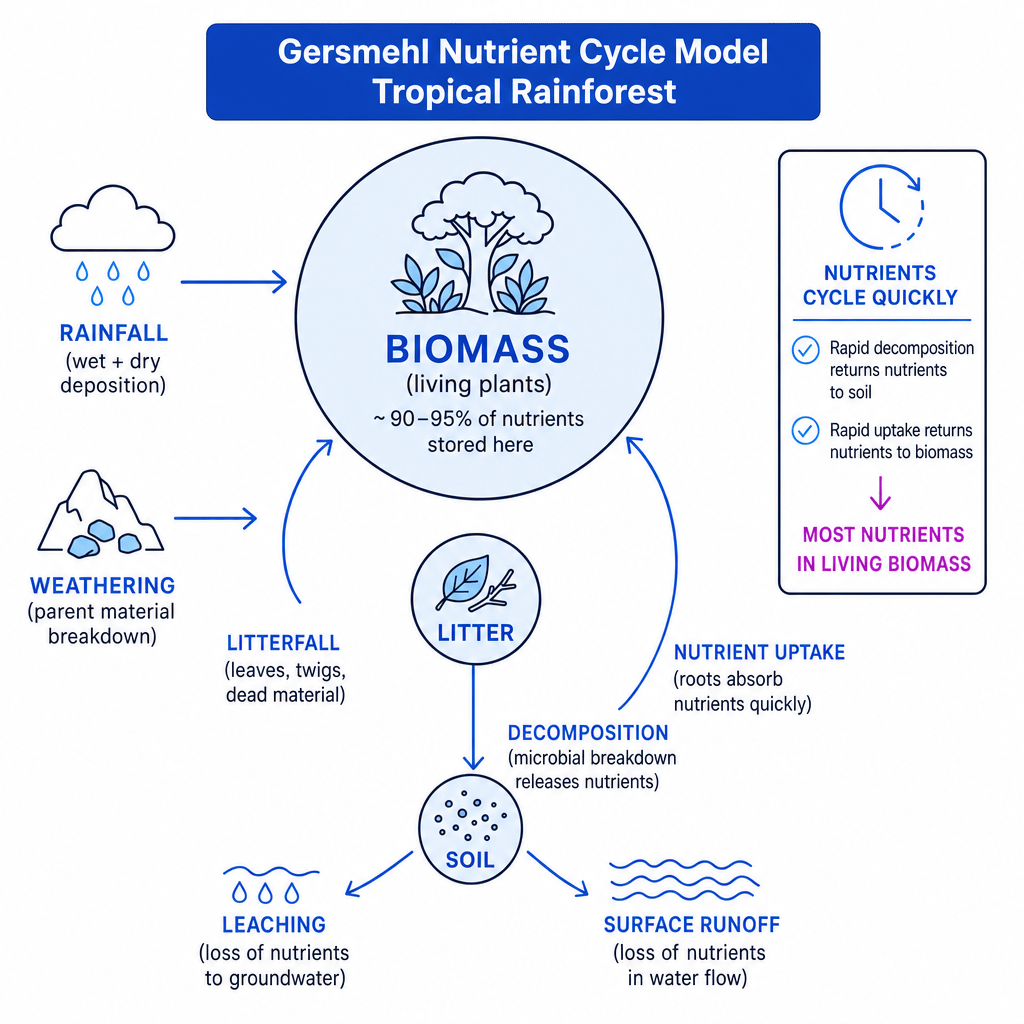
Nutrients cycle quickly
Tropical rainforests look rich, but the system depends on fast nutrient recycling between litter, soil and living biomass. If the forest is removed, the nutrient cycle is easily disrupted.
Why biodiversity is so high
Biodiversity
Biodiversity means the variety of living things in an area, including the number of species and the genetic variety within those species.
Tropical rainforests have very high biodiversity because:
- the climate is warm and wet all year, so plants can grow continuously;
- high plant productivity supports many food webs;
- the forest has many niches, meaning different roles or spaces that species can occupy;
- vertical layers create different habitats from the forest floor to the tree tops;
- species have evolved specialised relationships, such as pollinators matched to particular flowers.
Plant and animal adaptations
An adaptation is a feature that helps an organism survive and reproduce in its environment.
Rainforest vegetation is stratified, meaning it is arranged in layers:
- emergent layer — tallest trees rising above the canopy;
- canopy — dense roof of tree crowns where much life is found;
- understorey — darker, humid layer below the canopy;
- forest floor — very shaded ground layer with rapid decomposition.
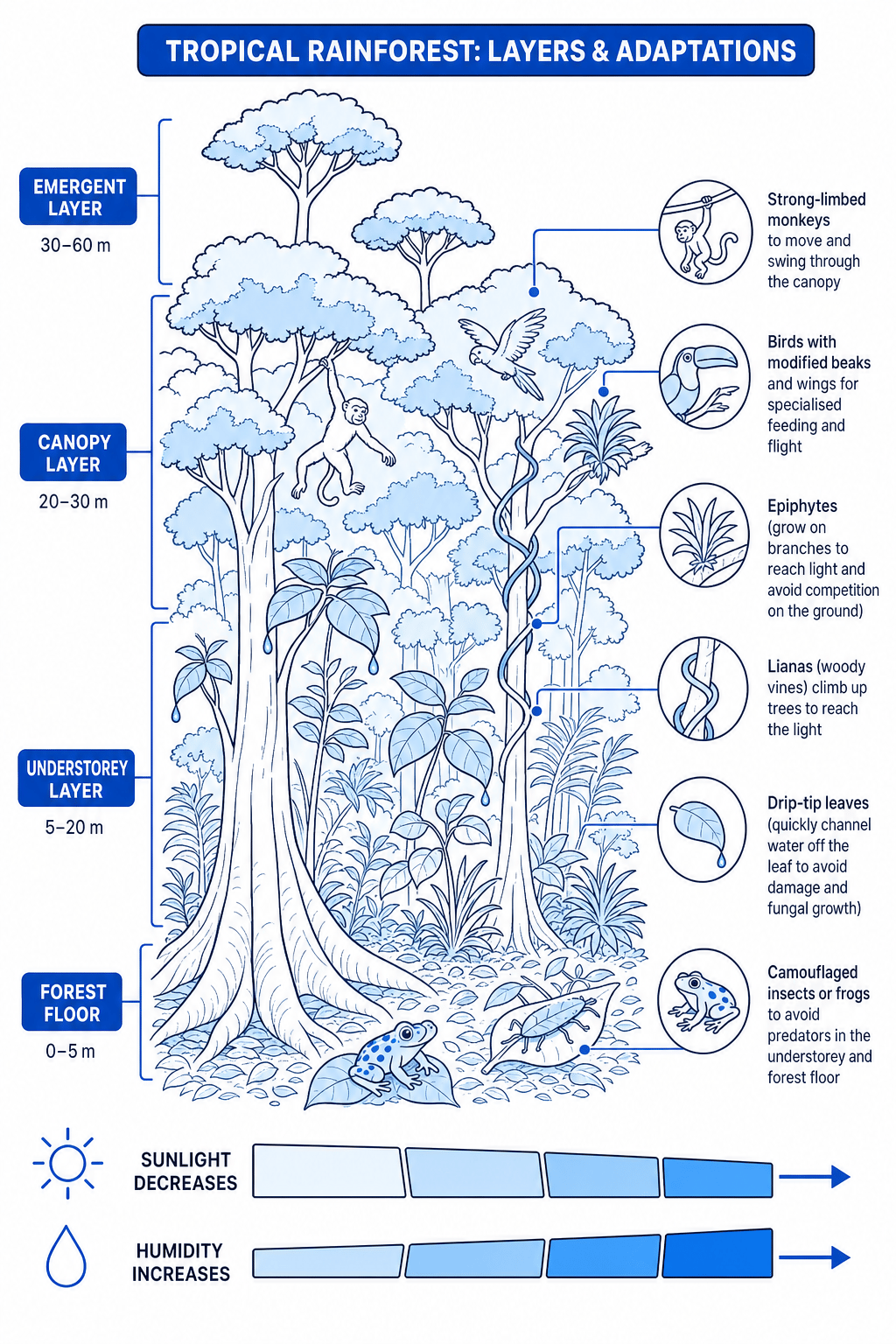
Plant adaptations include buttress roots, which spread out from tree bases for support in shallow soils, and drip-tip leaves, which help shed heavy rainfall quickly and reduce fungal growth.
Animal adaptations include strong limbs for climbing and swinging, modified wings and beaks for specialised feeding, and camouflage to avoid predators or ambush prey.
Linking adaptations to survival
- Identify the environmental pressure: the canopy is crowded, wet and full of competition for light and food.
- Match the adaptation to that pressure: a bird with a specialised beak may be able to feed on certain fruits, insects or nectar that other birds cannot use.
- Explain the advantage: by reducing competition, the adaptation improves the bird’s chance of feeding, surviving and reproducing.
Adaptation explanations
For full explanation, use the chain: condition → adaptation → advantage. For example: heavy rain → drip-tip leaves → water runs off quickly, reducing rot and fungal growth.
Goods and services from rainforests
Ecosystem goods are physical products people can use. Ecosystem services are benefits ecosystems provide, including regulating climate and supporting life.
| Good or service | Rainforest example |
|---|---|
| Foodstuffs | Brazil nuts, cocoa, bananas, fruits and spices |
| Medicines | Plant chemicals used in medicines or medical research |
| Timber | Tropical hardwoods such as mahogany and balsa |
| Recreation | Wildlife watching, rainforest trails and ecotourism |
| Climate regulation | Carbon storage and water recycling |
| Habitat support | Maintaining biodiversity and food webs |
Rainforests are valuable at global, national and local scales. For example, the Amazon stores carbon globally, supports Brazil and Peru economically, and provides food, materials and cultural value for local communities.
Threat from climate change
Climate change means long-term changes in temperature, rainfall and weather patterns, largely driven today by human greenhouse gas emissions.
Climate change can threaten rainforest structure, functioning and biodiversity.
- Structure: drought and fire can kill large trees, opening gaps in the canopy.
- Functioning: less rainfall can reduce decomposition, nutrient cycling and evapotranspiration.
- Biodiversity: species adapted to stable hot, wet conditions may struggle to migrate or adapt quickly enough.
Tipping points
A tipping point is a threshold where change becomes difficult to reverse. Some scientists warn that parts of the Amazon could shift towards a drier, more savanna-like ecosystem if warming, drought and deforestation reinforce each other.
Causes of deforestation
Deforestation
Deforestation is the permanent removal of forest, usually so the land can be used for something else.
Deforestation has both economic and social causes.
Conversion to agriculture
Forest may be cleared for cattle ranching, soya farming, palm oil plantations or small-scale subsistence farming. This happens because agricultural land can generate income, exports and food.
In the Brazilian Amazon, cattle ranching and commercial crops have been major causes of forest clearance. In Indonesia and Malaysia, palm oil plantations have been a major pressure.
Resource extraction
Rainforests contain valuable timber, minerals, oil and gas. Logging roads can open up previously remote forest, making further clearance easier.
Mining can also cause pollution, soil erosion and settlement growth around extraction sites.
Population pressure
Population growth, migration and poverty can increase demand for land, fuelwood, housing and jobs. Some people clear forest because they have few other livelihood options.
Calculating percentage forest loss
Suppose a rainforest area falls from 100 km² to 82 km².
-
Use the percentage change formula:
percentage change=new value−old valueold value×100\text{percentage change}=\frac{\text{new value}-\text{old value}}{\text{old value}}\times 100percentage change=old valuenew value−old value×100 -
Substitute the values:
82−100100×100=−18%\frac{82-100}{100}\times 100=-18\%10082−100×100=−18% -
Interpret the result: the negative sign means a decrease, so the forest area has fallen by 18%.
Sustainable management: Osa Peninsula, Costa Rica
Sustainable management
Sustainable management means using resources in a way that meets people’s needs now without damaging the ability of future generations to meet theirs.
A useful located example is the Osa Peninsula, in south-west Costa Rica, a Central American country between Nicaragua and Panama. The region includes important rainforest areas such as Corcovado National Park.
Governance
Governance means how decisions are made and enforced by governments, organisations and communities.
Costa Rica has used protected areas, national parks, forest laws and payments for ecosystem services to encourage conservation. Better governance can reduce illegal logging and give landowners a financial reason to keep forest standing.
Commodity value
Commodity value means the market value of products such as timber, beef, palm oil, gold or crops.
High commodity prices can encourage clearance. Sustainable management tries to change the incentive, so standing forest becomes economically valuable through carbon storage payments, sustainable products, research and tourism.
Ecotourism
Ecotourism is tourism that aims to protect the environment and benefit local people. In the Osa Peninsula, visitors come for wildlife, rainforest trails and national parks. This can create jobs for guides, lodges and transport providers.
However, ecotourism only supports sustainability if profits reach local communities and visitor pressure is controlled.
Evaluating sustainable management in the Osa Peninsula
- Link governance to conservation: protected areas and forest laws help limit clearance and maintain habitats.
- Link economic incentives to behaviour: ecotourism and payments for ecosystem services can make standing forest worth more to local people than clearing it.
- Add a limitation: if illegal extraction, poverty or high commodity prices create stronger incentives, rainforest may still be at risk.
In the exam
- For rainforest processes, write linked chains: climate → vegetation → nutrient cycling → soils/water/animals.
- For adaptations, do not just name the feature; explain how it helps survival in hot, wet, competitive conditions.
- For the located example, name the place and country, then connect governance, commodity value and ecotourism to sustainable management.
Check yourself
- Why are tropical rainforest soils often nutrient-poor even though the forest is dense?
- How could climate change affect rainforest structure, functioning and biodiversity?
- In the Osa Peninsula, how can ecotourism help sustainable rainforest management?
