

What you'll learn
- The difference between arid places (naturally very dry) and drought as a temporary hazard.
- The main physical and human causes of drought.
- Why planet-scale wind and pressure patterns make some regions more drought-prone.
- How impacts and responses vary in California, USA and Ethiopia.
1. Arid environments are not the same as drought
Drought is easiest to understand if you first separate normal dryness from an unusual shortage of water.
Drought and arid environments
A drought is a prolonged period when water supply is below what is normal for a place, causing shortages for people, farming or natural environments. An arid environment is a place with a long-term dry climate, usually receiving very low rainfall, often below about 250 mm per year.
In an arid environment, dryness is expected. Plants, animals and people may be adapted to it. In a drought, conditions are unusually dry compared with that place’s normal climate, so even a normally wet country can experience drought.
Arid environment vs drought hazard
| Feature | Arid environment | Drought |
|---|---|---|
| Timescale | Long-term climate pattern | Temporary event lasting weeks, months or years |
| Rainfall | Normally very low | Lower than usual for that place |
| Water stores | Usually limited | Rivers, reservoirs and groundwater fall below normal |
| Main issue | Living with permanent dryness | Sudden or worsening shortage creates a hazard |
Evapotranspiration means water being lost from the land to the atmosphere by evaporation from surfaces and transpiration from plants. In hot, dry places, evapotranspiration can be very high, making water shortages worse.
Drought does not mean desert
Do not write that drought only happens in deserts. Drought can affect semi-arid areas, Mediterranean climates, temperate countries and even normally wet regions if rainfall is unusually low for long enough.
2. Why droughts are hazardous
A hazard is an event or process that threatens people, property or the environment. Drought becomes hazardous because water is essential for drinking, growing food, producing energy, industry and maintaining ecosystems — living organisms and their physical environment interacting.
Droughts can lead to:
- Water shortages for homes, farms and businesses.
- Food insecurity, where people do not have reliable access to enough safe, nutritious food.
- Crop failure and livestock deaths, especially where farming depends on rainfall.
- Wildfires, because vegetation becomes dry and flammable.
- Health problems, including dehydration, malnutrition and diseases linked to poor water quality.
- Ecosystem stress, such as tree death, reduced river habitats and loss of wetlands.
Why drought is dangerous
Drought is a slow-onset hazard: it may develop gradually, but its impacts can spread through water supply, food production, health, economies and ecosystems.
3. Causes of drought
Drought usually has more than one cause. A physical rainfall shortage can be made worse by human water use.
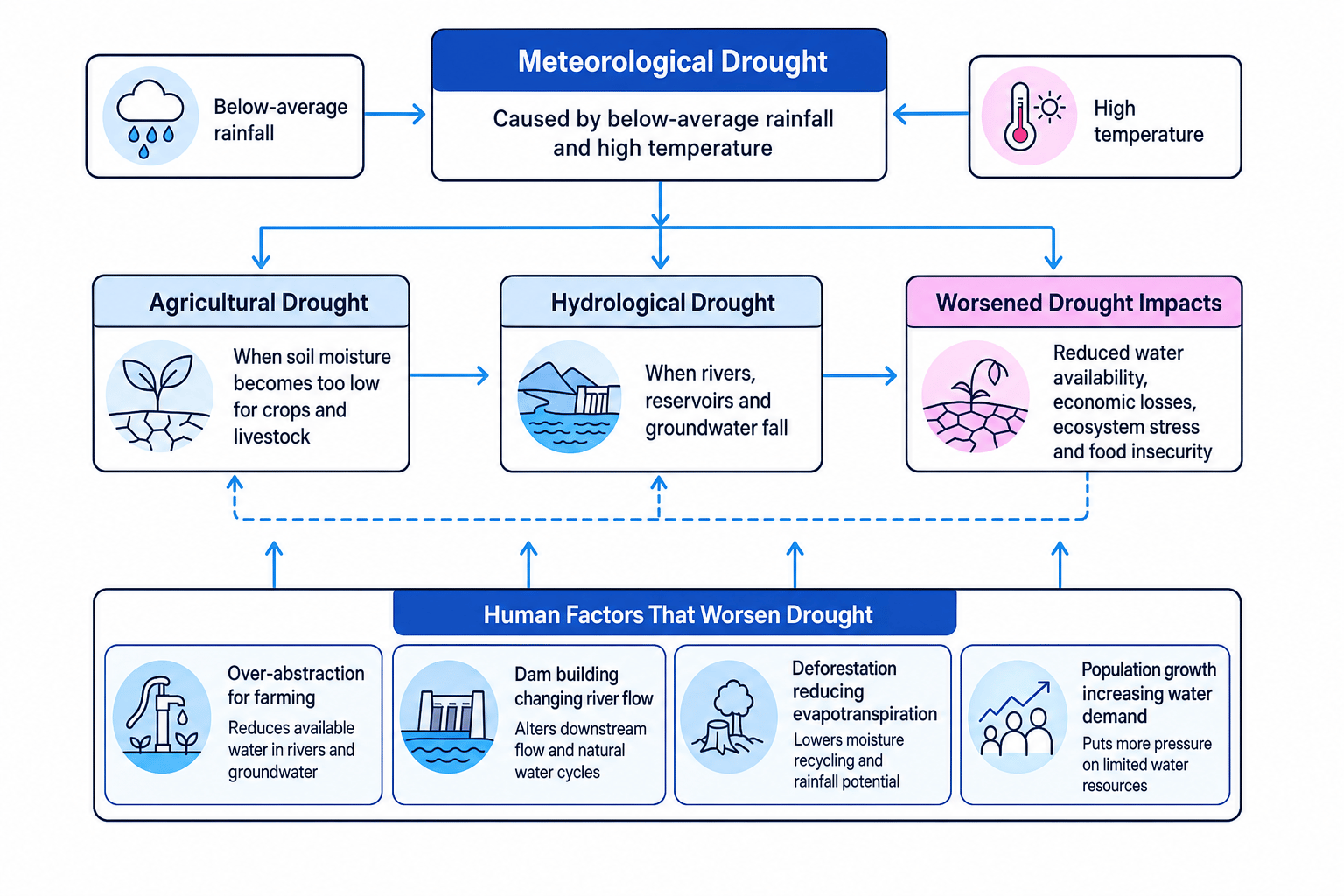
The diagram below shows how a rainfall shortage can develop into different types of drought, and how human actions can intensify the problem.
Meteorological drought
A meteorological drought happens when precipitation — rain, snow, sleet or hail — is below average for a period of time. High temperatures can worsen it because more water evaporates.
Agricultural drought
An agricultural drought happens when soil moisture becomes too low for crops and pasture to grow properly. This is especially serious in places with rain-fed farming, where crops depend mainly on rainfall rather than irrigation.
Hydrological drought
A hydrological drought happens when water stores such as rivers, reservoirs and groundwater fall below normal. Groundwater is water stored underground in soil and rock. Hydrological drought often develops later than meteorological drought because rivers and reservoirs may take time to respond.
Human causes that worsen drought
Human actions do not always start a drought, but they can make water shortages more severe:
- Agricultural over-abstraction: taking too much water from rivers or underground stores for irrigation.
- Dam building: dams can store water, but they may reduce river flow downstream if not managed carefully.
- Deforestation: removing forests can reduce evapotranspiration and moisture recycling, and can increase surface runoff and soil erosion.
- Rising demand: population growth, urbanisation and industry increase pressure on limited water supplies.
Calculating a rainfall deficit
A region’s long-term average annual rainfall is 600 mm. In one year it receives 420 mm.
- Calculate the rainfall shortfall: 600 mm minus 420 mm gives a deficit of 180 mm.
- Convert the deficit into a percentage of the long-term average: 180600×100=30%\frac{180}{600} \times 100 = 30\%600180×100=30%.
- Interpret the result: rainfall was 30% below average, suggesting meteorological drought risk, especially if this continues for several months or years.
- Add a geographical judgement: if reservoirs, rivers and groundwater also fall, the drought is becoming hydrological as well as meteorological.
Reading rainfall trend graphs
On a rainfall line graph or bar chart, look for a run of below-average months or years, not just one dry month. Compare the rainfall data with the long-term average, then link the pattern to likely impacts such as falling soil moisture or reservoir levels.
4. Why some locations are more vulnerable
Vulnerability means how likely people or places are to be harmed by a hazard. Some regions are naturally more vulnerable to drought because of global atmospheric circulation — the large-scale movement of air around the planet.
Near the Equator, warm air rises and often brings heavy rainfall. Around 30 degrees north and south, air sinks, creating subtropical high pressure. High pressure means sinking air, clear skies and limited cloud formation, so rainfall is low. This helps explain major dry belts such as the Sahara, the Arabian Desert, the Kalahari, the Australian interior and parts of the south-west USA.
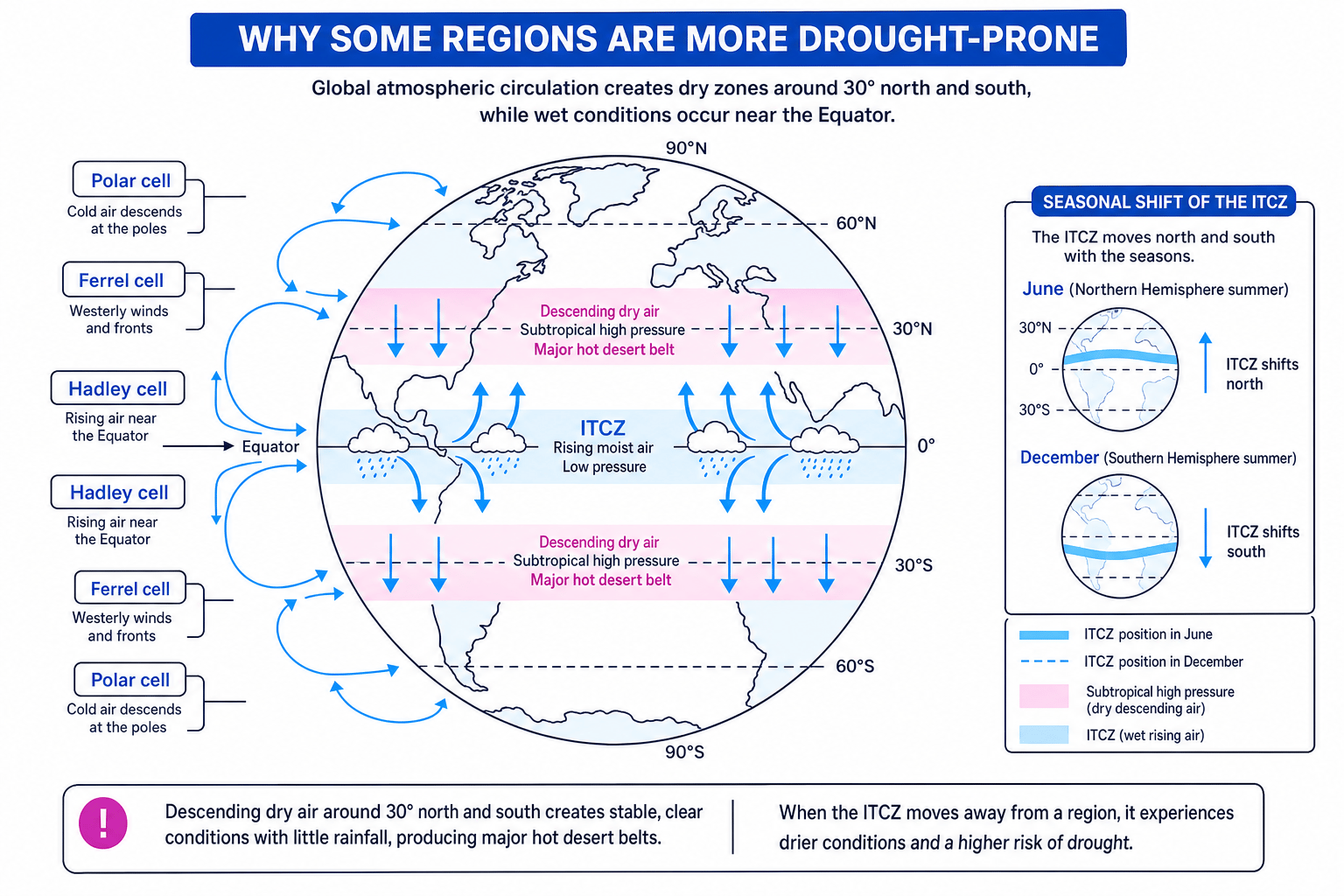
The ITCZ, or Inter-Tropical Convergence Zone, is a band of rising air and rainfall near the Equator. It shifts north and south with the seasons. If it does not bring expected seasonal rainfall, drought can develop, especially in semi-arid regions at the margins of deserts.
Drought risk also changes over time because of:
- Seasonal movement of rain belts, especially in monsoon regions.
- ENSO, the El Niño–Southern Oscillation, which is a natural warming and cooling pattern in the tropical Pacific that can shift rainfall patterns globally.
- Climate change, meaning long-term changes in average climate conditions. Warmer temperatures can increase evaporation and make droughts more intense in some regions.
Climate change attribution
Avoid writing that climate change “caused” every drought. A stronger answer says climate change can increase drought risk or severity where it raises temperatures, increases evaporation or changes rainfall patterns.
5. Located examples: California, USA and Ethiopia
The same physical drought can have very different impacts depending on a country’s level of development. A developed country usually has higher average income, stronger infrastructure and greater government capacity. A developing country often has lower average income and less access to services, though this varies within each country.
Exact data changes by source and year, but the contrast is important: the USA has very high GNI per capita, while Ethiopia’s is much lower. GNI per capita is a measure of average income per person in US dollars.
| Factor | California, USA — developed country located example | Ethiopia — developing country located example |
|---|---|---|
| Drought example | Severe drought in the 2010s, especially 2012–16 | Severe 2015–16 drought linked to El Niño |
| Main vulnerability | High water demand from cities and irrigated farming | Heavy reliance on rain-fed farming and pastoralism |
| People impacts | Water restrictions, farm losses, job losses, higher wildfire risk | Crop failure, livestock deaths, food insecurity and migration |
| Ecosystem impacts | Tree death, stressed rivers, reduced fish habitats, wildfire damage | Loss of grazing land, drying waterholes, soil erosion and habitat stress |
California, USA: impacts
California is a wealthy state in a developed country, but it is still vulnerable because it has large cities, valuable agriculture and high water demand. During the 2012–16 drought, some farmers left land uncultivated, groundwater pumping increased, and state-wide water-saving rules were introduced. Ecosystems were also affected: rivers became warmer and lower, wetlands shrank, and many trees died during the drought period, with heat and pests adding to the damage.
Ethiopia: impacts
Ethiopia, in the Horn of Africa, is more vulnerable because many people depend directly on seasonal rainfall for crops and livestock. During the 2015–16 drought, over 10 million people were reported to need food assistance. Pastoralists — people who rely on herding animals — lost livestock when grazing land and water points dried up. Children’s health and schooling were affected, and some households migrated in search of work, food or water.
Comparing drought vulnerability from data
Suppose you are given data showing that California has high average income and widespread water infrastructure, while rural Ethiopia has lower average income and many people depend on rain-fed farming.
- Compare exposure to the drought: both places face rainfall shortages, but Ethiopia’s farmers and pastoralists are more directly exposed because livelihoods depend on seasonal rain.
- Compare capacity to respond: California can use reservoirs, emergency funding, water transfers and technology, while Ethiopia may depend more on food aid, boreholes and safety-net programmes.
- Reach a balanced judgement: California may suffer very high economic and ecosystem costs, but Ethiopia is more likely to experience severe food insecurity and health impacts because vulnerability is higher.
6. Responses to drought
Responses can come from individuals, organisations and governments. Good answers separate short-term emergency actions from long-term management.
| Actor | California, USA | Ethiopia |
|---|---|---|
| Individuals | Shorter showers, less lawn watering, water-efficient appliances, farmers using drip irrigation or switching crops | Collecting water from boreholes, selling or moving livestock, planting drought-resistant crops, migration for work |
| Organisations | Water companies, farming groups, universities and environmental agencies monitoring water use and ecosystems | NGOs and United Nations agencies providing food aid, clean water, cash support and livestock help |
| Governments | State emergency declarations, urban water-use restrictions, groundwater regulation, reservoir management, recycling and desalination projects | Early-warning systems, food distribution, Productive Safety Net Programme, boreholes, irrigation schemes and water harvesting |
NGOs are non-governmental organisations, such as charities and aid agencies. Ethiopia’s Productive Safety Net Programme is a government-led system designed to support vulnerable households, often through cash or food in exchange for community work.
Responses vary by development
Developed countries often focus on managing demand, protecting infrastructure and reducing economic losses. Developing countries may need more emergency support to protect food security, health and livelihoods, especially in rural areas.
Assuming rich countries are safe
Developed countries can still suffer serious drought impacts. The difference is often the type and scale of impact: economic losses and ecosystem damage may be very high, while deaths and food insecurity are usually lower because response capacity is stronger.
In the exam
- Separate physical causes such as high pressure and rainfall deficit from human factors such as over-abstraction, dams and deforestation.
- For impacts and responses, name the place and country, then compare people and ecosystems.
- Use data carefully: say “about” or “approximately” for case-study figures, and explain what the number shows.
Check yourself
- How is an arid environment different from a drought?
- Why does descending air around 30 degrees north and south increase drought risk?
- How did responses in California and Ethiopia reflect their different levels of development?
