

What you'll learn
- How energy resources are classified as renewable or non-renewable.
- Why countries use different energy mixes, including the UK.
- How demand for energy has changed and how different resources affect people and the environment.
- How energy can be managed more sustainably at local, national and international scales.
In Topic 6 you study either Energy or Water. These notes cover the Energy option.
1. The big picture: what is an energy resource?
An energy resource is a source of power that people can use for heating, transport, electricity, industry and everyday life.
Energy matters because modern societies depend on it. Homes need heating and lighting, factories need power, transport needs fuel, and digital technology needs electricity.
Renewable and non-renewable energy
- A renewable energy resource is naturally replaced on a human timescale, such as wind, solar power and hydro-electric power.
- A non-renewable energy resource exists in finite stores, meaning it can run out, such as coal, oil, natural gas and uranium for nuclear power.
- Hydro-electric power, often shortened to HEP, is electricity generated by moving water, usually through turbines in a dam.
Here is the overall structure of the topic: resources feed into a country’s energy mix, which is shaped by population, wealth and resource availability.
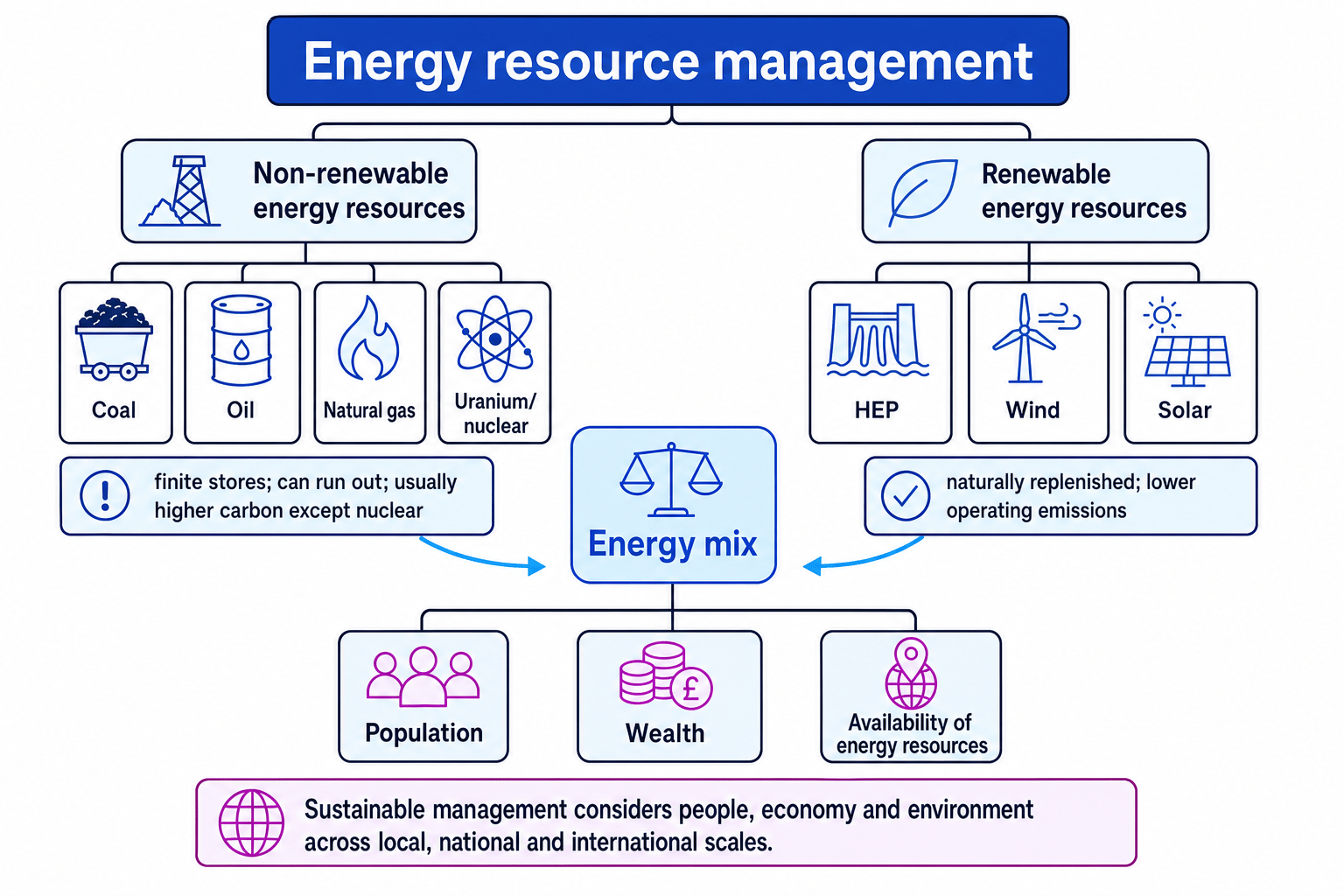
The core idea
No country relies on just one energy source. Countries manage risk by using an energy mix, but each choice creates benefits, costs and conflicts.
2. Developing energy resources
To develop an energy resource means to extract, build, invest in and use it. Development can create jobs and improve energy supply, but it can also damage environments or communities.
One non-renewable resource: natural gas
Natural gas is a fossil fuel formed from ancient organic matter. It is used for heating, electricity generation and industry.
Advantages of developing natural gas include:
- It produces less carbon dioxide than coal when burned.
- Gas power stations can be switched on quickly, helping when demand rises.
- Domestic gas production can improve energy security, meaning a reliable and affordable energy supply.
- It can create jobs, tax income and investment.
Disadvantages include:
- It is finite, so it will eventually run out.
- It still releases greenhouse gases when burned.
- Methane leaks during extraction and transport are a serious climate concern.
- Extraction can disturb landscapes and communities.
One renewable resource: wind power
Wind power uses turbines to convert moving air into electricity. The UK has strong wind resources, especially offshore in the North Sea.
Advantages include:
- Very low emissions once turbines are operating.
- No fuel cost because wind is free.
- Offshore wind can generate large amounts of electricity.
- It reduces dependence on imported fuels.
Disadvantages include:
- Wind is intermittent, meaning it does not blow all the time.
- Some people object to the visual impact of turbines.
- Turbines and cables can affect wildlife and marine ecosystems.
- The electricity grid may need expensive upgrades and storage.
3. The UK’s energy mix
Energy mix
A country’s energy mix is the proportion of different energy sources it uses, such as oil, gas, nuclear, coal and renewables.
The UK’s energy mix has changed a lot. Coal used to be very important, but it has almost disappeared from electricity generation. Gas, oil, nuclear and renewables now play much bigger roles.
For the UK’s total energy use, oil and natural gas remain very important because transport depends heavily on oil and many homes use gas for heating. Renewables have grown quickly, especially wind power. Nuclear provides a smaller but steady share. Coal is now very small.
For UK electricity generation, the mix is greener than total energy use: renewables often provide around 40% or more in recent years, gas remains important, nuclear contributes a significant share, and coal is near zero. Exact figures change each year, so revise the data your teacher gives you.
Energy mix is not always electricity mix
Do not assume “energy mix” always means electricity. Total energy includes transport fuels, heating and industry, so oil and gas can look much more important than they do in an electricity-only graph.
Calculating a change in the energy mix
If a graph shows coal’s share of electricity generation falling from 40% to 1%, you can calculate the size of the change.
percentage change=new value−old valueold value×100\text{percentage change} = \frac{\text{new value} - \text{old value}}{\text{old value}} \times 100percentage change=old valuenew value−old value×100- Work out the percentage-point change: 1% minus 40% gives -39 percentage points.
- Use the percentage change method: -39 divided by 40, then multiplied by 100, gives about -98%.
- Interpret the result: coal’s share has almost completely disappeared, but this describes a share of electricity, not necessarily total energy consumption.
4. Why energy mixes vary globally
Energy resources are unevenly distributed. World maps often show clear clusters:
- Oil is especially important in the Middle East, Russia and the USA.
- Coal is abundant in countries such as China, India, Australia and the USA.
- Natural gas is important in Russia, the Middle East and North America.
- Uranium is mined in countries such as Kazakhstan, Canada and Australia.
- HEP is common where there is steep relief and reliable water, such as Norway or parts of Brazil.
- Solar power has high potential in sunny regions, including North Africa and Australia.
- Wind power is strong in exposed coastal areas, such as the UK and Denmark.
Three big factors shape a country’s energy mix:
- Population — larger populations usually create higher total demand.
- Wealth — richer countries often use more energy per person and can afford expensive technology.
- Availability of resources — countries often use what they have locally, although trade and politics also matter.
Using energy maps and line graphs
When reading a world energy map, describe patterns, not just places. When reading a line graph of population or energy demand, quote data from the start and end, describe the overall trend, and mention whether the gradient is getting steeper or flatter.
5. Rising demand and changing supply
Over the last 100 years, global demand for energy has risen sharply.
This is mainly because:
- World population has grown from about 2 billion in the 1920s to over 8 billion today.
- More people live in cities and use electricity, transport and manufactured goods.
- Rising wealth has increased car ownership, air travel, heating, cooling and appliance use.
- Technology has expanded supply through deep-sea drilling, pipelines, nuclear power, fracking, large dams, wind turbines and solar panels.
Impacts of developing non-renewable resources
Non-renewable resources can support development, but they create serious environmental issues.
- Coal can provide cheap electricity and jobs, but mining damages landscapes and burning coal releases large amounts of carbon dioxide and air pollution.
- Oil is vital for transport and petrochemicals, but spills can damage ecosystems and burning oil adds to climate change.
- Natural gas is flexible and often cleaner than coal, but it still emits carbon dioxide and methane leaks are harmful.
- Uranium is used in nuclear power, which has low operating emissions, but nuclear plants are expensive and radioactive waste must be managed safely.
Impacts of developing renewable resources
Renewables reduce dependence on fossil fuels, but they are not impact-free.
- HEP can produce reliable electricity and help control floods, but dams may flood valleys, displace people and disrupt river ecosystems.
- Wind power has low emissions, but turbines can cause local opposition and wildlife concerns.
- Solar power can be used at many scales, from rooftops to solar farms, but it needs sunlight and can create land-use conflicts.
Fracking and energy shortages
Fracking
Fracking, or hydraulic fracturing, is a method of extracting shale gas by pumping water, sand and chemicals underground at high pressure to crack rocks and release gas.
Fracking can help resolve short-term energy shortages by increasing domestic gas supply. The USA’s shale gas boom is a major example of how technology can rapidly increase energy production.
However, fracking is controversial. Concerns include water use, chemical pollution, methane leaks, traffic, noise and small earthquakes. In the UK, fracking has faced strong public opposition and strict regulation.
Fracking is not a long-term sustainability fix
Fracking may improve energy security in the short term, but shale gas is still a fossil fuel. It does not remove the need to reduce emissions and manage demand.
6. Stakeholders and conflict
A stakeholder is a person, group or organisation affected by a decision. Energy decisions often create conflict because stakeholders value different things.
- Individuals may want cheap energy but oppose a wind farm, pylon route or fracking site near their home.
- Energy companies may support new extraction or power stations because they create profit and jobs.
- Environmental organisations often campaign for renewables, energy efficiency and protection of ecosystems.
- Governments try to balance energy security, cost, jobs, public opinion and climate targets.
This is why energy management is not just a technical issue. It is also political, economic and social.
7. Sustainable management of energy
Sustainable management and footprints
- Sustainable management means using resources in a way that meets present needs without damaging the ability of future generations to meet theirs.
- A carbon footprint is the total greenhouse gas emissions caused by a person, place or activity, usually measured in tonnes of CO2e per year.
- CO2e means carbon dioxide equivalent: it combines different greenhouse gases into one comparable measure.
- An ecological footprint estimates the biologically productive land and sea area needed to support a lifestyle, often measured in global hectares per person.
Both renewable and non-renewable resources need management.
Non-renewables are finite and often polluting, so countries must reduce waste, improve efficiency and shift towards lower-carbon alternatives. Renewables also need management because dams, turbines, solar farms, batteries and transmission lines can affect communities and ecosystems.
Sustainable energy management works at several scales:
- Local — home insulation, LED lighting, public transport, rooftop solar and energy-saving behaviour.
- National — subsidies for renewables, carbon budgets, fuel taxes, planning rules and investment in the grid.
- International — climate agreements, technology transfer and cooperation over energy markets.
Calculating a carbon footprint
A household uses 3,000 kWh of electricity in a year. The emission factor is 0.20 kg CO2e per kWh. It also uses 10,000 kWh of gas, with an emission factor of 0.18 kg CO2e per kWh.
- Calculate electricity emissions: 3,000 kWh multiplied by 0.20 kg CO2e per kWh gives 600 kg CO2e.
- Calculate gas emissions: 10,000 kWh multiplied by 0.18 kg CO2e per kWh gives 1,800 kg CO2e.
- Add the two sources: 600 kg CO2e plus 1,800 kg CO2e gives 2,400 kg CO2e.
- Convert kilograms to tonnes: 2,400 kg is 2.4 tonnes CO2e per year.
One-sided sustainability
Do not write as if “renewable” automatically means “perfect”. Sustainable management means balancing environmental, economic and social impacts.
8. Located examples of sustainable energy management
Developed country: the UK
The UK is a high-income developed country in north-west Europe. It has tried to manage energy more sustainably by phasing out coal, expanding offshore wind, improving energy efficiency and setting a legal target for net zero greenhouse gas emissions by 2050.
A key strength is the UK’s huge offshore wind potential, especially in the North Sea. A challenge is that heating and transport still rely heavily on fossil fuels, so the UK needs more home insulation, electric vehicles, low-carbon heating and grid upgrades.
Emerging or developing country: Kenya
Kenya is a developing or emerging country in East Africa. It is a strong located example because it has invested heavily in renewable energy, especially geothermal power in the Rift Valley, wind power such as the Lake Turkana Wind Power project, and solar mini-grids for rural areas.
This can improve energy access, reduce reliance on imported fuels and support economic development. However, costs, grid connections, land rights and impacts on local communities still need careful management.
In the exam
- Link every energy point to people, economy and environment: jobs and prices are as important as emissions and ecosystems.
- Use named places accurately: for example, UK offshore wind in the North Sea or Kenya’s geothermal energy in the Rift Valley.
- If using data, say what it shows: distinguish percentage-point change from percentage change, and distinguish total energy from electricity.
Check yourself
- Why might two countries with similar populations have very different energy mixes?
- How can fracking improve energy security while still creating environmental concerns?
- Why do renewable energy resources still need sustainable management?
