

What you'll learn
- Why fresh water is unevenly distributed globally, nationally and locally.
- How water use differs between developed, emerging and developing countries.
- Why both the UK and lower-income countries can have water supply problems.
- How technology, stakeholders and sustainable management can reduce water shortages.
This is the Water option in Topic 6
In Edexcel GCSE Geography A Topic 6, you study either Energy or Water. These notes cover the Water resource management option.
1. The basics: what counts as fresh water?
Most water on Earth is salty ocean water. Only about 3% is fresh water, and most of that is locked up in ice sheets, glaciers or underground aquifers. A much smaller share is easily available in rivers, lakes and reservoirs.
Fresh water
Fresh water is water with low salt content, found in places such as rivers, lakes, glaciers and groundwater stores. It may still need treatment before it is safe to drink.
Two important words run through this whole topic:
- Supply means the amount of water available for people, farming, industry and ecosystems.
- Demand means how much water people want or need to use.
The big issue
The world does not have a simple “not enough water” problem. It has an uneven water problem: water is not always in the right place, at the right time, in the right quality, or available to the people who need it.
2. Global freshwater distribution
Fresh water is unevenly distributed because of physical factors such as:
- Climate: areas with high rainfall, such as the Amazon Basin, usually have more water.
- Temperature: hot areas lose more water through evaporation, which is water changing from liquid to vapour.
- Relief: mountains can create high rainfall through uplift, especially on windward slopes.
- Geology: some rocks store water well as aquifers, which are underground stores of water.
- River systems: large drainage basins can move water from wetter areas to drier ones.
Water surplus and water deficit
A water surplus happens when water supply is greater than demand. A water deficit happens when demand is greater than available supply.
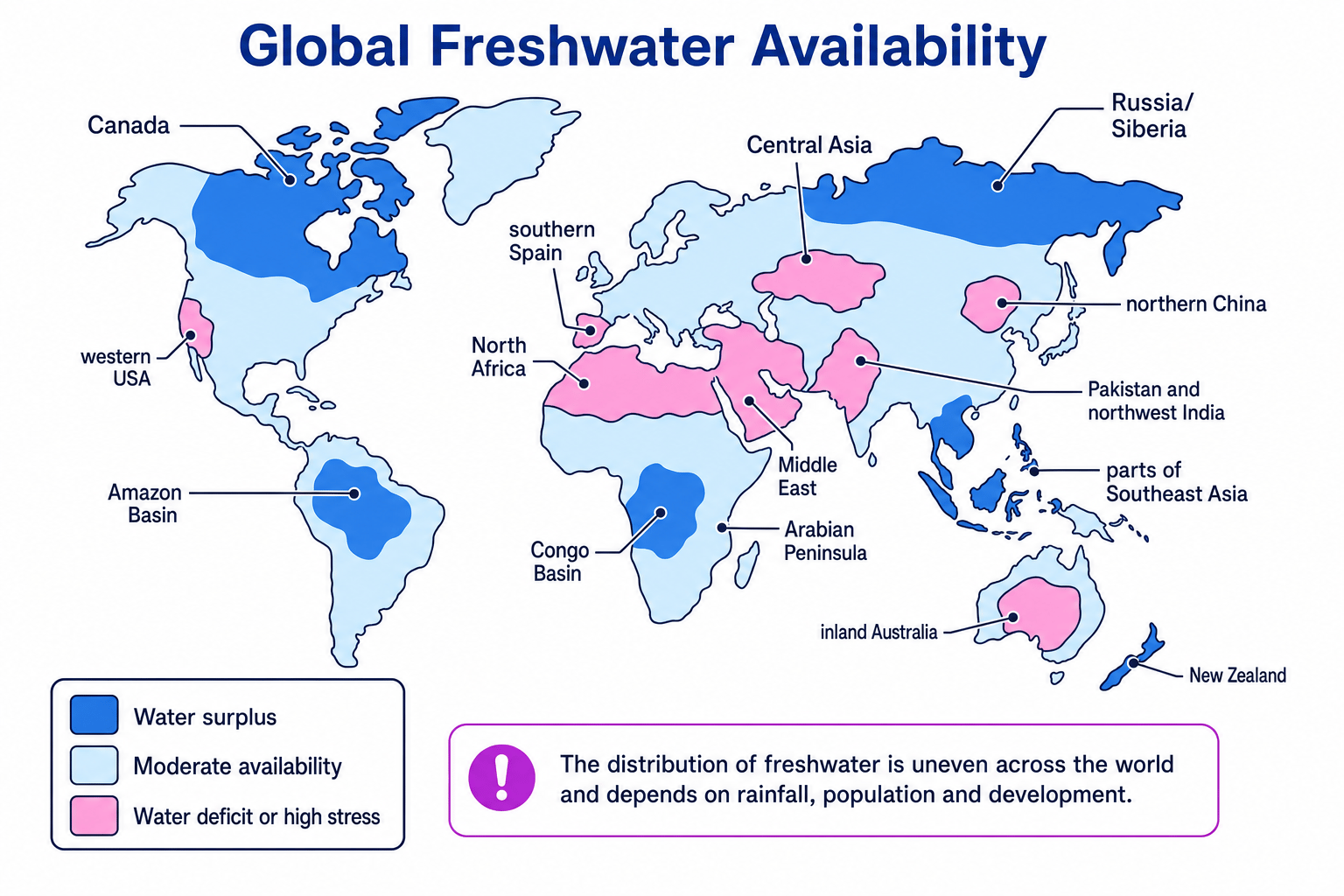
This sketch map shows the broad global pattern: surplus areas are often wet, less densely populated or have large river systems, while deficit areas often combine low rainfall with high demand.
Water availability varies at different scales
At a global scale, Canada, Russia, the Amazon Basin and the Congo Basin have large freshwater resources. North Africa, the Middle East, Central Asia and inland Australia face much greater pressure.
At a national scale, one country can contain both wet and dry regions. The UK is a good example: western and northern areas are wetter, while south-east England is drier but has high demand.
At a local scale, access can vary between neighbourhoods. A wealthy urban area may have piped treated water, while a nearby informal settlement may rely on standpipes, wells or untreated river water.
Availability is not the same as access
A country can have plenty of rainfall overall but still have poor access to safe water if it lacks pipes, treatment works, reservoirs or reliable governance.
3. Water stress: comparing supply with demand
Water stress
Water stress happens when water demand is high compared with the amount of renewable fresh water available. It is often shown on world maps using categories such as low, medium, high and extremely high stress.
A useful way to think about relative water stress is:
Water stress=annual water withdrawalsannual renewable freshwater supply×100\text{Water stress} = \frac{\text{annual water withdrawals}}{\text{annual renewable freshwater supply}} \times 100Water stress=annual renewable freshwater supplyannual water withdrawals×100If a country withdraws a large share of its renewable water each year, it is more vulnerable to drought, shortages and conflict between users.
Calculating relative water stress
A country has annual renewable freshwater supply of 120 billion cubic metres. Its annual water withdrawals are 48 billion cubic metres.
- Choose the correct relationship: water stress compares withdrawals with renewable supply, so use withdrawals as the numerator.
- Substitute the values: 48120×100=40%\frac{48}{120} \times 100 = 40\%12048×100=40%.
- Interpret the result: withdrawing 40% of renewable supply suggests high pressure, especially if demand is seasonal or water quality is poor.
Reading water stress maps
When you describe a water stress map, link the pattern to both physical supply and human demand. For example, the Middle East has low rainfall and high urban, agricultural and industrial demand.
4. How supply and demand have changed in the last 50 years
Over the past 50 years, global water demand has risen because of:
- Population growth: more people need water for drinking, cooking and washing.
- Urbanisation: cities need large, reliable water and sewage systems.
- Industrialisation: factories, energy production and manufacturing use water.
- Rising living standards: more appliances, showers, gardens and water-intensive diets.
- Irrigation: farming increasingly uses artificial watering to grow crops in dry areas.
Human intervention has also changed supply. Dams, reservoirs, canals, water transfers, desalination plants and wastewater recycling can increase usable supply in some places. However, over-abstraction of groundwater, pollution and climate change can reduce reliable supply.
Water withdrawal
A water withdrawal is water taken from a source such as a river, lake or aquifer for human use. Some may return to the system, but often in a different place or lower quality.
Line graphs often show future population projections against available water resources. If the population line rises while available water stays roughly fixed, water available per person falls.
Using a population projection to infer water pressure
A line graph shows world population increasing from about 8.0 billion to 9.7 billion by 2050 in one medium projection. Assume total renewable freshwater supply stays roughly the same.
- Calculate the percentage population increase: 9.7−8.08.0×100≈21%\frac{9.7 - 8.0}{8.0} \times 100 \approx 21\%8.09.7−8.0×100≈21%.
- Convert this into pressure on water per person: if supply is unchanged, the same water is shared between about 21% more people.
- Interpret the pattern: average water availability per person would fall unless efficiency, recycling, storage or new supplies improve.
5. Water use in developed, emerging and developing countries
Levels of development
A developed country is a high-income country with advanced infrastructure and services. An emerging country is rapidly industrialising and becoming wealthier. A developing country has lower average income and may have weaker infrastructure and services.
Water use is usually divided into three sectors:
| Sector | Meaning | Typical pattern |
|---|---|---|
| Agriculture | Farming, especially irrigation and livestock | Often the biggest user globally |
| Industry | Manufacturing, mining, energy and processing | Higher share in many developed and emerging economies |
| Domestic | Homes, schools, hospitals and services | Higher per-person use where piped water and appliances are common |
Globally, agriculture uses the largest share of water — often quoted at around 70% of withdrawals — but the pattern varies by country.
In many developing countries, agriculture may dominate water use because economies rely heavily on farming and irrigation. Domestic use may be lower because fewer homes have piped water, washing machines, flush toilets or gardens.
In many developed countries, industry and domestic use often take a larger share because people have higher incomes, more appliances, more reliable piped supply and more water treatment. Agriculture may still be important, but it is often more efficient or less dominant in the economy.
Development affects water use
As countries become wealthier and more urban, water demand often shifts from mainly agriculture towards more domestic, industrial and service-sector use.
6. Why the UK has water supply problems
The UK is not a dry country overall, but it still has water supply problems.
Uneven rainfall
The west and north of the UK receive more rainfall because moist air from the Atlantic rises over upland areas, creating relief rainfall. South-east England is drier but has high population density, London’s demand, intensive farming and many businesses.
Seasonal imbalance
Rainfall is often higher in winter, when demand is lower. Demand rises in summer because of gardens, tourism, farming and hot weather, but river levels and reservoirs may fall.
Ageing infrastructure
Much of the UK’s water and sewage network is old. Ageing pipes can leak, wasting treated water before it reaches users. Older combined sewer systems can also overflow during heavy rainfall, causing pollution in rivers and coastal waters.
The UK problem is not simply low rainfall
For the UK, the key issue is mismatch: wet areas are often far from high-demand areas, and rainfall does not always arrive in the season when it is most needed.
7. Why emerging and developing countries have water supply problems
Many emerging and developing countries face water supply problems for different reasons.
Untreated water
Some communities rely on rivers, ponds, wells or standpipes without reliable treatment. This increases the risk of diseases such as cholera and diarrhoea.
Pollution of water courses
A water course is a channel such as a river or stream. Water courses can be polluted by untreated sewage, industrial waste, fertilisers, pesticides and dumped rubbish. Pollution reduces the amount of water that is safe to use.
Low annual rainfall
Some countries or regions, such as parts of the Sahel, the Horn of Africa and the Middle East, have low or unreliable rainfall. Drought can make shortages much worse, especially where storage is limited.
8. Stakeholders and attitudes to water use
Stakeholder
A stakeholder is a person or group with an interest in a decision. In water management, stakeholders include individuals, farmers, businesses, water companies, environmental groups, charities and governments.
Different stakeholders often disagree:
- Individuals may want cheap, reliable water for homes.
- Farmers may want irrigation to protect crops and income.
- Industries may want secure water supplies for production.
- Environmental organisations may want more water left in rivers and wetlands.
- Governments may prioritise economic growth, public health, food supply or international relations.
This creates conflict over exploitation, which means using a resource for human benefit. Exploitation can support development, but overuse can damage ecosystems and future supply.
9. Desalination: using technology to increase supply
Desalination
Desalination is the removal of salt from seawater or salty groundwater to produce fresh water.
Many modern plants use reverse osmosis, where seawater is pushed at high pressure through a membrane that allows water molecules through but blocks most salts.
This diagram shows how a reverse osmosis desalination plant turns seawater into usable fresh water, while producing salty waste called brine.
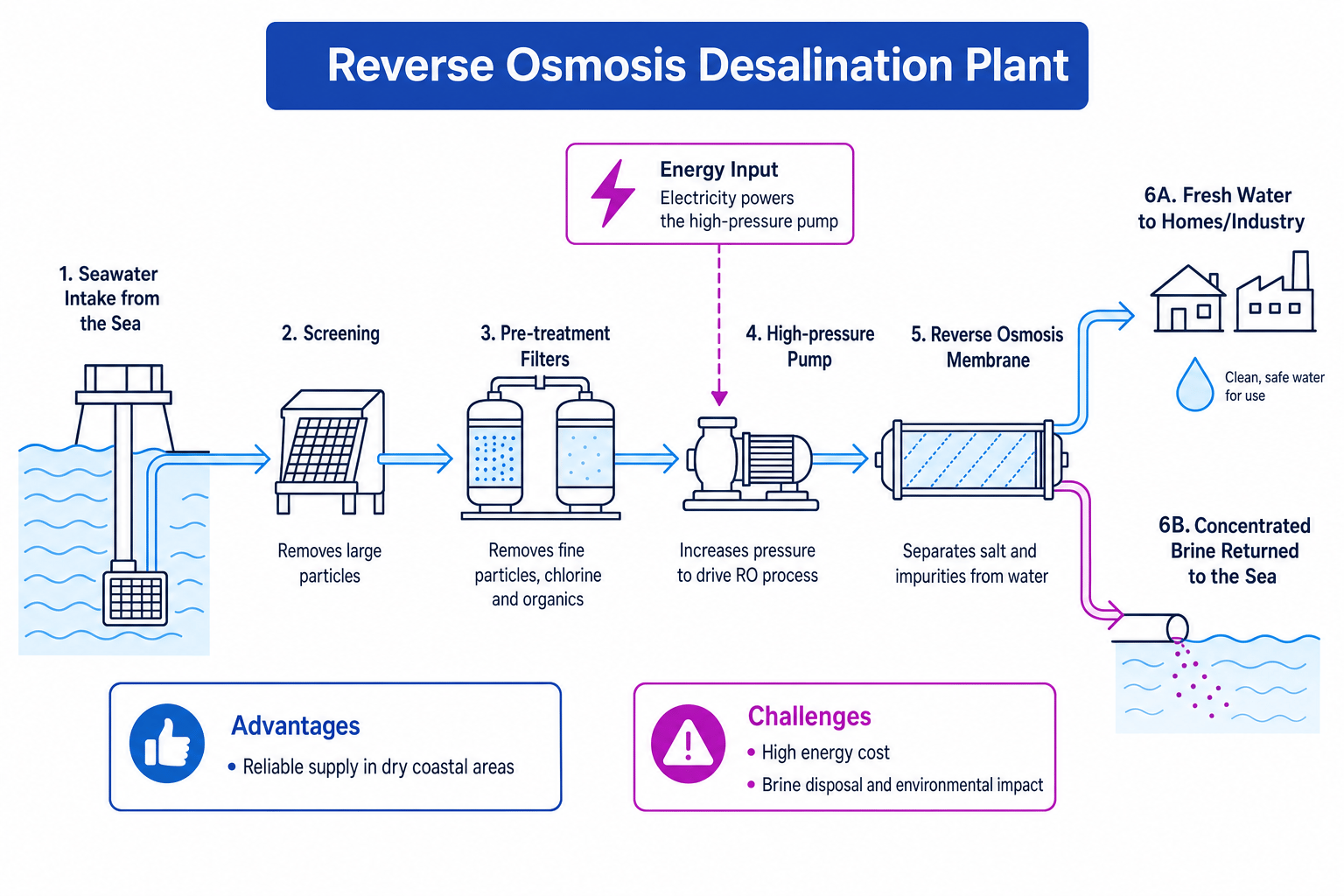
Desalination is useful for dry, coastal, wealthy places such as Saudi Arabia, the United Arab Emirates, Israel and Singapore. It provides reliable supply, but it is expensive, energy-intensive and can damage marine ecosystems if concentrated brine is returned carelessly to the sea.
10. Sustainable water management
Sustainable water management
Sustainable water management means using and managing water so that people’s needs are met now without damaging ecosystems or reducing water security for future generations.
Water needs sustainable management because:
- accessible fresh water is limited;
- demand is rising;
- pollution can make water unusable;
- climate change may increase droughts and floods;
- rivers, wetlands and wildlife need water too;
- shared rivers can create tension between countries.
Management happens at different scales:
- Local: fixing leaks, water meters, rainwater harvesting, community wells, sand dams.
- National: reservoirs, drought plans, water pricing, pollution laws, transfers between regions.
- International: treaties for shared rivers such as the Nile, Mekong or Colorado.
11. Located examples of sustainable management
Developed country: Singapore
Singapore is a developed city-state in South-east Asia. It has high demand, little land for large reservoirs and limited natural freshwater sources.
Singapore’s national water agency, PUB, manages water through the “Four National Taps”:
- local catchment water stored in reservoirs;
- imported water from Malaysia;
- NEWater, which is highly treated recycled wastewater;
- desalinated seawater.
It also uses water pricing, public education, efficient appliances and leakage control. This is relatively sustainable because it diversifies supply and reduces dependence on one source, although desalination still uses a lot of energy.
Emerging or developing country: Kenya
Kenya, in East Africa, has very uneven rainfall. Some areas, especially in the east and north, are semi-arid and vulnerable to drought. Rural communities may have limited piped water, while cities such as Nairobi have rapidly growing demand.
In counties such as Kitui and Makueni, communities and organisations have built sand dams across seasonal riverbeds. A concrete wall traps sand during floods, and water is stored in the sand behind the dam. People can then access water through shallow wells or pumps.
Sand dams are more sustainable than many high-cost schemes because they are local, low-energy and reduce evaporation. They can support farming, tree planting and time savings for households. However, they need suitable geology, community maintenance and enough seasonal rainfall to recharge.
No single solution works everywhere
Sustainable water management depends on place. Singapore can afford advanced recycling and desalination, while rural Kenya may benefit more from low-cost community storage and protection of local sources.
In the exam
- For water distribution questions, always separate supply factors such as rainfall from demand factors such as population, farming and industry.
- When using a map or graph, quote the pattern first, then explain it with place-specific reasons.
- For management questions, include both benefits and limitations, and name the stakeholders affected.
Check yourself
- Why can a country with high rainfall still have water supply problems?
- How does water use usually differ between developed and developing countries?
- What makes Singapore’s and Kenya’s water management strategies sustainable in different ways?
