

What you'll learn
- What natural resources are, and how they can be classified.
- How people exploit environments to obtain food, energy and water.
- How exploitation can damage environments.
- How global and UK resource distribution and consumption can be shown on maps and data visualisations.
1. What is a natural resource?
A resource is something people can use. In Geography, we focus on the parts of the physical environment that help meet human needs such as food, shelter, energy, water and materials.
Natural resources and their main types
A natural resource is any feature or part of the environment that can be used to meet human needs. Resources may be biotic (living or once-living, such as fish, forests and crops), abiotic (non-living, such as water, rocks and minerals), renewable (naturally replaced if managed carefully) or non-renewable (finite, or replaced so slowly that humans treat them as limited).
The categories can overlap. For example, a forest is biotic because it is living, and it can be renewable if trees are replanted and harvesting is controlled. Fossil fuels are formed from once-living material, but they are non-renewable because they take millions of years to form.
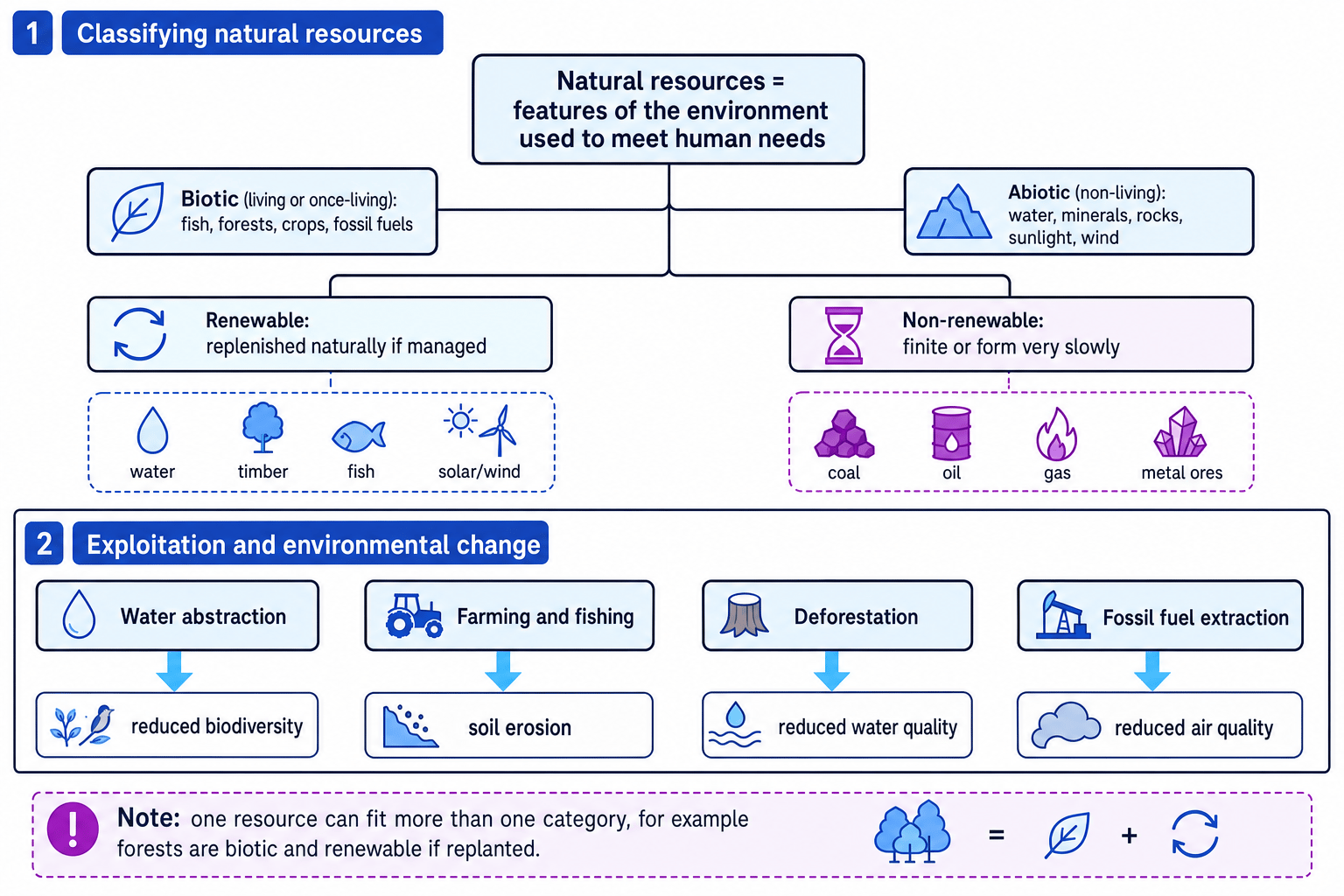
Classifying a resource
Suppose you are asked to classify North Sea oil as a natural resource.
- Decide whether it comes from living or non-living material: oil formed from ancient organic matter, so it is linked to once-living material.
- Decide whether it can be replaced on a human timescale: oil takes millions of years to form, so it is not naturally replaced quickly.
- Combine the classifications: North Sea oil can be described as a natural resource and a fossil fuel; for GCSE purposes, the key classification is that it is non-renewable.
2. Exploiting environments to obtain resources
Exploitation means using an environment to obtain resources. This word does not always mean “bad”, but it often suggests that the environment is being used intensively.
Food
People obtain food through:
- Farming: growing crops and rearing livestock.
- Fishing: catching wild fish or farming fish in aquaculture.
- Deforestation: clearing forest to create farmland, for example cattle ranching and soya farming in parts of the Amazon Basin in Brazil.
Energy
Energy is obtained through:
- Extracting fossil fuels such as coal, oil and natural gas.
- Building renewable energy schemes such as wind farms, solar farms and hydroelectric power stations.
- Growing crops for biofuels, such as sugar cane ethanol in Brazil.
Water
Water is obtained by:
- Abstraction: taking water from rivers, lakes or underground stores called aquifers.
- Building reservoirs, such as Kielder Water in Northumberland, northern England (located example), which stores water for supply.
- Desalination in some countries, where salt is removed from seawater, for example in parts of the Gulf states.
Resources link people and environments
Resource management is about balancing human needs with the ability of environments to keep functioning. The same resource can create benefits, such as jobs and electricity, but also costs, such as pollution or habitat loss.
3. How exploitation changes environments
When people extract or use resources, they often alter ecosystems and physical processes.
Reduced biodiversity
Biodiversity means the variety of living organisms in an area. Deforestation, overfishing and pollution can reduce biodiversity by destroying habitats or removing species faster than they can recover.
For example, tropical rainforest clearance in the Amazon Basin can reduce the number of plant, animal and insect species because complex forest habitats are replaced by simpler farmland.
Soil erosion
Soil erosion is the removal of soil by wind, rain, rivers or human activity. It becomes worse when vegetation is removed, because roots no longer bind the soil together and leaves no longer protect the surface from heavy rainfall.
This matters because soil is needed for farming. Losing fertile topsoil can reduce crop yields and increase river sediment, which can affect water quality.
Reduced water and air quality
Water quality refers to how clean or polluted water is. Farming can add fertilisers, pesticides and animal waste to rivers. Mining and oil extraction can also cause spills or chemical pollution.
Air quality refers to how clean or polluted the air is. Burning fossil fuels releases pollutants and greenhouse gases. Poor air quality can damage health, especially in cities and industrial areas.
Thinking exploitation only happens in poorer countries
High-income countries also exploit resources heavily. The UK has extracted coal, oil and gas, farms intensively in lowland areas, imports food grown overseas, and consumes large amounts of energy and water compared with many lower-income countries.
4. Global distribution of natural resources
Distribution means where something is found. Natural resources are unevenly distributed because of geology, climate, relief, soils and ecosystems.
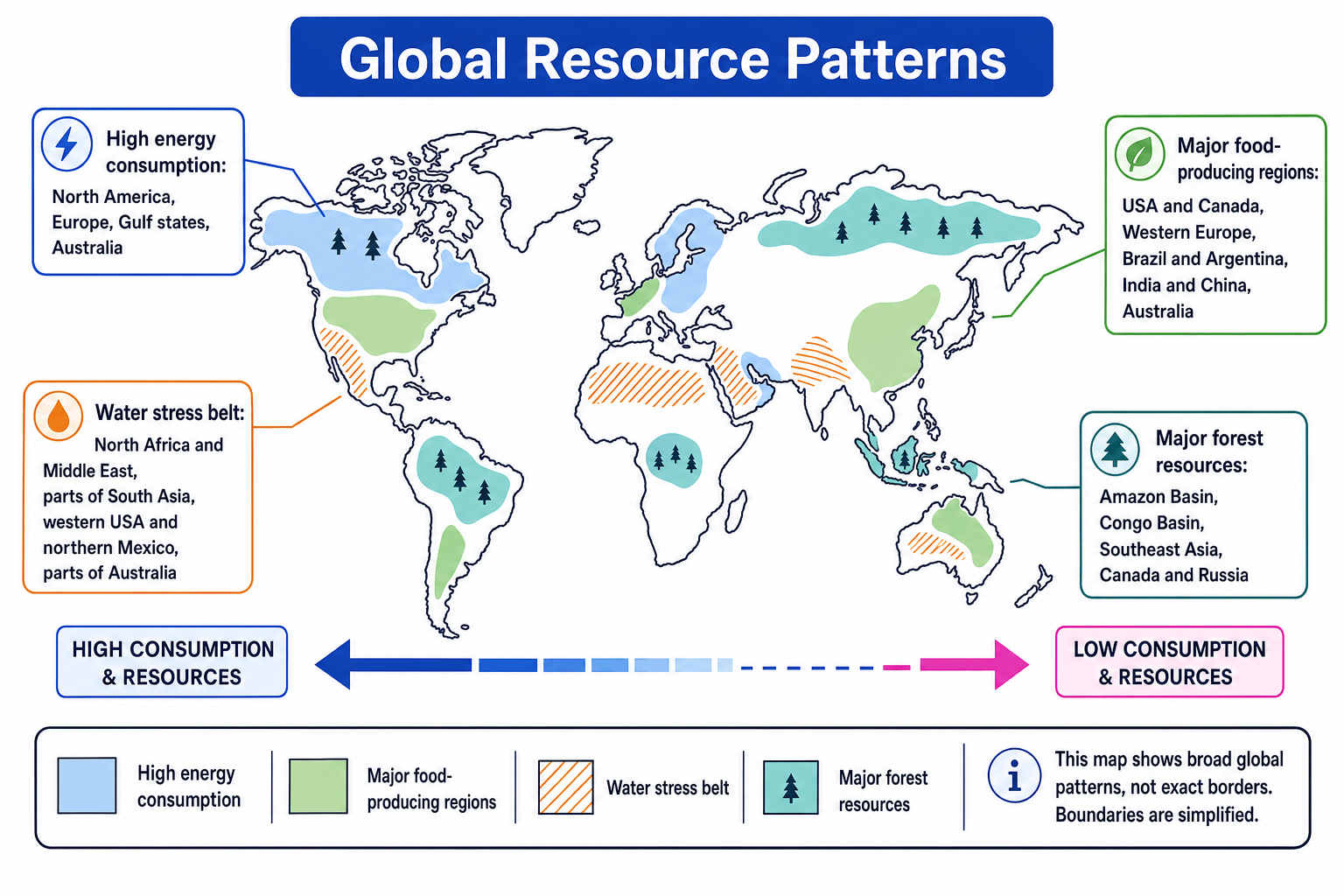
Soil and agriculture
Good agricultural land is often found in fertile lowlands and river basins. Examples include:
- The Great Plains of the USA and Canada.
- The Indo-Gangetic Plain in India and Pakistan.
- Parts of western Europe, including northern France and eastern England.
Climate matters too. Areas with reliable rainfall and suitable temperatures can support more productive farming, while deserts and very cold regions are more limited.
Forestry
Major forest resources include:
- Tropical rainforests in the Amazon Basin, Congo Basin and Southeast Asia.
- Boreal forests in Canada, Russia and Scandinavia.
Forests provide timber, fuelwood, habitats and carbon storage. However, they may be cleared for farming, mining, roads or settlements.
Fossil fuels
Fossil fuels are found where ancient organic material was buried and transformed by heat and pressure. Major oil and gas regions include the Middle East, Russia, the USA and parts of the North Sea. Major coal producers include China, India, the USA and Australia.
Water supply
Freshwater supply depends on rainfall, rivers, glaciers, groundwater and population pressure. Countries such as Canada, Brazil and Russia have large freshwater resources, while parts of North Africa and the Middle East face severe water stress.
Rock and minerals
Minerals depend strongly on geology. For example, Chile is a major copper producer, Australia and Brazil have large iron ore resources, and China is important for rare earth minerals. These resources are not spread evenly, so countries often trade to obtain what they lack.
5. UK distribution of natural resources
The UK also has uneven resource distribution.
UK agriculture and soils
The east and south-east of England, including East Anglia and Lincolnshire, have flatter land, drier conditions and fertile soils, so they are important for arable farming such as wheat, barley and vegetables.
The west and north of the UK are generally wetter and hillier, with thinner soils in upland areas. These areas are more often used for pastoral farming, especially sheep and cattle.
UK forestry
The UK has less forest cover than many European countries, although woodland is increasing in some places. Commercial forestry is found in upland areas, including parts of Scotland, Wales and northern England. Kielder Forest in Northumberland is one of England’s largest areas of planted forest.
UK fossil fuels
The UK has historic coalfields in South Wales, Yorkshire, the East Midlands, North East England and central Scotland. Coal mining has declined sharply, but it shaped many settlements and landscapes.
Oil and gas have been extracted from the North Sea, east of Scotland and north-east England. Production is now lower than at its peak, so the UK relies more on imports and a changing energy mix.
UK water supply
The UK’s water problem is about mismatch. The west and north receive more rainfall, while the south and east have higher population density, more demand and lower rainfall. This creates pressure in places such as south-east England.
Remember the UK water mismatch
A simple way to remember UK water stress is: wet uplands in the north and west; high demand in the south and east.
6. Global patterns of resource consumption
Consumption means how much of a resource is used. It can be measured as total use or per capita, meaning per person.
Food consumption
Food consumption is generally higher in high-income countries, especially for meat, dairy and processed foods. In some low-income countries, food insecurity is linked to poverty, conflict, drought, poor infrastructure or unequal access, rather than simply a lack of food in the world.
Emerging economies such as China and India have rising food demand as incomes increase, diets change and urban populations grow.
Energy consumption
Energy consumption is highest per person in many high-income countries and oil-rich states. North America, Europe, Australia and the Gulf states often show high energy use. Rapidly industrialising countries such as China and India have very high total energy demand because their populations and industries are large.
Many low-income countries, especially in parts of sub-Saharan Africa, have much lower energy consumption per person because access to electricity and industry is more limited.
Water consumption
Water use is affected by population size, farming, industry and lifestyle. Globally, agriculture accounts for around 70% of freshwater withdrawals, although exact figures vary by source and year.
High water use can happen in dry regions if there is irrigation, for example parts of the western USA, northern India and the Middle East. Water scarcity is worst where low supply combines with high demand, pollution or weak infrastructure.
Distribution is not the same as consumption
A country may have many resources but consume little, or have few resources but consume a lot through imports. Always separate where resources are found from where resources are used.
7. Reading resource maps and data visualisations
A choropleth map uses shading or colour to show data values for areas such as countries or regions. In this topic, choropleth maps might show energy use per person, access to safe water, food supply, forest cover or mineral production.
Gapminder-style visualisations often use animated bubble charts. The x-axis and y-axis show two variables, the bubble size may show population, and colours often represent world regions.
Choropleth map
A choropleth map is a thematic map where areas are shaded according to data values. It is useful for showing broad spatial patterns, but it can hide variation inside each area.
Interpreting a resource choropleth
Imagine a world choropleth map shows energy consumption per person.
- Check what is being measured: “per person” means a small wealthy country can appear higher than a large country with lower average use.
- Identify the broad pattern: if North America, Europe, Australia and Gulf states are in the darkest categories, the pattern suggests high consumption in many richer or oil-producing countries.
- Add exceptions or detail: a country such as China may have very high total energy use but not always the highest per-person use because its population is so large.
- Suggest reasons: wealth, industry, transport, climate, energy prices and access to fossil fuels can all affect energy demand.
Ignoring the map key
Do not describe a choropleth map as “dark means bad” or “light means good”. The meaning depends on the key, the units and whether the data is total, per person or percentage.
8. Why this overview matters for Resource management
This section gives you the “big picture” before studying resource issues in more depth. In Topic 6, you will later focus on either Energy or Water as the optional in-depth part, depending on what your class studies.
For now, aim to understand three linked ideas:
- Resources are unevenly distributed because environments differ.
- Consumption is uneven because wealth, population, technology and lifestyles differ.
- Exploitation creates benefits, but can also damage biodiversity, soils, water and air.
In the exam
- Separate distribution from consumption: say whether you are describing where resources are found or where they are used.
- Use map evidence precisely: name regions or countries, quote the category from the key if given, and mention anomalies.
- Explain using linked reasons: climate, geology, population, wealth, technology and trade are often stronger answers than a simple list.
- For UK questions, contrast the north/west with the south/east where relevant, especially for water, farming and population pressure.
Check yourself
- What is the difference between a renewable and a non-renewable resource?
- Why might a country with limited fossil fuels still have high energy consumption?
- How does UK rainfall distribution create water supply problems?
