

In your AQA GCSE English Literature Paper 2 exam, you will be asked to write an essay on a theme or a character in Pigeon English. To achieve the highest marks, you must treat the characters not as real people, but as deliberate artistic creations—or constructs—designed by Stephen Kelman to convey powerful ideas about society, immigration, and youth.
What you'll learn
- How to analyze Harri Opoku’s unique voice as a symbol of vulnerable innocence.
- The structural function of foil characters like Dean and Lydia.
- How the Dell Farm Crew (DFC) and the symbolic Pigeon represent opposing paths of destruction and spiritual salvation.
- How to write a sophisticated, top-mark analytical paragraph exploring characterization.
Understanding Characters as Constructs
Before analyzing individual characters, you must master the core critical approach required for GCSE English Literature.
Character as a Construct
A construct is a character designed by an author to represent a specific theme, ideology, or social group. Authors use constructs to argue a point about the real world rather than just to tell a story.
When writing your essay, always use the author’s name as the subject of your sentences: "Kelman uses Harri to represent..." rather than "Harri is a boy who..." This ensures you are constantly addressing his methods and purposes.
The 'Real Person' Pitfall
Never talk about characters as if they have lives outside the novel. Writing "If Harri had stayed in Ghana, he would have been safer" is a mistake. Instead, write: "Kelman contrasts the remembered safety of Ghana with the urban hostility of London to highlight..."
Harri Opoku: The Innocent Observer
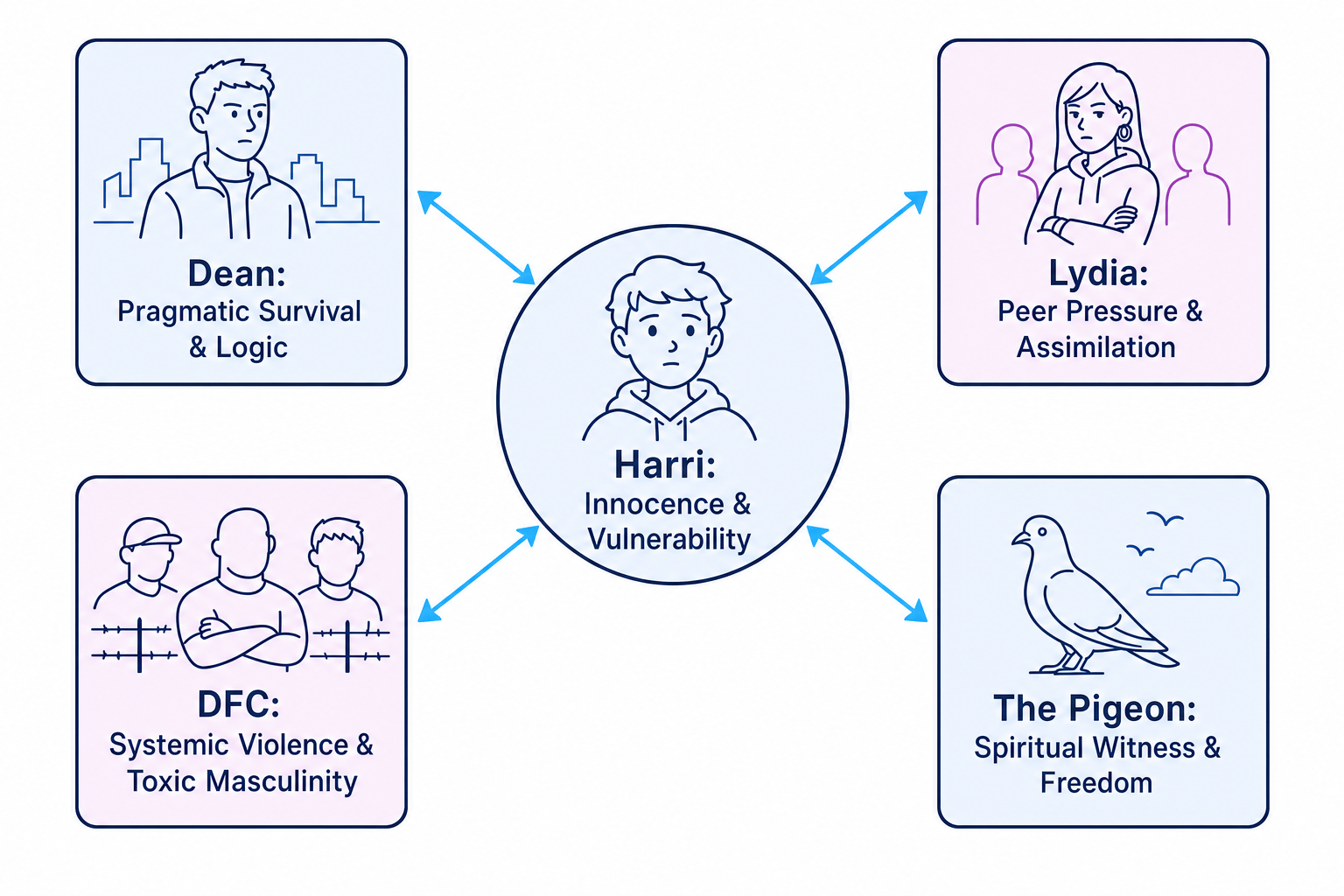
Harrison (Harri) Opoku is the eleven-year-old protagonist and first-person narrator of the novel. Kelman uses Harri’s unique perspective to expose the harsh realities of inner-city London life.
The Dual Voice: Ghanaian and London Slang
Harri’s linguistic style is a hybrid. He uses Ghanaian terms of endearment and exclamation (like "asweh"—I swear, and "palaver"—trouble) alongside London street slang ("chook", "heavy", "safe").
- The Meaning: This hybrid language highlights Harri's position caught between two cultures. He is trying to assimilate into his new urban environment while remaining tethered to his innocent, community-focused Ghanaian heritage.
- The Key Quote: "You can do the preying-mantis on them. It’s a specialized move." Harri blends childish imagination with the survival techniques needed on the estate.
Vulnerability and Foreshadowing
Harri’s innocence is his most endearing quality, but it is also what makes him highly vulnerable. He is unable to decode the true danger of his surroundings.
- The Meaning: Kelman uses Harri's naive narration to create dramatic irony—the reader understands the fatal danger of the Dell Farm Crew long before Harri does.
- The Key Quote: When discussing the DFC, Harri innocently notes, "They're only boys. They just want to look big." His failure to recognize their capacity for violence foreshadows his tragic end.
Harri's Narrative Lens
Kelman uses Harri’s first-person narrative perspective as a moral filter. By viewing a violent, neglected estate through the innocent eyes of an eleven-year-old child, the tragedy of the environment is magnified.
Foil Characters: Dean and Lydia
To deepen his exploration of youth, Kelman surrounds Harri with characters who act as foils.
Foil
A foil is a character who contrasts with another character (usually the protagonist) in order to highlight particular qualities of that protagonist.
Dean: Pragmatic Survival
Dean is Harri’s best friend and acts as a direct foil to Harri's imaginative innocence. While Harri views the world with wonder, Dean is realistic and shaped by the cynical wisdom of a child raised entirely on the estate.
- Key Contrast: Dean is obsessed with detective work through the lens of CSI, looking for objective evidence ("CSI rules"). Harri, conversely, looks for magic, spirits, and personal connections.
- Kelman’s Purpose: Kelman uses Dean to show that survival on the estate requires a hardened, pragmatic outlook. Dean survives because he knows when to keep his head down; Harri dies because his curiosity and innocence prevent him from doing so.
Lydia: The Struggle for Assimilation
Lydia is Harri’s older sister. Unlike Harri, who retains his connection to Ghana, Lydia is desperate to fit in with the older, cooler estate kids, eventually associating with girls linked to the DFC.
- Key Contrast: While Harri respects authority (his mother and his teachers), Lydia rebels, hiding secrets and trying to shed her immigrant identity.
- Kelman’s Purpose: Through Lydia, Kelman explores the gendered pressures of the estate. While boys are pressured into violent gangs, girls are pressured into complicity and the sacrifice of their moral integrity to gain protection.
The Antagonists: The Dell Farm Crew (DFC)
The DFC, led by figures like Killa and X-Fire, are the primary antagonists of the novel. However, Kelman does not present them as cartoonish villains; they are complex symbols of social failure.
Systemic Deprivation and Toxic Masculinity
The DFC represent what happens when children are left behind by social institutions (schools, police, government).
- The Key Quote: "They only want you if you're a soldier. If you're a soldier you have to do what the general says."
- The Meaning: The gang mimics military and corporate hierarchies. For these boys, who feel powerless and invisible to wider British society, the gang offers a distorted sense of power, identity, and protection.
Quote Integration Tip
When writing about the DFC, avoid just calling them "evil." Use words like disenfranchised, marginalized, and institutional failure. This shows examiners you are thinking about context (AO3).
The Non-Human Character: The Pigeon
One of the most unique aspects of Kelman’s characterization is his decision to give a voice to the pigeon that visits Harri’s balcony.
Spiritual Guardian and Cosmic Perspective
The Pigeon acts as a magical realist element in the novel. It represents nature, the spiritual world, and an objective, non-human perspective on human suffering.
- The Key Quote: "You only get one life and it’s small. You have to make it count."
- The Meaning: While humans on the estate are trapped by physical and social borders, the Pigeon is free. It watches over Harri and offers him a form of spiritual comfort, ultimately acting as a vehicle for his soul after his death.
Step-by-Step Character Analysis
When writing a character analysis in the exam, you must move from what the character does (plot) to how the writer presents them (methods) to why the writer did this (theme/context).
Analyzing character vulnerability
Read this question: How does Kelman present Harri’s vulnerability in Pigeon English? Here is how to construct a top-tier paragraph using five analytical steps.
- Formulate a conceptual thesis statement (AO1/AO3): Begin by stating how Kelman uses Harri's character to deliver a message about society.
- Example: "Kelman presents Harri's vulnerability not as a personal weakness, but as a tragic consequence of his innocent disposition colliding with a hostile, neglected social environment."
- Introduce precise textual evidence (AO1): Integrate a short, focused quotation that directly supports your thesis.
- Example: This vulnerability is starkly highlighted when Harri describes his protective clothing: he wears "yellow socks" because they are his "lucky ones" to protect him from the gangs.
- Identify the writer's methods (AO2): Name the literary devices or techniques Kelman employs in this passage.
- Example: Kelman uses the symbol of "lucky" socks and the motif of superstitions to highlight Harri's childlike coping mechanisms.
- Analyze the linguistic and psychological effect (AO2): Explain how these methods work on the reader and what they reveal about the character.
- Example: The adjective "lucky" emphasizes Harri's cognitive disconnect; he relies on magical thinking and childish superstition to navigate a highly dangerous, physical reality of knife crime. This contrast highlights how ill-equipped his innocent mind is for the brutal estate environment.
- Link to wider contextual themes (AO3): Connect the analysis back to the novel's overarching social message.
- Example: Through this, Kelman criticizes a society that fails to provide institutional safety for immigrant children, forcing them to rely on fragile, imaginary shields for survival.
In the exam
- Focus on the 'Why': Every time you analyze a character's action, ask yourself: Why did Kelman choose to write this? What social issue is he trying to expose?
- Track Character Arcs: Look at how characters change. Harri moves from absolute wonder to growing fear, yet he retains his core innocence until his death.
- Compare and Contrast: Use foil characters (like Dean or Lydia) in your body paragraphs to show how Kelman offers alternative perspectives on the same central theme.
Check yourself
- Why does Kelman use a child narrator rather than an adult narrator to tell this tragic story?
- In what ways does Dean act as a warning to the reader about the necessity of losing one's innocence to survive?
- How does the Dell Farm Crew use language to manipulate and control the younger children on the estate?
