Mary Shelley’s Frankenstein is much more than a simple horror story. It is a complex, multi-layered tale about scientific ambition, isolation, and the consequences of abandoning our moral responsibilities.
To score highly in your GCSE English Literature exam, you cannot just memorise "what happens." You must understand how the story is told, why Shelley structured it this way, and how the plot sequence develops her key themes (AO1 and AO2).
What you'll learn
- The unique "nested" frame narrative structure of the novel.
- The five key stages of the plot, from Victor's ambition to his ultimate downfall.
- How to link structural plot choices directly to Shelley's wider social and philosophical messages.
1. The Structure: A Story Within a Story
Before diving into the chronological events, you must understand the novel's form. Frankenstein does not start with Victor in his laboratory. Instead, it uses a unique structural device known as a frame narrative.
Frame Narrative
A frame narrative is a literary technique where an introductory story (the "frame") sets the stage for a second, more central narrative. In Frankenstein, the story is nested like Russian dolls or concentric circles.
The novel is also partly epistolary (written in the form of letters), which gives the narrative a sense of realism and immediacy.
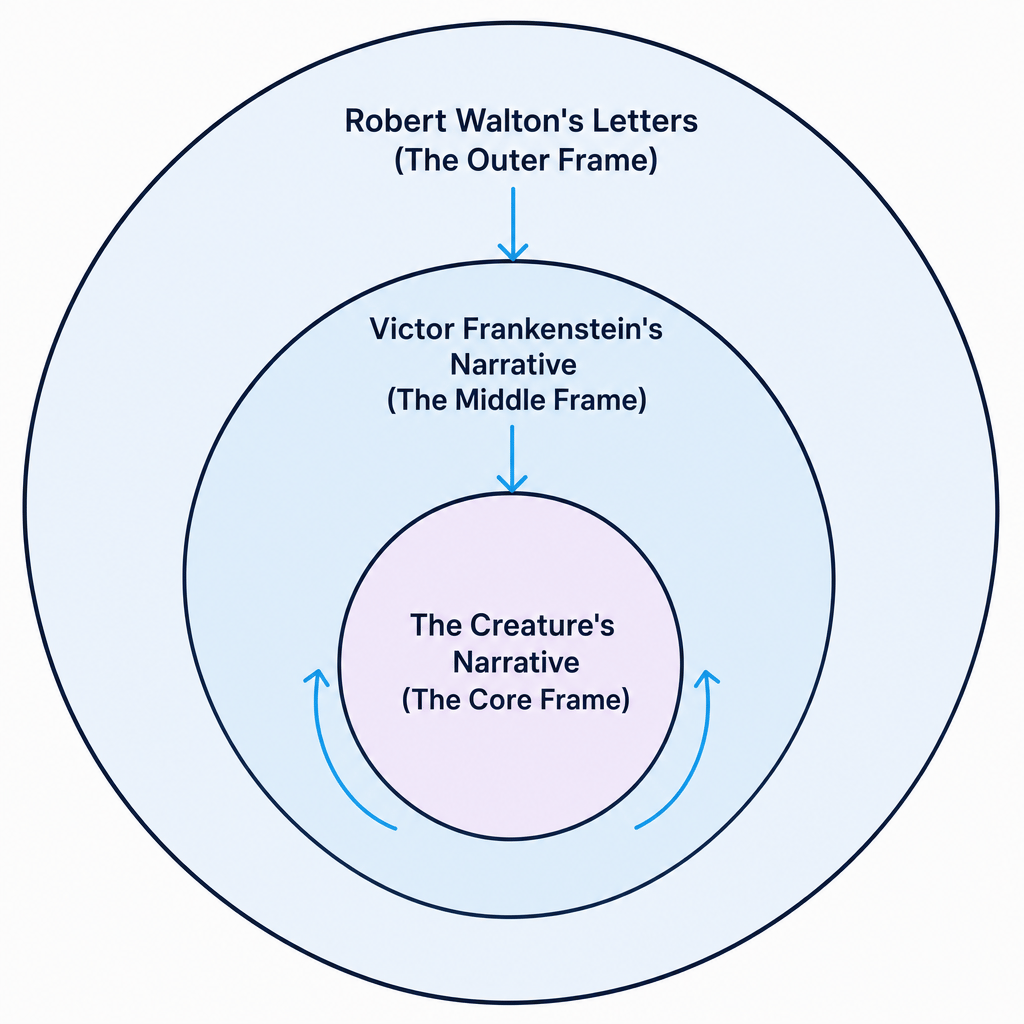
This structure means we hear the story through three distinct voices:
- Robert Walton's Letters (The Outer Frame): Writing to his sister, Margaret Saville, Walton describes his Arctic expedition and his rescue of a dying, desperate stranger: Victor Frankenstein.
- Victor Frankenstein's Story (The Middle Frame): Victor narrates his life, his scientific triumph, and his subsequent ruin to Walton as a warning.
- The Creature's Story (The Inner Frame): At the absolute centre of the novel, the Creature speaks in his own voice, describing his survival, his self-education, and his intense pain at being rejected by humanity.
The Power of the Nested Narrative
By placing the Creature’s voice at the absolute centre of the novel, Shelley forces the reader to look past Victor's biased view of a "miserable monster" and directly confront the Creature’s humanity, suffering, and intellect.
2. Chronological Plot Breakdown
Let's look at the actual sequence of events that unfolds across these three narrative layers.
Stage 1: The Frame and Victor's Early Life (Exposition)
The novel opens with Captain Robert Walton exploring the icy wilderness of the North Pole. He is lonely and longs for a friend. He rescues Victor Frankenstein, who is weak, frozen, and chasing a giant figure across the ice. Victor, seeing Walton's dangerous levels of ambition, decides to tell him his life story as a warning.
Victor describes his idyllic childhood in Geneva, Switzerland, his love for his adopted cousin Elizabeth Lavenza, and his best friend Henry Clerval. He becomes obsessed with finding the secret of life and goes to study science at the University of Ingolstadt.
Stage 2: The Creation and Abandonment (Inciting Incident)
Driven by hubris (excessive pride), Victor works tirelessly to conquer death. Using body parts harvested from "the dissecting room and the slaughter-house," he brings his creation to life on a "dreary night of November."
However, the moment the Creature opens its watery yellow eyes, Victor is seized by "breathless horror and disgust." He flees his laboratory, abandoning his creation. When he returns the next morning, the Creature is gone. Victor collapses with a nervous fever, nursed back to health by Henry Clerval.
Who is 'Frankenstein'?
Never refer to the Creature as "Frankenstein." Frankenstein is the creator; the Creature is nameless, often referred to as "the monster," "the daemon," "the fiend," or simply "the Creature." Confusing the two is a very common mistake that instantly lowers the academic quality of your essay.
Stage 3: Tragedy Strikes and the Central Meeting (Rising Action)
Victor receives news that his young brother, William, has been murdered. Returning to Geneva, Victor spots the Creature in a lightning storm and instantly realizes he is the killer. However, the innocent family servant, Justine Moritz, is blamed, framed by a locket the Creature placed in her pocket. Victor stays silent to protect his own secret, and Justine is executed.
Consumed by guilt, Victor hikes into the Alps. On the Mer de Glace glacier, the Creature confronts him. Surprisingly eloquent, the Creature demands that Victor listen to his story.
The Creature explains how he survived in the wilderness, learned language and morality by secretly observing the loving De Lacey family in their cottage, but was violently rejected by them and every other human he met because of his terrifying appearance.
Key Quotation to Memorise
The Creature tells Victor: "I ought to be thy Adam; but I am rather the fallen angel, whom thou drivest from joy for no misdeed." This biblical allusion to Milton's Paradise Lost highlights the Creature's sense of injustice at being abandoned by his creator.
Stage 4: The Broken Promise (The Climax of the Subplot)
The Creature makes a final demand: Victor must create a female companion for him so they can live in peaceful isolation in the wilds of South America. If Victor agrees, the Creature will leave humanity alone.
Victor reluctantly begins work on a remote island in the Orkneys, Scotland. However, halfway through, terrified that the two creatures might breed a "race of devils," Victor tears the half-finished female to pieces right in front of the watching Creature.
Enraged, the Creature vows: "I shall be with you on your wedding-night."
Stage 5: Vengeance and Death (Falling Action & Resolution)
The Creature systematically destroys everyone Victor loves:
- He strangles Henry Clerval (Victor is accused of the murder but acquitted).
- He murders Elizabeth on her wedding night, fulfilling his terrifying promise.
- Victor’s father, Alphonse, dies of grief shortly after.
With nothing left to live for, Victor vows revenge. He chases the Creature across the world, eventually ending up in the frozen wastes of the Arctic, where he is rescued by Walton.
After finishing his story, Victor dies on Walton's ship. Shortly after, Walton finds the Creature in the cabin, weeping over Victor's corpse. The Creature expresses deep remorse for his crimes, declaring that his own suffering was far worse than Victor's. He leaves the ship, heading further north to burn himself on a funeral pyre, disappearing "in darkness and distance."
3. Structural Analysis: Why it Matters
In your GCSE exam, you will be asked to analyse language, form, and structure (AO2). To get top marks, you must connect the plot structure directly to the writer's intentions.
Analyzing the structural purpose of the inner narrative
Imagine you get an exam question about how Shelley presents the theme of isolation. Walk through these steps to build a high-level analytical paragraph linking plot structure to meaning:
- Identify the structural choice: Point out that the Creature's story is physically positioned at the exact centre of the novel (Chapters 11–16 of the 1818 edition).
- Analyse the effect of this choice: By forcing the reader to transition from Victor's harsh, biased outer frame to the Creature's eloquent first-person perspective, Shelley temporarily pauses Victor's narrative of vengeance. This forces the reader to experience the world through the Creature's senses, creating a profound sense of sympathy for his isolation.
- Connect to context and writer's intention (AO3): Shelley uses this structure to critique the cold, objective scientific rationalism of the Enlightenment (represented by Victor) and instead promote Romantic ideals of empathy, nature, and the fundamental goodness of the individual before they are corrupted by an unfeeling society.
In the exam
- Never just retell the plot. Every time you mention an event (e.g., "when Victor destroys the female creature..."), immediately explain why it matters to the theme or character development (e.g., "...which represents Victor finally choosing moral responsibility over scientific ambition, yet triggering his ultimate personal ruin").
- Utilise the frame narrative. If writing about Walton, Victor, or the Creature, comment on how their stories mirror each other. Walton is a warning of what Victor could have been; Victor is a tragic warning of the dangers of unchecked scientific exploration.
- Be precise with setting. Notice how the landscape mirrors the plot (pathetic fallacy). The bleak, icy Arctic frame reflects the cold, isolated emotional states of both Victor and his creation.
Check yourself
- Why does Mary Shelley start the novel with Robert Walton's letters rather than Victor's childhood?
- What is the structural turning point (the climax) where the Creature's quest for love officially turns into a quest for total destruction?
- How does the ending of the novel (returning to Walton’s perspective) reinforce the idea of the novel as a "cautionary tale"?
