Mary Shelley’s Frankenstein is a rich, psychological novel. Rather than presenting simple "good versus evil" archetypes, Shelley populates her story with complex, deeply flawed characters who mirror and contrast one another.
To achieve top marks in your GCSE English Literature exam, you must look beyond what these characters do and understand why Shelley created them. They are constructs used to convey her radical ideas about science, nature, society, and parenting.
What you'll learn
- How to analyze Victor Frankenstein's scientific overreaching and his fatal flaw of hubris.
- Why the Monster is a complex, sympathetic figure rather than a mindless villain, reflecting Enlightenment and Romantic philosophies.
- How Robert Walton serves as a structural parallel and psychological "double" to Victor.
- How to analyze Shelley's characterization using precise literary terms and historical context.
Key Character Concepts
Before exploring individual characters, we need to define some critical literary concepts that Shelley uses to structure her characterization.
Hubris
Hubris is extreme pride or dangerous self-confidence. In literature, when a character exhibits hubris, they often attempt to bypass or override natural laws or divine boundaries, which invariably leads to their tragic downfall.
Doppelgänger
A doppelgänger (German for "double-walker") is a literary archetype where a character is accompanied by a biological or psychological double. This double often represents the repressed, darker aspects of the main character's psyche.
Romanticism
Romanticism was an artistic, literary, and intellectual movement of the late 18th and early 19th centuries. Romantics valued intense emotion, the sublime power of nature, individualism, and were deeply skeptical of the cold, mechanical rationalism of the Industrial Revolution and the Scientific Enlightenment.
The Core Characters of Frankenstein
Victor Frankenstein: The Overreaching Creator
Victor is the novel's protagonist, though he is far from a traditional hero. Driven by hubris and an obsession with natural philosophy, he seeks to conquer death and pioneer "new torrents of light into our dark world."
- The Modern Prometheus: In Greek mythology, Prometheus stole fire from the gods to give to humanity and was eternally punished. Victor similarly steals the secret of life from nature. His tragedy stems from his immediate abandonment of his creation due to its physical appearance: "the beauty of the dream vanished, and breathless horror and disgust filled my heart."
- Rejection of Domesticity: Victor constantly isolates himself from his loving family and his fiancée, Elizabeth. He chooses cold, intellectual obsession over human connection and the natural world, which Shelley portrays as a deep moral failure.
Victor's Tragic Trajectory
Victor's journey is defined by a shift from god-like ambition to utter victimization. He begins by wanting to create life, but his refusal to take responsibility for that life leads to the systematic destruction of everyone he loves.
The Monster: The Abandoned Child
The Monster is one of the most misunderstood characters in English literature. He does not begin as a monster; he is made one by the cruelty of humanity.
- The "Tabula Rasa" (Blank Slate): Drawing on the philosophy of John Locke, Shelley presents the Monster as a blank slate at birth. He is initially innocent, deeply appreciative of the natural world, and eager to love. He learns language and morality by watching the De Lacey family.
- The Cycle of Rejection: Because of his hideous appearance, the Monster faces immediate hostility from everyone he meets, starting with Victor. He tells Victor: "I was benevolent and good; misery made me a fiend."
- The "Fallen Angel": The Monster frequently compares himself to characters in John Milton's Paradise Lost (a book he learns to read). He notes that while Adam had the love of his creator, he is treated more like Satan, the "fallen angel, whom thou drivest from joy for no misdeed."
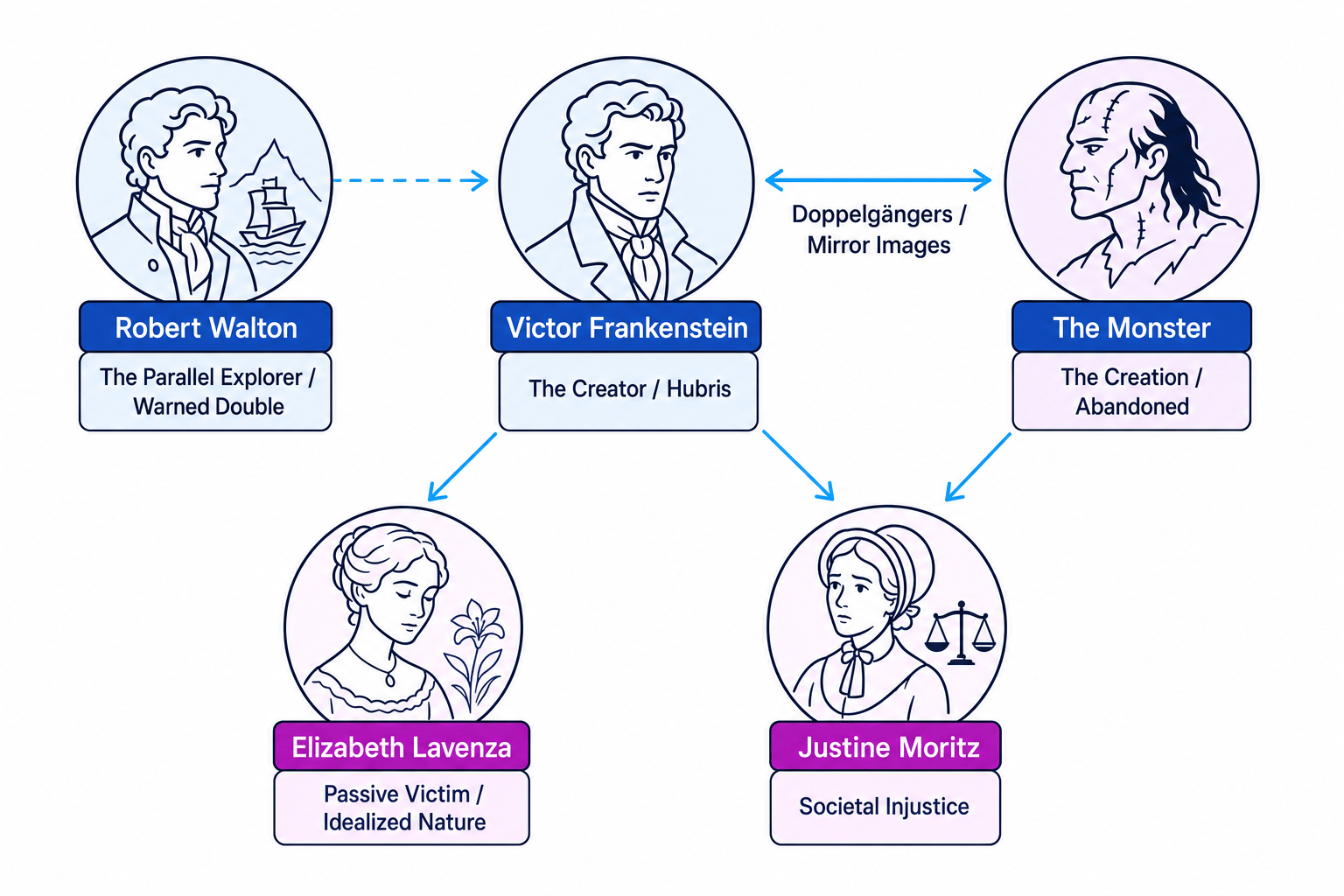
Robert Walton: The Mirror Image
Walton is the Arctic explorer whose letters home to his sister, Margaret Saville, frame the entire novel.
- The Parallel Ambition: Walton is also an overreacher, seeking to discover a northern passage to the Pacific and unlock the "wondrous power which attracts the needle." He is willing to sacrifice his crew's safety for his own glory.
- The Warning Received: Walton acts as a warning system for the reader. By listening to Victor's tragic tale, Walton learns the danger of unchecked ambition. Unlike Victor, Walton ultimately decides to turn his ship around and preserve the lives of his men, showing that redemption and restraint are possible.
The Female Characters: Passive Victims of Male Ambition
Elizabeth Lavenza, Justine Moritz, and Caroline Beaufort are often criticized as passive, idealized figures. However, Shelley (the daughter of pioneering feminist Mary Wollstonecraft) deliberately uses them to highlight the destructive nature of unchecked male ambition.
- Elizabeth Lavenza: She represents domestic harmony, love, and the beauty of nature. Victor views her as his "possession" ("looked upon Elizabeth as mine—mine to protect, love, and cherish"). Her murder on their wedding night is the ultimate consequence of Victor's attempt to create life without a woman.
- Justine Moritz: Framed and executed for the murder of William Frankenstein, Justine represents the failure of patriarchal institutions (the justice system and the church) to protect the vulnerable.
Character Relationships Map
The relationships in Frankenstein are highly symmetrical. Use the diagram below to visualize how these characters connect, mirror, and contrast with one another.
Analyzing Characterization (Worked Example)
In your GCSE exam, you must demonstrate the ability to analyze a specific passage or quotation closely, linking the writer's methods to characterization and broader thematic contexts.
Analyzing Victor's Hubris through Language
Task: Read the following quotation from Chapter 4, where Victor describes his state of mind while creating the Monster. Explain how Shelley presents Victor’s character and his relationship with nature.
"I seemed to have lost all soul or sensation but for this one pursuit... I pursued nature to her hiding-places... My limbs now tremble, and my eyes swim with the remembrance; but then a resistless and almost frantic impulse urged me forward; I seemed to have lost all soul or sensation but for this one pursuit."
Step-by-Step Analysis:
-
Identify the core character trait and link to theme (AO1): Acknowledge that this quote illustrates Victor’s obsessive, consuming ambition and his detachment from his own humanity. It demonstrates his hubris as he attempts to dominate the natural world.
-
Select and analyze key language methods (AO2): Examine the personification of nature in the phrase "I pursued nature to her hiding-places." The verb "pursued" coupled with the gendered pronoun "her" suggests an aggressive, invasive conquest of a feminized nature. This represents Victor's attempt to bypass the natural, female-centered process of reproduction in favor of scientific, male-dominated mastery.
-
Examine physical and psychological symptoms (AO2): Analyze the phrase "lost all soul or sensation" and the physical reactions ("limbs now tremble, and my eyes swim"). The sensory deprivation highlights how Victor's pursuit of unnatural knowledge cuts him off from his moral compass ("soul") and the real world ("sensation"). The physical trembling emphasizes the psychological trauma and sickness caused by violating natural boundaries.
-
Contextualize the characterization (AO3): Link this to the Romantic anxiety surrounding the Scientific Revolution and the Enlightenment. Shelley uses Victor's frantic, sickly state to warn her 19th-century readers that separating intellect from emotion and the sublime beauty of nature leads to physical and moral decay.
Treating the Monster as a Mindless Beast
Many students write about the Monster as if he is a mindless, unfeeling killer (often influenced by popular movie adaptations). In the novel, the Monster is highly articulate, deeply philosophical, and emotionally sensitive. When writing about him, always emphasize his capacity for language, empathy, and intellectual thought to show the examiner you have read the actual text.
Quoting the Monster's Rhetoric
When quoting the Monster, look for his use of balanced, formal, and elevated sentence structures. He speaks in a highly refined style that mirrors the King James Bible and John Milton’s Paradise Lost. This sophisticated speech makes his abandonment by Victor and rejection by society seem even more tragic and unjust.
In the exam
When writing a character essay for AQA GCSE English Literature, use the following structural strategies:
- Introduction: Start with a thesis statement that defines the character not as a real person, but as a literary construct. State clearly why Mary Shelley created them (e.g., "Shelley constructs the character of Victor Frankenstein to warn her contemporary audience of the dangers of unchecked scientific ambition and the neglect of parental duty.")
- Track the character's development: Ensure your essay has a chronological narrative. Show how the character changes from the beginning to the middle and end of the novel (e.g., Victor's transition from ambitious student to terrified creator, and finally to a broken, vengeful shell of a man).
- Analyze language, structure, and form (AO2): Identify specific language devices (such as religious imagery, gothic conventions, or pathetic fallacy) and structural choices (such as the epistolary frame narrative of Walton's letters) that Shelley uses to shape our perception of the characters.
- Integrate context naturally (AO3): Never write a separate "context paragraph." Instead, weave context directly into your character analysis. Link Victor’s ambitions to early 19th-century scientific developments (like Galvanism) and the Monster's suffering to social contract theories (like Rousseau’s ideas on the natural innocence of man).
Check yourself
- Why is it significant that Robert Walton ultimately decides to abort his voyage to the North Pole, whereas Victor refuses to give up his pursuit of the Monster?
- How does the Monster’s self-comparison to both Adam and Satan illustrate his psychological conflict?
- In what ways do the deaths of William, Justine, and Elizabeth represent the consequences of Victor’s actions rather than just the Monster's malice?
