Question 6
FThe graph shows the melting points and boiling points of four Group 7 elements.
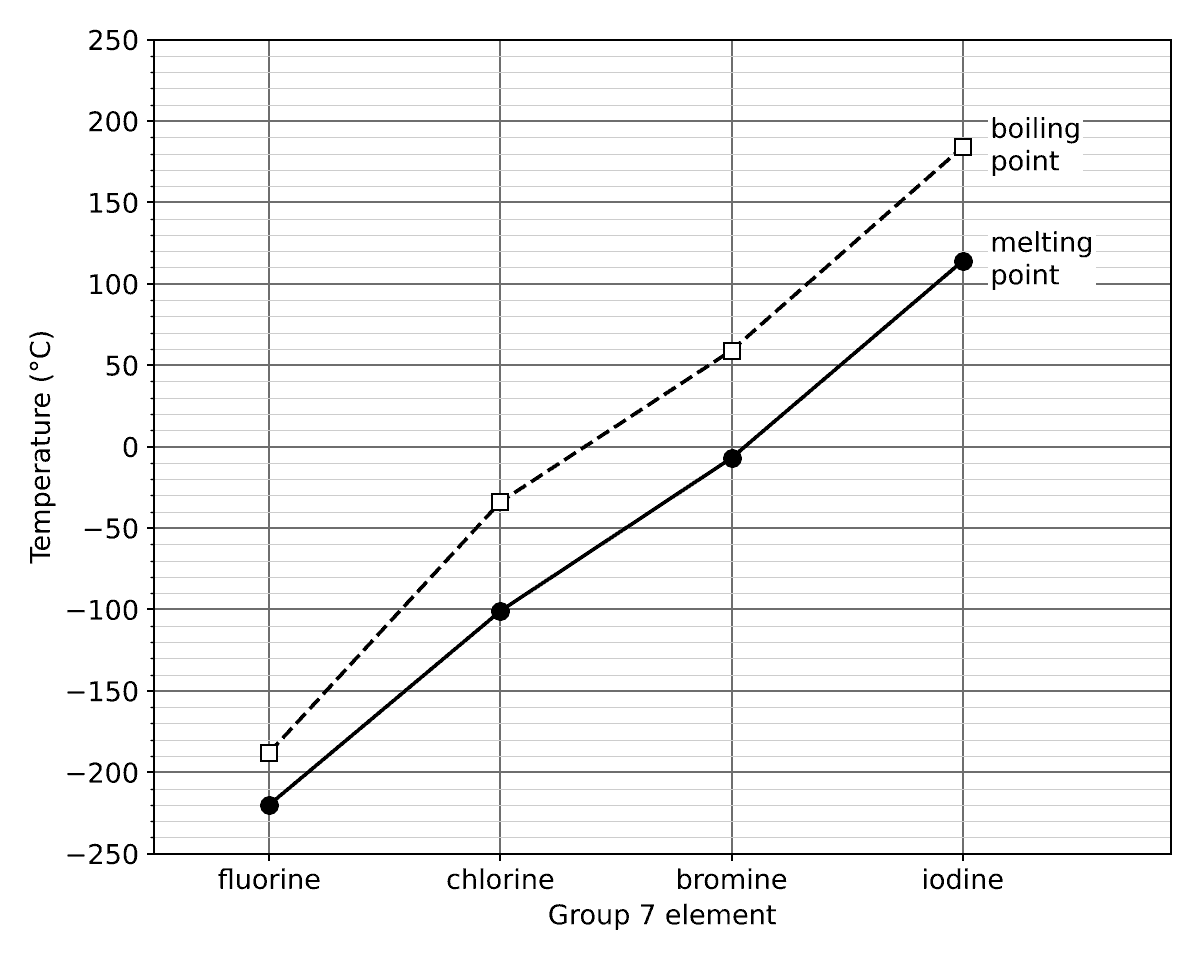
Which row shows the state of each element at −50 ∘C-50\,^\circ\mathrm{C}−50∘C?
Fluorine: gas; Chlorine: gas; Bromine: liquid; Iodine: solid
Fluorine: gas; Chlorine: liquid; Bromine: solid; Iodine: solid
Fluorine: gas; Chlorine: liquid; Bromine: liquid; Iodine: solid
Fluorine: liquid; Chlorine: liquid; Bromine: solid; Iodine: solid
4.1 Predicting chemical reactions Questions
60 exam-style questions on OCR GCSE Chemistry 4.1 Predicting chemical reactions, covering 4.1.1 Properties and trends in Groups 1, 7 and 0, 4.1.2 Properties of the transition metals, 4.1.3 Reactivity predicted from position in the Periodic Table, and 4.1.4 Reactivity of metals and the reactivity series. Each one has a worked solution and a mark scheme showing where the marks go.