Question 6
HThis question is about the Group 0 elements, the noble gases.
The table shows the densities of five noble gases at room temperature.
| Noble gas | Density at room temperature (g/dm³) |
|---|---|
| helium | 0.17 |
| neon | 0.84 |
| argon | 1.66 |
| krypton | 3.48 |
| xenon | 5.46 |
a.[2]
Explain why the noble gases are very unreactive. Use ideas about electrons.
b.[1]
The graph shows the boiling points of the same five noble gases.
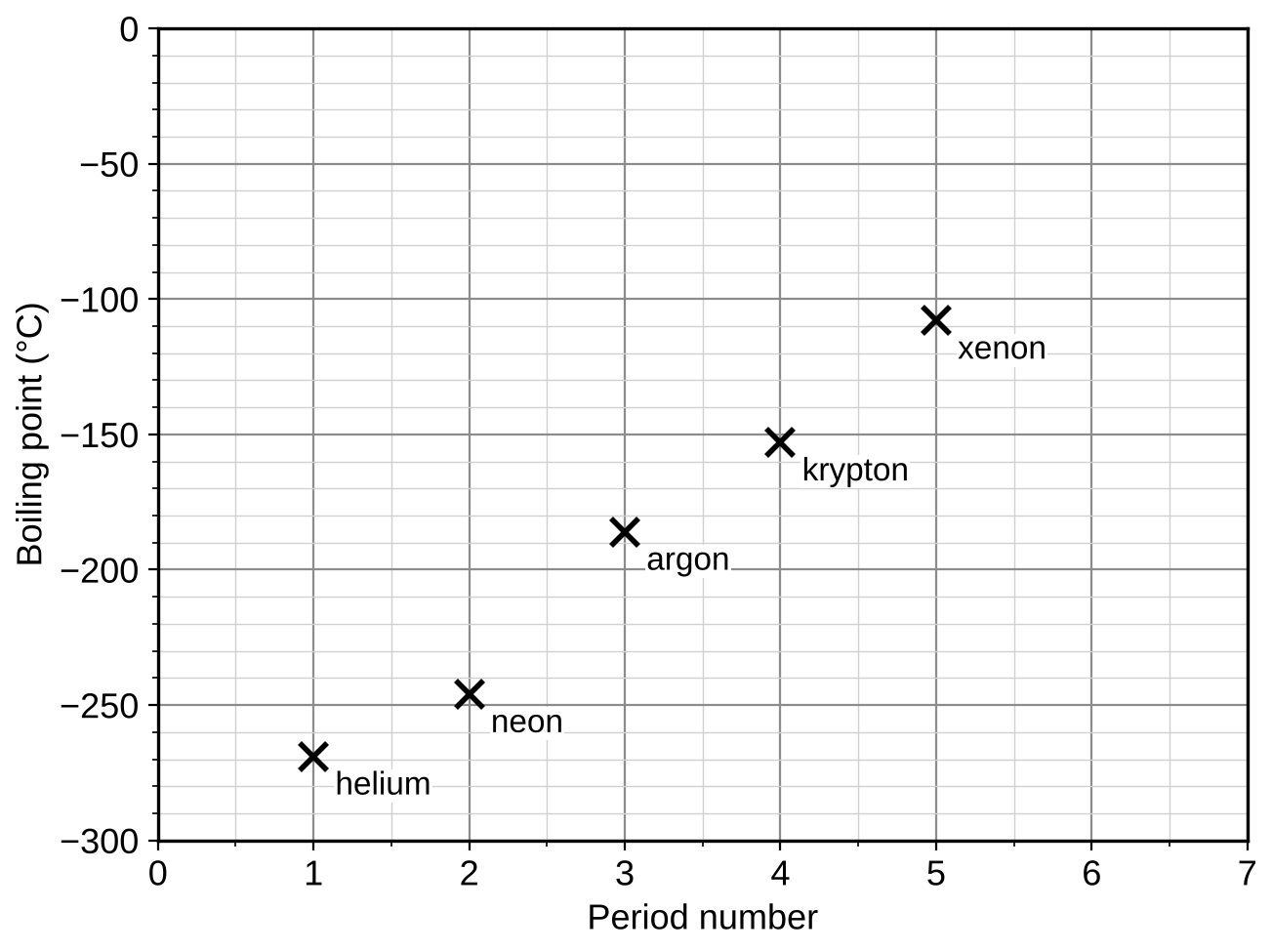
Radon is below xenon in Group 0. Radon is in Period 6.
Use the graph to predict the boiling point of radon.
c.i.[2]
The density of air at room temperature is 1.20 g/dm³.
Helium is used to fill weather balloons.
Give two reasons why helium is suitable. Use the table for one of your reasons.
c.ii.[1]
Argon is used to fill some types of light bulb, which contain a very hot metal filament.
Suggest why argon is used.
d.[2]
The noble gases exist as single atoms. Chlorine exists as molecules, Cl₂.
Explain this difference. Use ideas about electrons.
e.[2]
Explain why the boiling points of the noble gases increase down the group.
4.1 Predicting chemical reactions Questions
60 exam-style questions on OCR GCSE Chemistry 4.1 Predicting chemical reactions, covering 4.1.1 Properties and trends in Groups 1, 7 and 0, 4.1.2 Properties of the transition metals, 4.1.3 Reactivity predicted from position in the Periodic Table, and 4.1.4 Reactivity of metals and the reactivity series. Each one has a worked solution and a mark scheme showing where the marks go.