Question 5
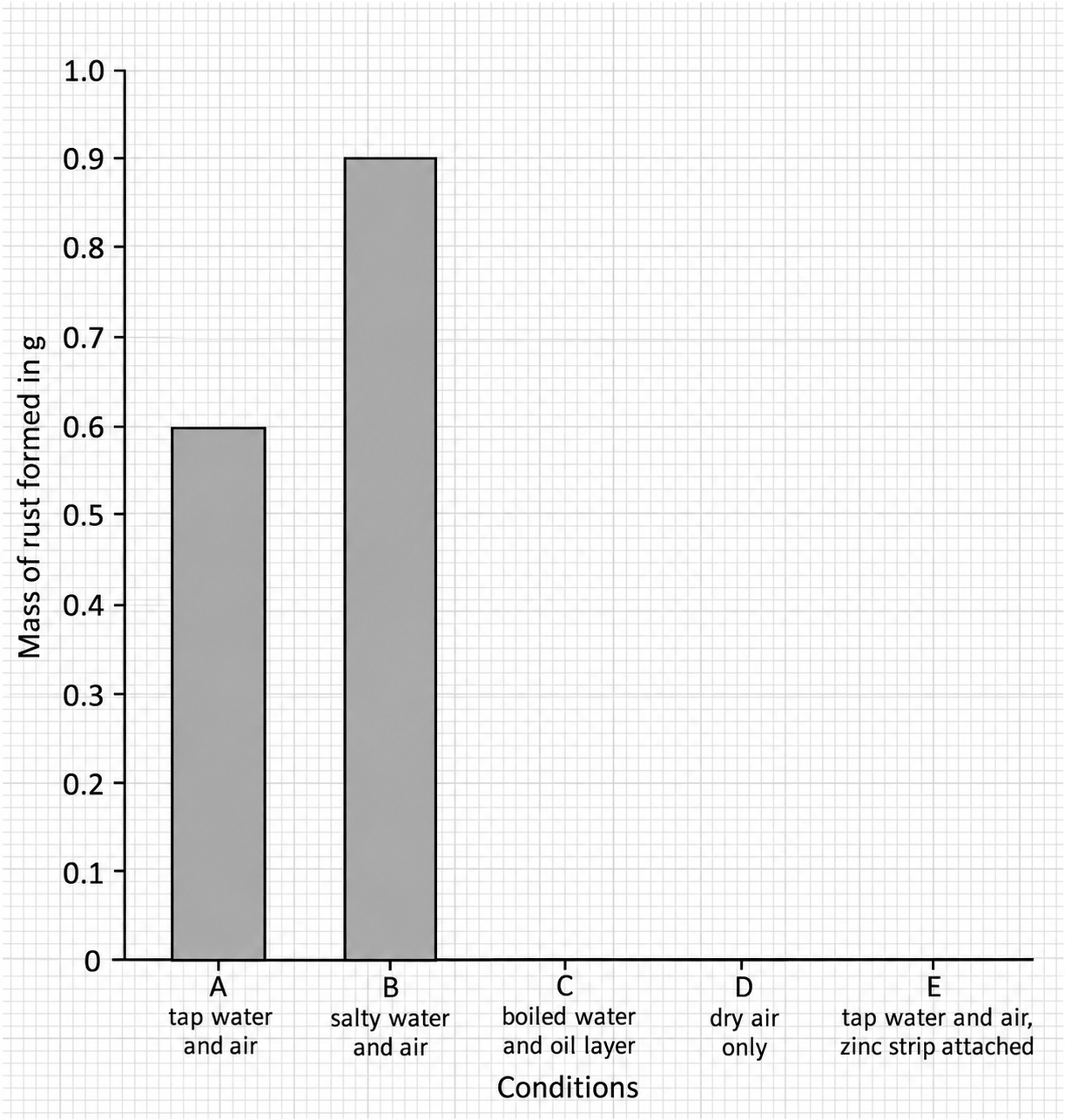
FA student investigated how quickly iron nails rusted under five different conditions, A to E. Each nail had the same mass at the start. After 14 days the student measured the mass of rust formed on each nail.
Figure: The mass of rust formed on identical iron nails kept under five different conditions for 14 days
a.[1]
Give the mass of rust formed on the nail in conditions B.
b.[2]
Use the results for conditions C and D to explain what the student can conclude about rusting.
c.[2]
Explain the result for conditions E.
d.[1]
Suggest why more rust formed in conditions B than in conditions A.
10.3 Using materials Questions
40 exam-style questions on AQA GCSE Chemistry 10.3 Using materials, covering 10.3.1 Corrosion and its prevention, 10.3.2 Alloys as useful materials, and 10.3.3 Ceramics, polymers and composites. Each one has a worked solution and a mark scheme showing where the marks go.