Question 9
HEthanol burns completely in oxygen. The figure shows the equation for the reaction using displayed formulae.
Figure: The equation for the complete combustion of ethanol, written using displayed formulae
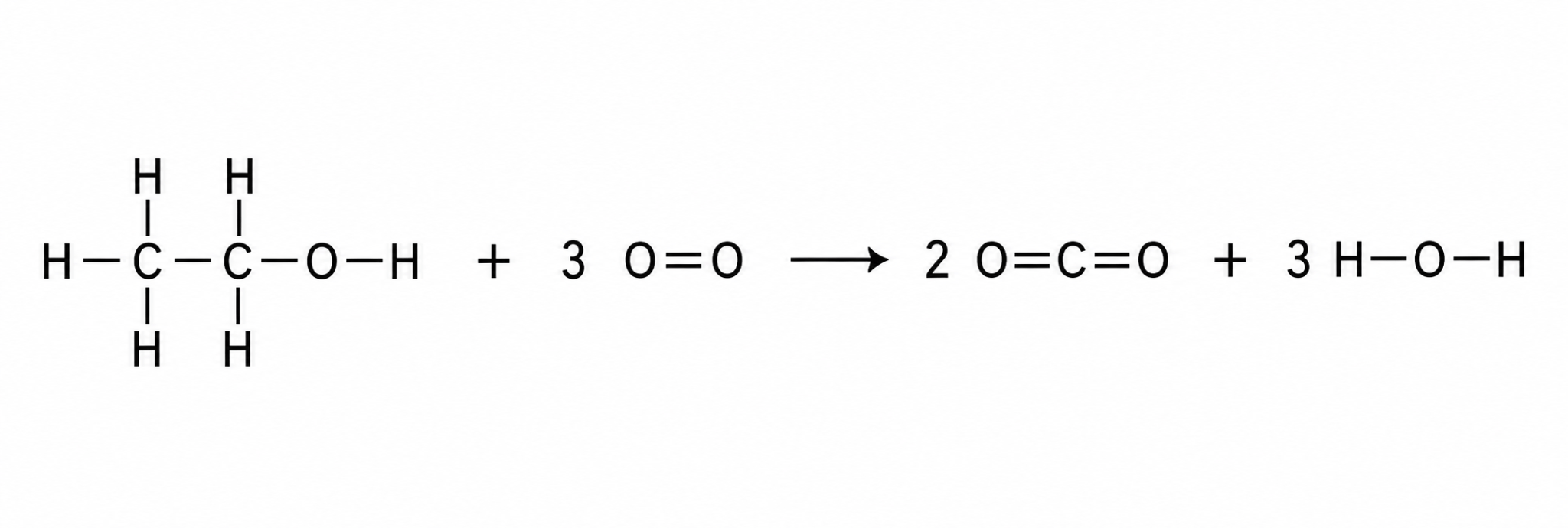
Table: The bond energies of the bonds in the reactants and in the products
| Bond | Bond energy in kJ/mol |
|---|---|
| C-H\text{C-H}C-H | 413 |
| C-C\text{C-C}C-C | 347 |
| C-O\text{C-O}C-O | 358 |
| O-H\text{O-H}O-H | 464 |
| O=O\text{O=O}O=O | 498 |
| C=O\text{C=O}C=O | 805 |
a.[2]
Use the figure and the table to calculate the energy needed to break all of the bonds in the reactants.
b.[2]
Calculate the energy released when all of the bonds in the products are formed.
c.[1]
Calculate the overall energy change of the reaction.
d.[1]
Give the evidence from your answer to part c that this reaction is exothermic.
5.1 Exothermic and endothermic reactions Questions
39 exam-style questions on AQA GCSE Chemistry 5.1 Exothermic and endothermic reactions, covering 5.1.1 Energy transfer during exothermic and endothermic reactions, 5.1.2 Reaction profiles, and 5.1.3 The energy change of reactions. Each one has a worked solution and a mark scheme showing where the marks go.