The product portfolio
Definition
Product portfolio: the full range of products a business sells, taken together rather than one at a time.
- Broadening the portfolio means adding products, which spreads risk, because a business selling one product has nothing left when that product reaches decline.
- Balancing the portfolio means holding products at different stages of their life rather than having everything bunched at the same stage.
- Because cash is limited, a business has to review the portfolio and decide which products deserve investment, which are left to earn quietly and which should be dropped.
Example
Unilever's portfolio runs from Marmite and PG Tips to Dove and Ben & Jerry's, so a poor year for one brand barely touches the size of the business.
The Boston matrix
Definition
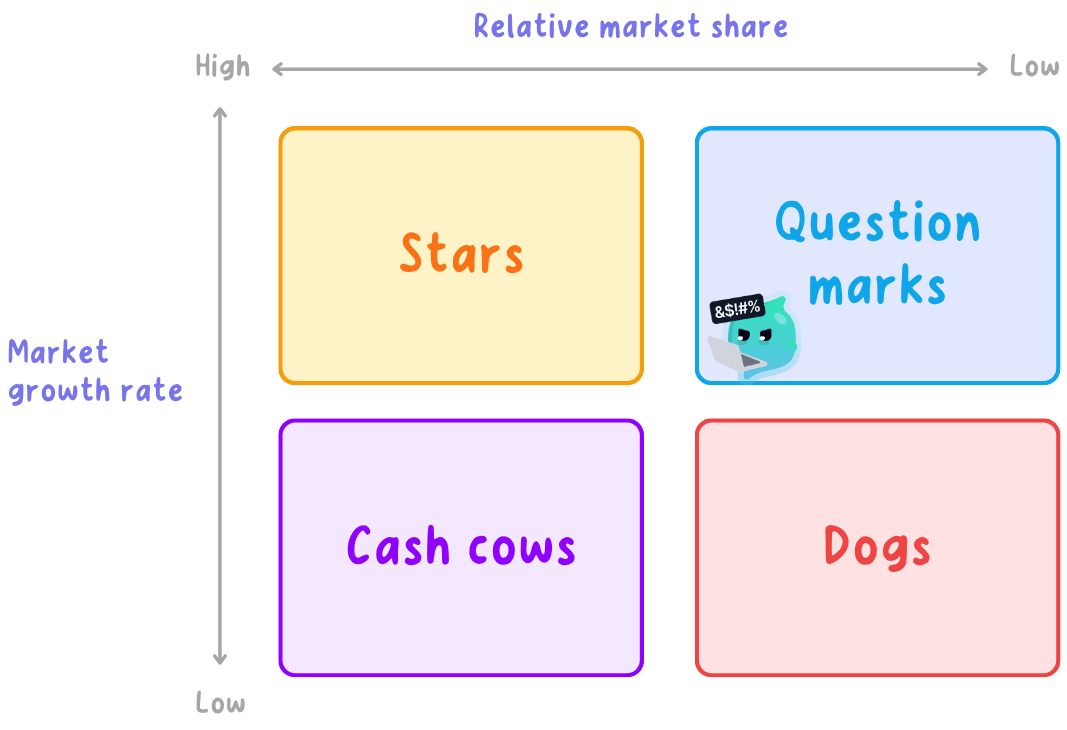
Boston matrix: a tool that places every product in a portfolio into one of four categories, using its market share and the growth of the market it sells in.
- The two measures are different things: market share is how big a slice of its market the product holds, while market growth is how fast the whole market is expanding.
- Stars: high market share in a fast-growing market, so they lead their market and sell strongly, but they swallow cash in advertising and extra capacity to keep up with the growth around them.
- Cash cows: high market share in a settled market that has stopped growing, and because they are well known and already paid for, they bring in far more cash than they need.
- Question marks, also called problem children: low market share in a fast-growing market, so they could become stars or could swallow money and never get there.
- Dogs: low market share in a market going nowhere, so they earn little and there is no growth left to win.
Common Mistake
- Both stars and cash cows have a high share, and both question marks and dogs have a low share, so within each pair it is the growth of the market that separates them.
- On the diagram the share axis runs from high on the left to low on the right, the opposite way round to most graphs, so read the labels before you place a product in a box.
- A cash cow is not a product with falling sales, it is a market leader whose market has simply stopped expanding.
Working out market share
- Market share is the product's own sales expressed as a percentage of the sales of the whole market, and the formula is not given to you, so learn it.
- High and low are judged against the biggest rival rather than against a fixed figure, so a 20% share is high in a market split between many small brands and low in one where a rival holds 60%.
Example
- A chocolate maker sells £48 million of its new plant-based bar in a market worth £600 million.
- An 8% slice is small, so with the plant-based market growing quickly this bar is a question mark, and the owners must decide whether to spend heavily on advertising and shelf space to build the share or drop it before more money goes in.
What a business does with each category
- Back the stars. Keep investing in promotion, distribution and capacity to hold the share while the market grows, because a star left alone loses its lead to a rival that is still spending.
- Milk the cash cows. Spend only what is needed to keep them selling, and use the cash they throw off to fund the stars and the question marks, which is what Cadbury's Dairy Milk does for the newer bars around it.
- Decide on the question marks. Either invest hard to build share while the market is still growing, or drop the product, because leaving it half-funded wastes money and wins nothing.
- Withdraw most dogs. Free up the shelf space, staff time and cash for something better, unless the product still covers its costs or completes a range customers expect to see.
Note
Products move between the categories over time, so a question mark that wins share becomes a star, and a star becomes a cash cow once its market stops growing.
Why a balanced portfolio matters
- A balanced portfolio has cash cows earning today and stars or promising question marks ready to earn tomorrow, so the money is generated in the same business that needs to spend it.
- A portfolio of nothing but cash cows has no future, because every one of those markets will eventually shrink and there is no replacement coming through.
- A portfolio of nothing but question marks runs out of cash, because they all need funding at once and none of them is paying for itself yet.
- Treat the matrix as a snapshot rather than an instruction, since it says nothing directly about profit and a product it calls a dog may still make money for its owner.
Exam technique
- Identify and explain the four categories of the Boston matrix wants both halves, so name the category and then give its share and growth pairing in the same sentence.
- When you classify a product from an extract, quote the evidence twice, once for its share and once for how fast its market is growing.
- If sales figures and a market total are both given, calculate the share rather than guessing whether it counts as high or low.
Self review
- What is a product portfolio?
- Which two measures does the Boston matrix use?
- Give the share and growth pairing for each of the four categories.
- Why does a business use the cash from a cash cow rather than reinvesting it in that product?
- Explain one problem a business would face if its whole portfolio were question marks.
