The stages of the product life cycle
Definition
Product life cycle: the stages a product passes through from first being developed to being withdrawn from sale, shown as a curve of sales over time.
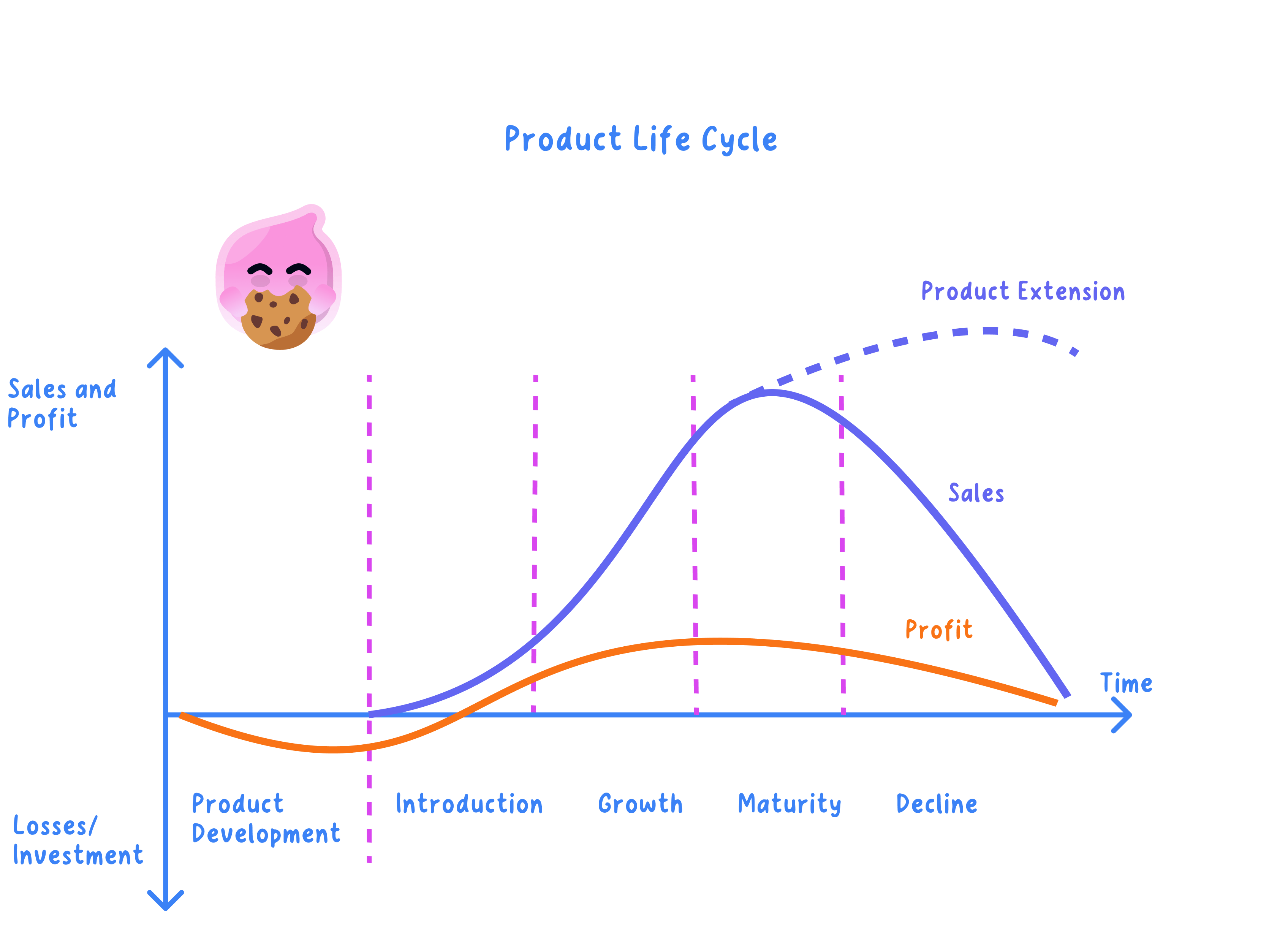
- The curve plots sales up the vertical axis against time along the horizontal axis, so the shape of the line is a picture of how demand for the product has changed: flat, then rising slowly, then steeply, then levelling off, then falling away. Most versions of the diagram add a second line for profit, which sits below zero while the product is still being developed.
- Research and development: the product is designed, built and tested before it goes on sale, so sales are zero. Diagrams sometimes label this stage product development. The business is spending on research, prototypes and machinery with nothing coming in, so cash flow is at its worst here.
- Introduction: the product is launched and sales begin, rising slowly because few customers know it exists. Heavy launch promotion means there is usually little or no profit yet, and many products fail at this point without ever growing.
- Growth: sales climb steeply as word spreads and more shops stock the product. Revenue rises fast and the product usually becomes profitable for the first time, which also attracts rivals into the market.
- Maturity: sales reach their peak and flatten out, because most customers who want the product already have it and competitors have filled the market. This is normally the most profitable stage, since development costs have been paid off and the product needs little introducing.
- Decline: sales fall as tastes change, technology moves on or a better rival arrives. The business then chooses between withdrawing the product and trying to extend its life.
- The stage a product has reached also drives the rest of the marketing mix, because price, promotion and place all shift as sales rise and fall, and the article on the integrated marketing mix follows those changes through.
Example
- A games console is developed for years behind closed doors, launches at a high price to gamers who queue for it, then sells in huge numbers for two or three Christmases.
- Sales flatten once most fans own one, so bundles with games and price cuts appear, and decline arrives the moment the next generation is announced.
Common Mistake
- Sales and profit are two separate lines, so the peak of the sales curve is not automatically the point at which the product earns the business most.
- Products move through the stages at wildly different speeds, since a fashion item can complete the whole curve in one summer while Heinz baked beans have sat in maturity for decades.
- Do not assume every product reaches every stage, because plenty never get past introduction.
Extension strategies
Definition
Extension strategy: an action taken to lift the sales of an existing product and delay its decline, so that its life in maturity is stretched out.
- Updating the packaging: a redesigned wrapper or bottle makes a familiar product look current and catches the eye again, which is why Cadbury has restyled the Dairy Milk wrapper repeatedly while the bar itself changed very little.
- Adding more or different features: new versions give existing owners a reason to buy again, so Nintendo added a bigger, brighter screen to the Switch four years after its launch.
- Changing the target market: aiming the same product at a different group reaches customers who never considered it, and it is the most powerful of the five because it finds a whole new source of demand.
- Advertising: a fresh campaign brings attention back to an ordinary product, which is how Warburtons keeps sliced bread in shoppers' minds with adverts built around well-known faces.
- Reducing the price: a lower price brings in customers who would not pay the old one, which is why Ford discounted the last Fiestas heavily before production ended in 2023, although every price cut takes profit off each sale.
- Timing decides how well any of them work, because an extension launched while the product is still selling well holds the curve up, whereas one launched after sales have collapsed is trying to revive a product customers have already left.
Example
- Lucozade was sold for decades as a drink for people recovering from illness, and sales faded as fewer households kept it in the cupboard.
- Repositioning it as a sports energy drink, with new bottles and athletes in the advertising, changed the target market and sent sales climbing for years afterwards.
When an extension strategy works
- The curve is not destiny, because a well-judged extension bends maturity or early decline back upwards, which is how Dairy Milk has stayed a leading bar for more than a century.
- Extension is worth the money when the brand is still respected and the market still exists, since there is demand left to win back and the business avoids the cost and risk of developing a replacement.
- It fails when the whole market is disappearing, so no amount of new packaging would have saved DVD players once households moved to streaming, and HMV lost the shelf space anyway.
- Match the strategy to the cause of the fall: if customers find the product dated, new features help, but if a rival is simply cheaper, a price cut may start a fight the business cannot win.
- Extension delays decline rather than cancelling it, so a business that relies on it alone eventually has nothing new to sell, which is why the portfolio also needs products in growth.
Exam technique
- Identify the stage of the life cycle the product has reached is answered from the sales figures or the graph, so quote what sales are doing before you name the stage.
- Flattening sales are maturity and only falling sales are decline, so growth that has slowed down is not yet decline.
- Research and development sits before any sales exist, so it is the stage most often left out when the five are listed.
Self review
- List the five stages of the product life cycle in order.
- At which stage is cash flow at its worst, and why?
- What does the shape of the curve tell you about demand between introduction and decline?
- Name the five extension strategies and give a real product for one of them.
- When would you advise a business not to bother extending a product's life?
