To investigate how dorsal coloration and patterning in the common lizard (Zootoca vivipara) affect both thermoregulation and predation risk by avian predators, researchers created plasticine lizard models with different patterns and placed them under controlled conditions.
On a warm day, the researchers placed the models under a heat lamp for 30 minutes and measured their internal temperature:
- Solid dark brown model: 39∘C39^\circ\text{C}39∘C
- Solid light green model: 29∘C29^\circ\text{C}29∘C
- Striped model (2 mm2\text{ mm}2 mm wide stripes): 34∘C34^\circ\text{C}34∘C
- Blotched model (10 mm10\text{ mm}10 mm wide spots): 36∘C36^\circ\text{C}36∘C
Do these temperature results support the hypothesis that patterned designs allow ectotherms to maintain a lower body temperature than solid designs? Explain your answer.
Suggest one experimental variable (concerning the physical setup of the models) that should be controlled when measuring their temperature, and explain why.
The researchers also placed 100 of each model type in a woodland habitat and recorded the number of avian predator attack marks on the plasticine models over 48 hours. A graph of their findings is shown below:
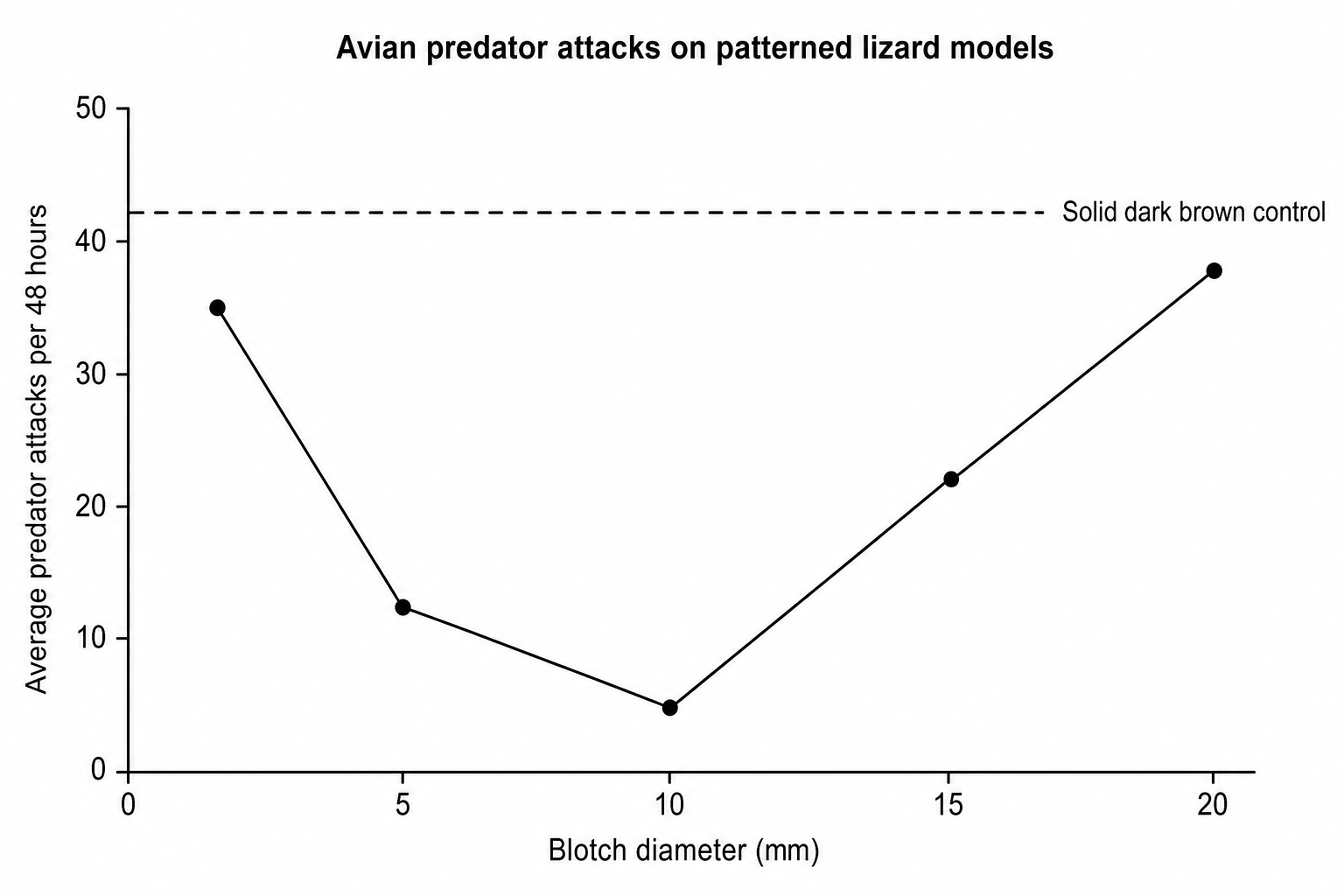
Describe what the graph shows about the link between blotch diameter and protection from avian predators.
Use the graph to suggest the optimal blotch diameter that should be selected for to minimize predation, and explain your choice.
Predation by birds is a major selective pressure. Use the theory of natural selection to explain how blotched patterning could have evolved in wild populations of these lizards.