A population of land snails (Cepaea nemoralis) lives in a dense woodland where the forest floor is covered in dark, damp leaf litter. Song thrushes actively hunt these snails by sight, preying heavily on individuals with light-coloured shells, while dark-shelled snails remain well-camouflaged.
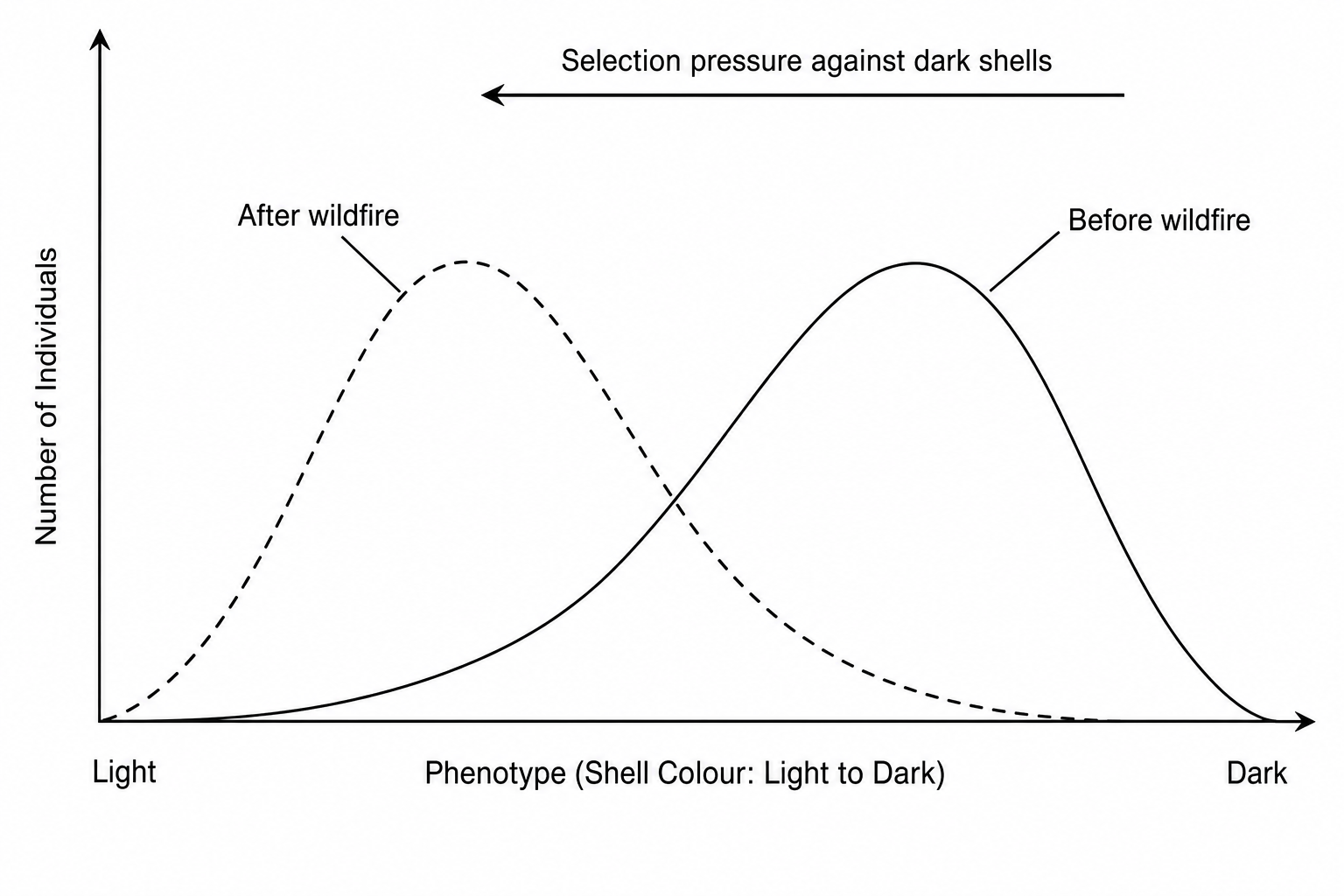
Following a severe wildfire, the tree canopy is destroyed, and the forest floor becomes covered in pale ash, making the dark-shelled snails highly visible to predators while light-shelled snails are now camouflaged. This process is illustrated in the selection curves below:
Which of the following best describes the resulting evolutionary process in this snail population?
Stabilising selection will operate, maintaining the initial high frequency of dark-shell alleles to preserve the population's overall genetic diversity.
Disruptive selection will occur, selecting against intermediate phenotypes and leading to a bimodal distribution of shell colours.
Directional selection will operate, where the change in environmental selection pressure favours the survival of light-shelled individuals, increasing the frequency of light-shell alleles in the gene pool.
Genetic drift will rapidly eliminate the dark-shell allele through random survival of individuals, independent of their camouflage.