Question 5
FCharles Darwin visited the Galápagos Islands in 1835. He collected finches from different islands.
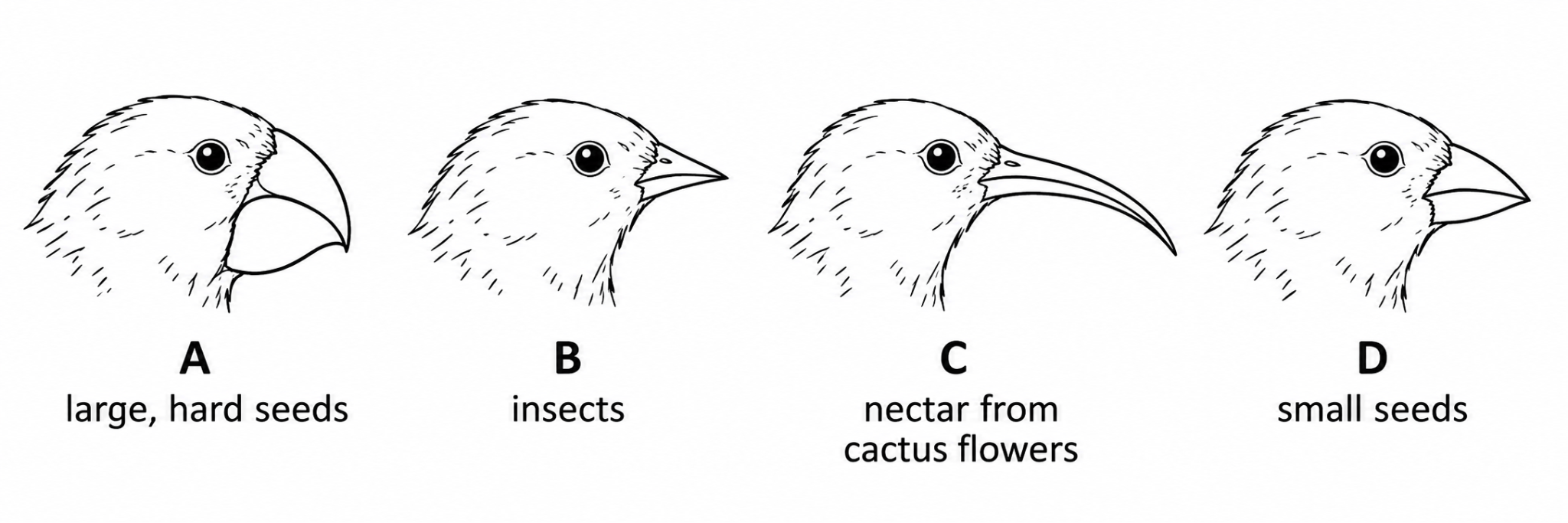
The Figure shows the heads of four types of finch, A, B, C and D, and the food each one eats.
Figure
a.[1]
Another scientist developed the theory of evolution by natural selection at the same time as Darwin, working on his own.
Name this scientist.
b.[1]
Suggest how the shape of the beak of finch A helps it to survive.
c.[3]
Scientists think that all four types of finch evolved from one type of finch that arrived on the islands from South America.
Explain how finches with different beak shapes could have evolved on different islands.
d.[2]
Darwin published his theory in 1859. Many people did not accept it at first.
Give two reasons why.
5.2 Natural selection and evolution Questions
122 exam-style questions on OCR GCSE Biology 5.2 Natural selection and evolution, covering 5.2.1 Genetic variation within a population, 5.2.2 Developments in classification systems, 5.2.3 How evolution occurs through natural selection, 5.2.4 Evolution as change over time, 5.2.5 Evidence for evolution, and 5.2.6 Darwin and Wallace. Each one has a worked solution and a mark scheme showing where the marks go.