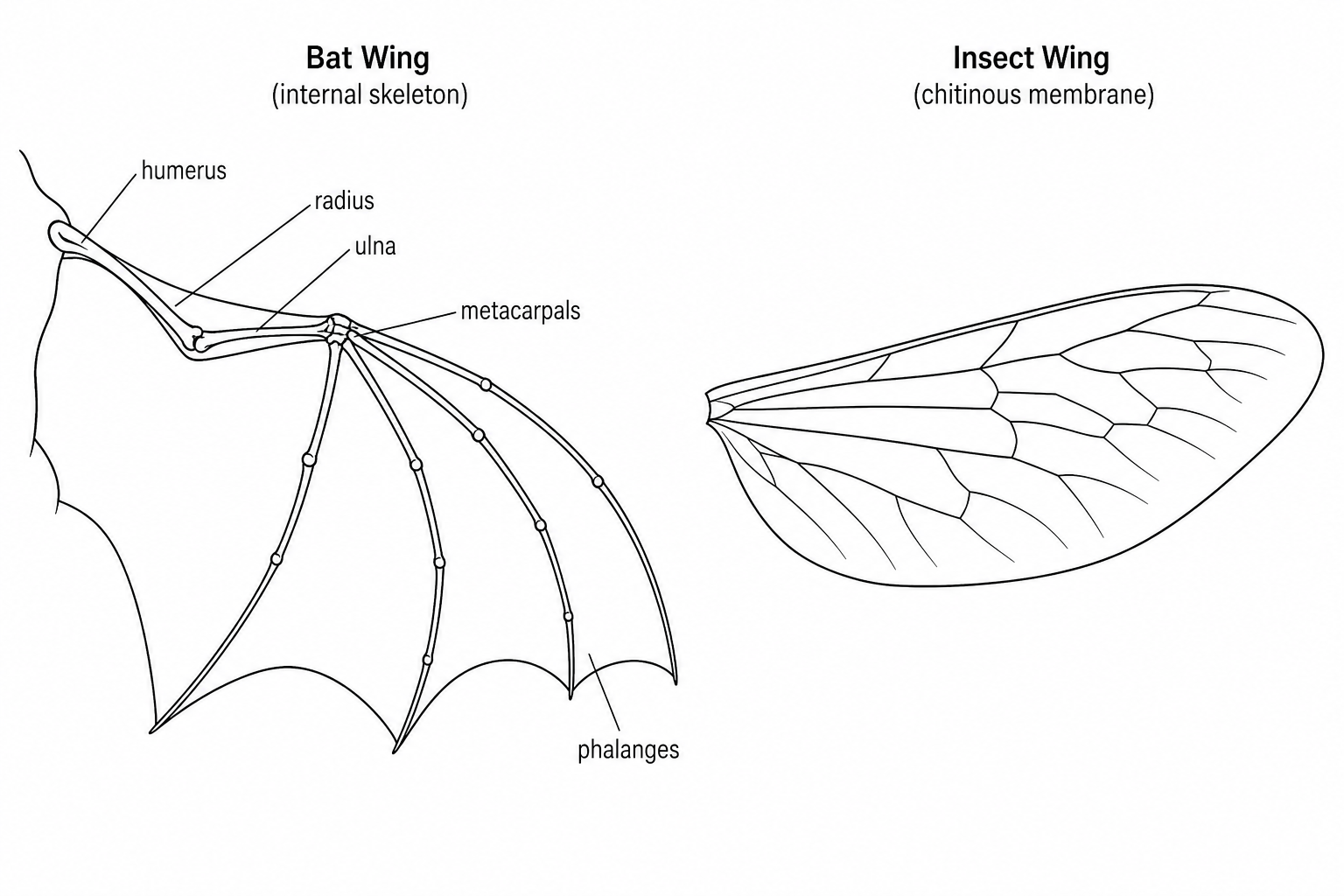
Biologists comparing the functional flight structures of a microbat (Myotis lucifugus) and a hawkmoth (Manduca sexta) observe that while both structures are highly adapted for powered flight, their developmental origins and anatomical structures are completely different, as shown in the diagram below.
Which of the following statements correctly explains this observation in the context of evolutionary mechanisms?
The wings of bats and hawkmoths are homologous structures, demonstrating that these diverse taxa share a recent common ancestor from which the genetic blueprint for flight was inherited.
The wings are analogous structures that arose through convergent evolution, where similar selection pressures in their environments selected for independent adaptations that serve a similar function.
The shared function of flight arises because similar niches directly induce directed mutations in the genetic code of both species, allowing them to rapidly evolve comparable adaptations.
The differences in internal anatomy indicate divergent evolution, where a common ancestor with a primitive flight organ split into two lineages that adapted to different ecological niches.