A group of students investigated the distribution and percentage cover of two halophytic plant species, Salicornia (glasswort) and Spartina (cordgrass), across a salt marsh. They recorded their data along a line perpendicular to the shoreline and plotted the results in the kite diagram below:
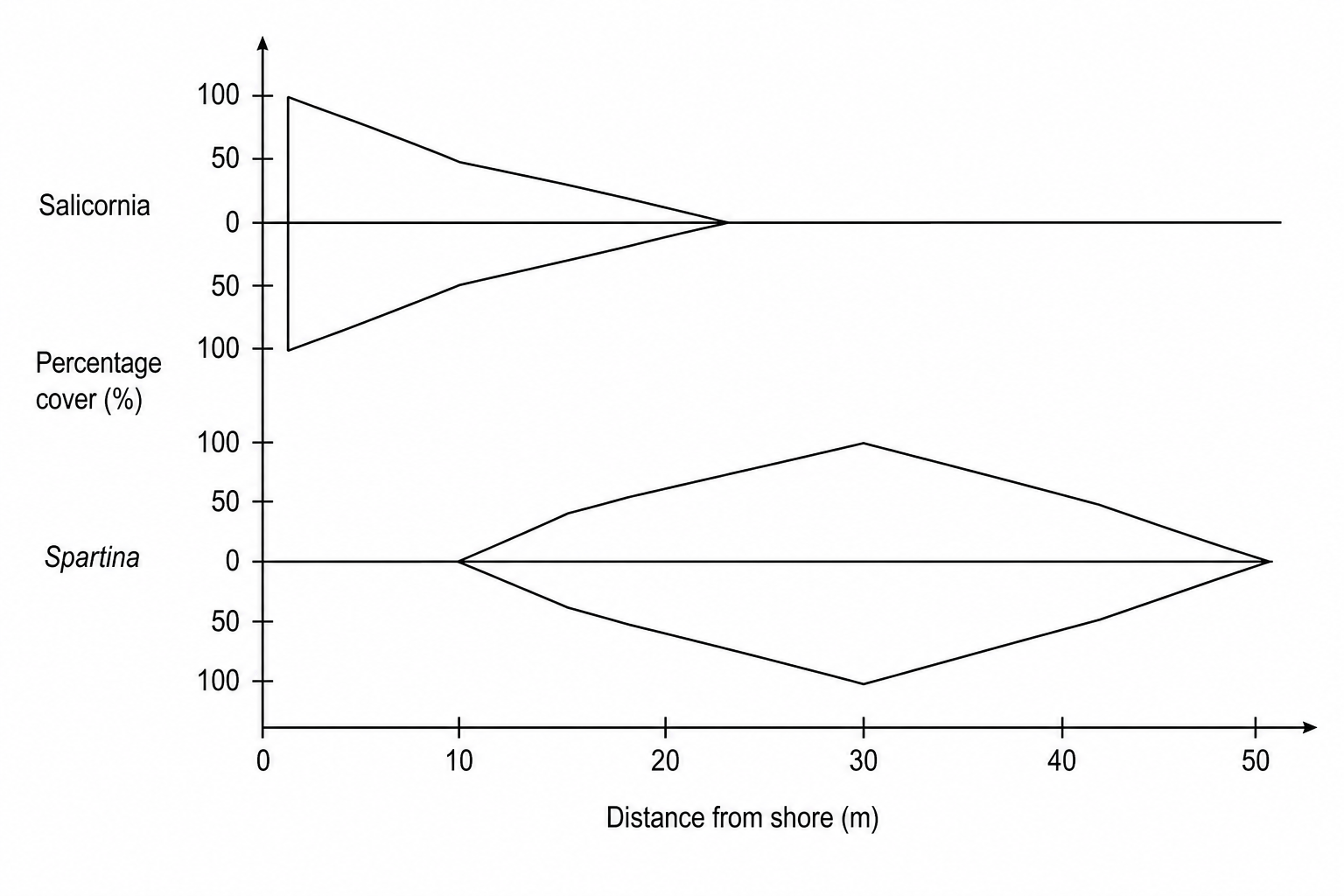
Which of the following describes the most appropriate field sampling methodology to collect quantitative data for constructing this diagram, and the correct ecological justification for its use?
Random sampling using 0.25 m20.25\text{ m}^20.25 m2 quadrats placed via coordinates from a random number generator across the whole marsh, because this avoids bias when analyzing species distribution across a gradient.
Systematic sampling using an interrupted belt transect, where 0.25 m20.25\text{ m}^20.25 m2 quadrats are placed at 5 m5\text{ m}5 m intervals along a line perpendicular to the shore, because this maps changes in percentage cover against a measured environmental gradient.
Systematic sampling using a line transect, where only species touching the continuous 50 m50\text{ m}50 m tape measure are recorded, because this direct touch method is the only way to calculate percentage cover for low-growing halophytic plants.
Stratified random sampling, where the salt marsh is split into two distinct 25 m25\text{ m}25 m zones and random coordinates are used in each zone, because it eliminates the need to record distance measurements from the shore.