The diagram below shows the typical sizes of several cell structures alongside the resolution ranges of a standard Light Microscope (LM) and a Transmission Electron Microscope (TEM).
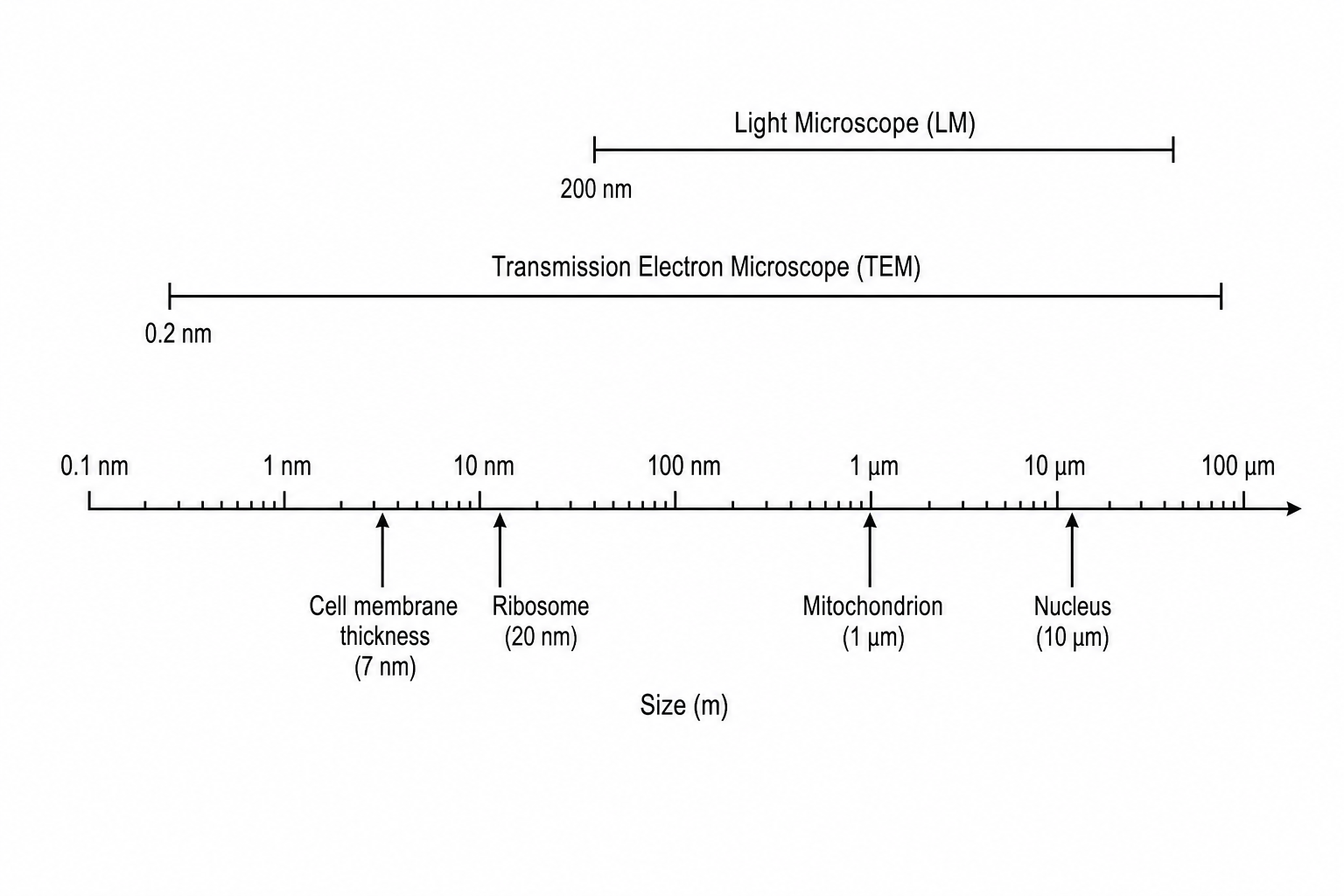
Based on the diagram and your knowledge of cell structures, which of the following statements correctly identifies which cell structures can be resolved by each microscope and explains the underlying physical principle?
The LM can resolve the cell membrane thickness because 7 nm7\text{ nm}7 nm is within the range of visible light, whereas the TEM cannot resolve ribosomes because their spherical structure prevents the alignment of the electron beam.
Both the LM and TEM can resolve the nucleus and mitochondrion, but only the TEM can resolve the ribosome and the cell membrane thickness, because the TEM uses an electron beam with a much shorter wavelength than visible light, resulting in a much higher resolution.
Only the TEM can resolve the nucleus and mitochondrion, whereas neither microscope can resolve the ribosome because its size (20 nm20\text{ nm}20 nm) is below the physical limit of magnification for electromagnetic radiation.
Both microscopes can resolve all four listed structures provided that the magnification of the LM is increased to ×100,000\times 100,000×100,000, because magnification is the primary factor that determines the limit of resolution.