Selective reabsorption of glucose occurs in the nephron as shown in the diagram below.
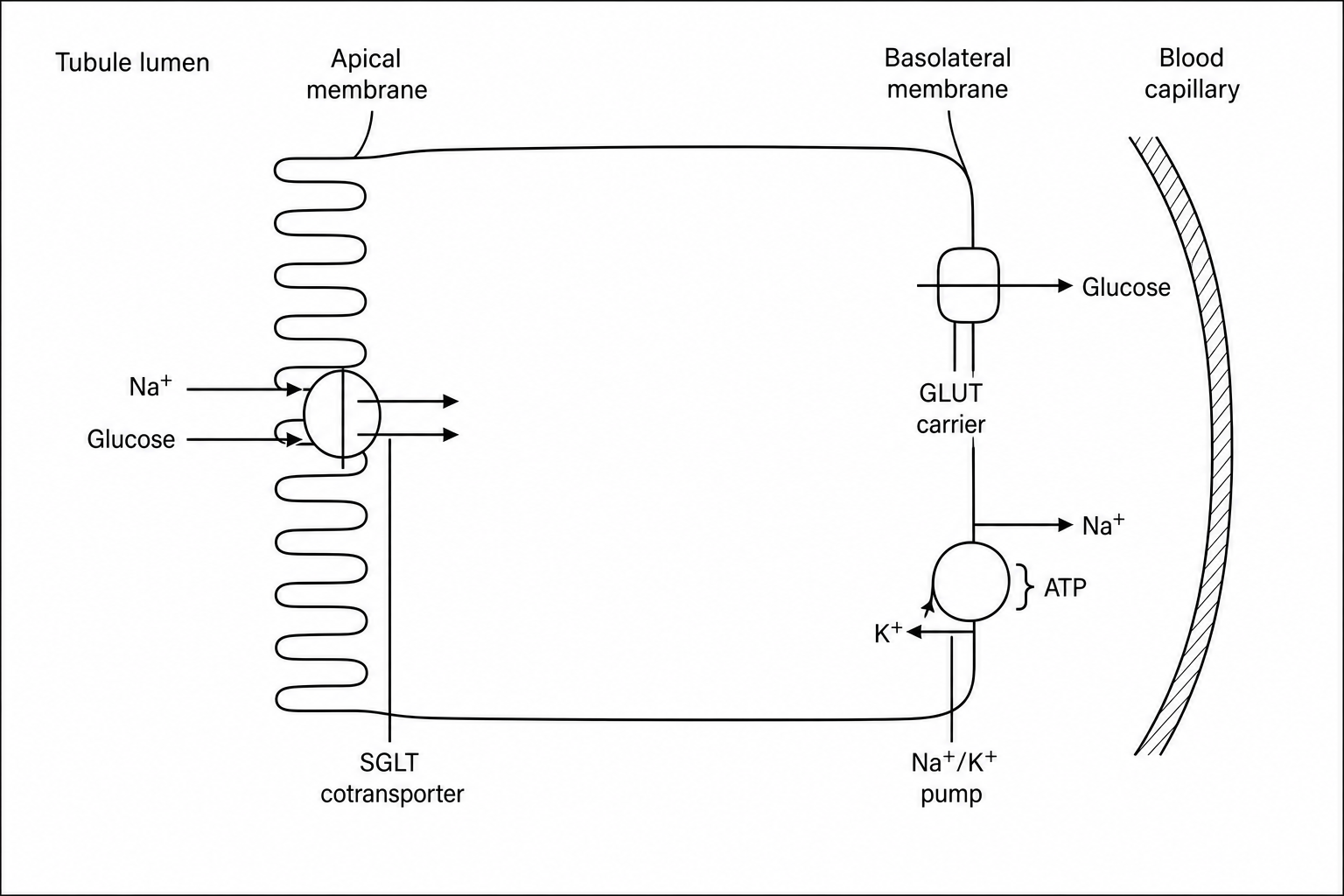
In a healthy individual, all glucose in the glomerular filtrate is reabsorbed. However, in patients with untreated Type 1 diabetes, glucose often appears in the urine (glucosuria). Which of the following statements correctly explains the mechanism of glucose reabsorption and why glucose appears in the urine of an untreated Type 1 diabetic?
Glucose is reabsorbed in the proximal convoluted tubule (PCT). In untreated Type 1 diabetes, the concentration of glucose in the filtrate exceeds the transport maximum (TmT_mTm) of the Na+\text{Na}^+Na+/glucose cotransporters (saturating them), meaning the excess glucose remains in the filtrate and is excreted in the urine.
Glucose is reabsorbed in the distal convoluted tubule (DCT). In untreated Type 1 diabetes, the absence of insulin prevents the activation of Na+\text{Na}^+Na+/glucose cotransporters on the apical membrane, meaning glucose cannot be reabsorbed and is excreted in the urine.
Glucose is reabsorbed in the proximal convoluted tubule (PCT). In untreated Type 1 diabetes, high blood glucose concentration causes the active transport of Na+\text{Na}^+Na+ by the Na+/K+\text{Na}^+/\text{K}^+Na+/K+ pump to reverse, driving glucose back into the tubule lumen.
Glucose is reabsorbed in the collecting duct. In untreated Type 1 diabetes, insulin deficiency prevents the insertion of glucose carrier proteins (GLUT) into the apical membrane of the collecting duct, leading to glucose in the urine.