The Nervous System Lets You React to Your Surroundings
Neurone
A nerve cell that carries information as fast electrical impulses; a bundle of neurones is called a nerve.
- The nervous system enables you to react to your surroundings and coordinate your behaviour.
- Information travels as fast electrical impulses along cells called neurones.
- A bundle of neurones is called a nerve.
- Because impulses are so fast, you can respond to a change within a fraction of a second.
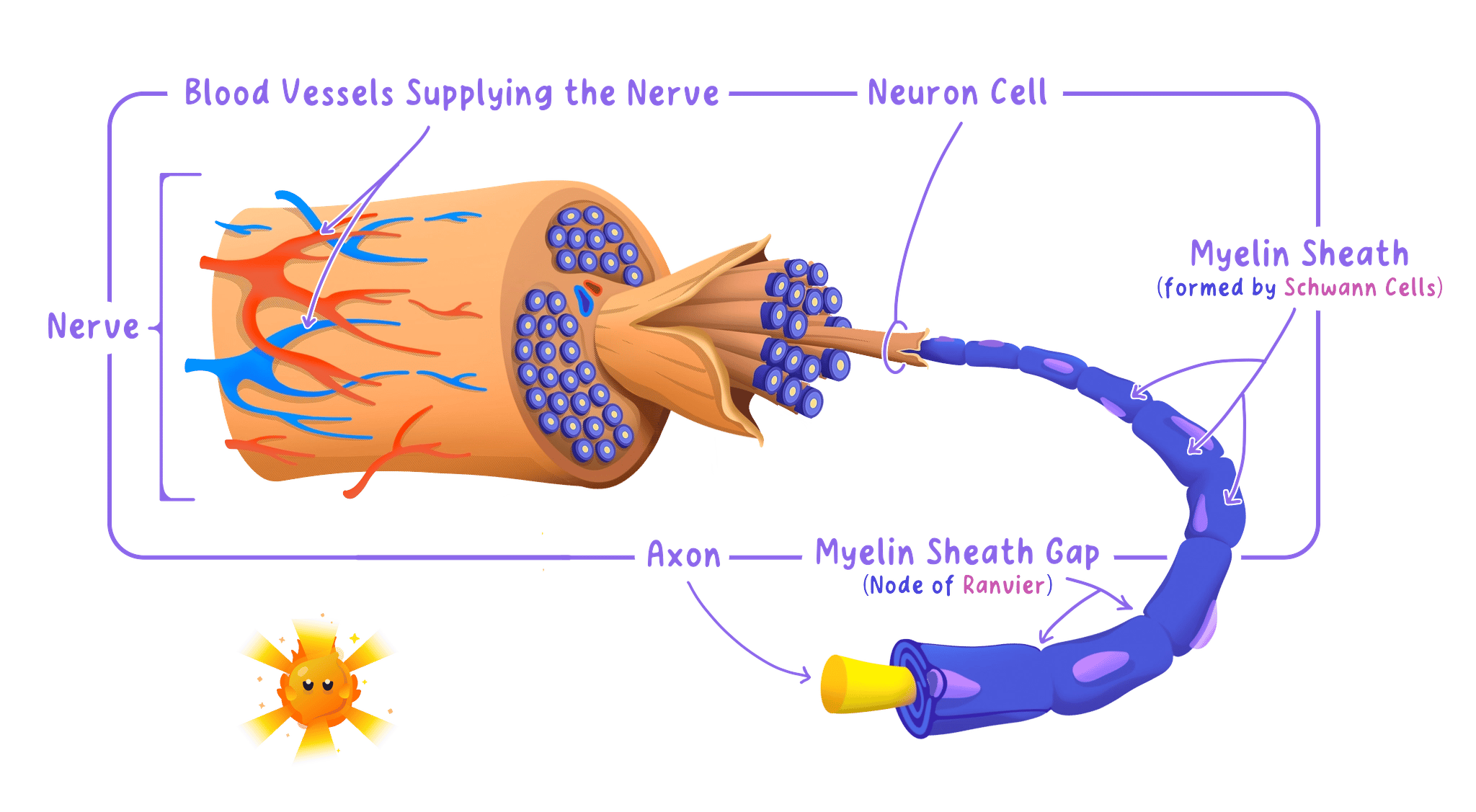
The nervous system uses fast electrical impulses so you can detect a change and respond to it almost at once.
The Central Nervous System Coordinates Everything
Central nervous system
The brain and spinal cord, which receive information from receptors and coordinate the body's response.
- The central nervous system (CNS) is the brain and the spinal cord.
- The CNS receives information from receptors and coordinates the body's response.
- The nerves connecting the CNS to the rest of the body make up the peripheral nervous system.
In humans the CNS is the brain and spinal cord; everything else is the peripheral nervous system.
Receptors Detect the Stimulus
Receptor
A cell that detects a stimulus, a change in the environment, and starts an electrical impulse; receptors are often grouped in sense organs.
- A receptor detects a stimulus, which is a change in the environment.
- Receptors are often grouped in sense organs: the eyes detect light, the ears detect sound and balance, the skin detects touch, pressure and temperature, and the nose and tongue detect chemicals.
- The receptor sends an impulse along a sensory neurone to the CNS.
Light receptor cells in your eyes detect a change in light and start an impulse that travels to your brain.
Effectors Carry Out the Response
Effector
A muscle or gland that carries out the response; muscles respond by contracting and glands by secreting hormones.
- The CNS sends impulses along motor neurones to effectors.
- Effectors are muscles, which respond by contracting, or glands, which respond by secreting hormones.
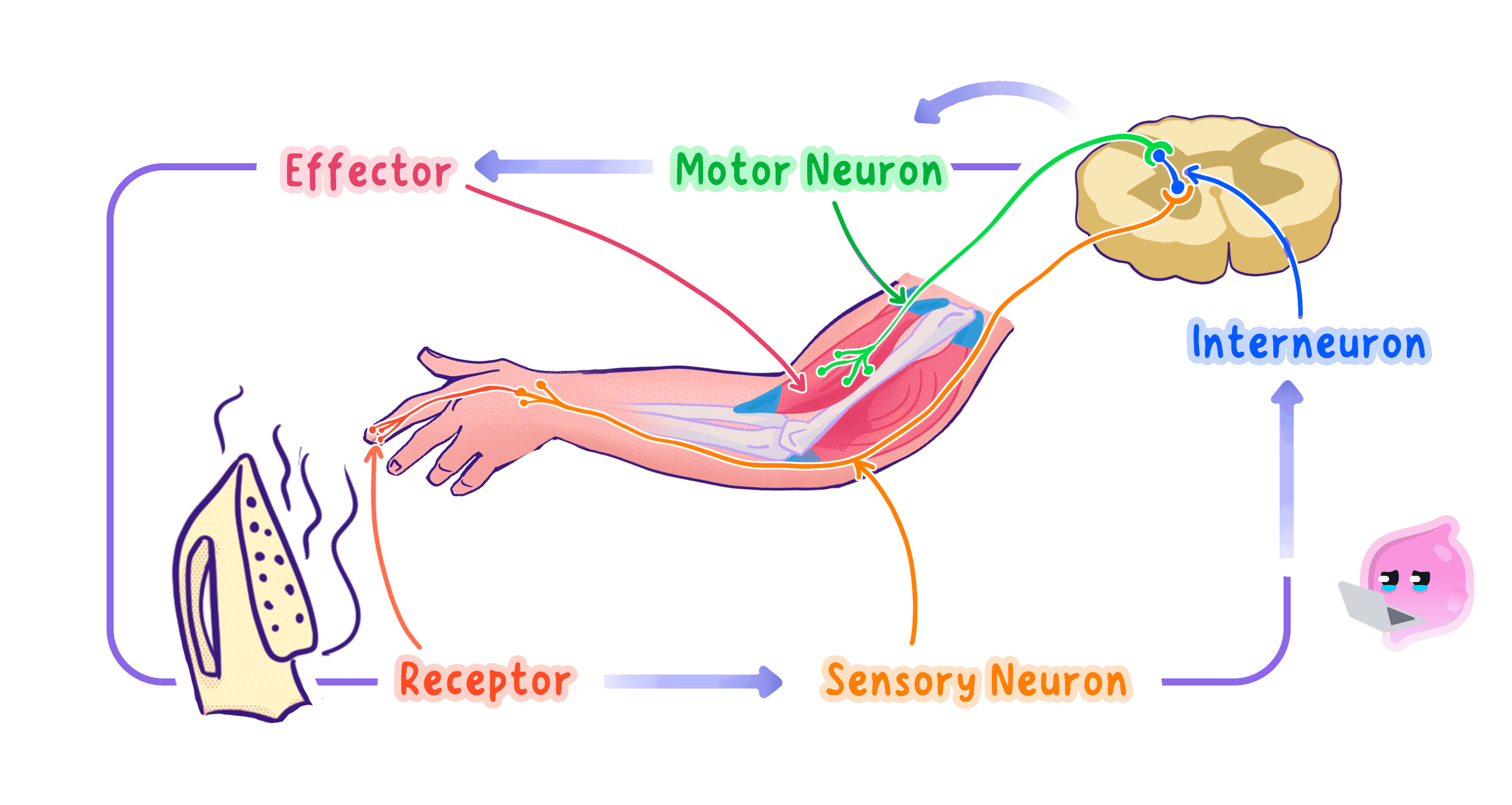
- stimulus→receptor→coordinator (CNS)→effector→response\text{stimulus} \rightarrow \text{receptor} \rightarrow \text{coordinator (CNS)} \rightarrow \text{effector} \rightarrow \text{response}stimulus→receptor→coordinator (CNS)→effector→response
Sensory neurones carry impulses to the CNS; motor neurones carry impulses from the CNS to the effectors.
Reflex Actions Are Fast and Automatic
Reflex action
A fast, automatic response that does not involve the conscious part of the brain, helping to protect the body from harm.
- Some responses are so fast they happen without you thinking; these are reflex actions.
- They are automatic and rapid and do not involve the conscious part of the brain.
- This makes them fast, which protects the body from harm, and also controls basic functions such as breathing.
Because a reflex skips the conscious brain, the time between the stimulus and the response is as short as possible.
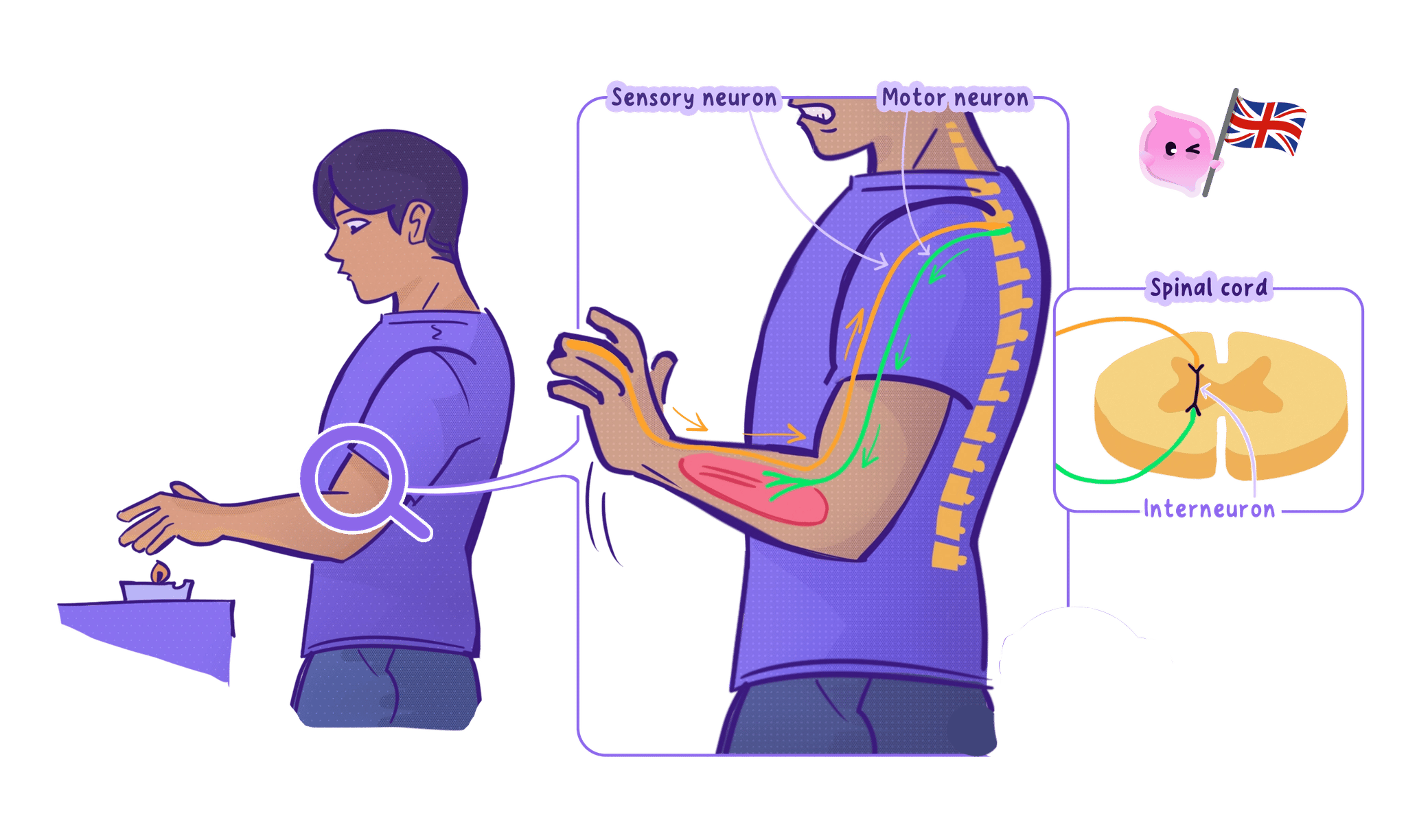
The Reflex Arc
Synapse
The tiny gap between two neurones, where the impulse is passed on by chemicals (neurotransmitters) that diffuse across.
- A stimulus, such as touching a hot object, is detected by a receptor in the skin.
- A sensory neurone carries the impulse to the CNS (the spinal cord).
- A relay neurone in the CNS passes the impulse to a motor neurone.
- The motor neurone carries the impulse to the effector (a muscle), which contracts to move the hand away.
- stimulus→receptor→sensory neurone→relay neurone→motor neurone→effector→response\text{stimulus} \rightarrow \text{receptor} \rightarrow \text{sensory neurone} \rightarrow \text{relay neurone} \rightarrow \text{motor neurone} \rightarrow \text{effector} \rightarrow \text{response}stimulus→receptor→sensory neurone→relay neurone→motor neurone→effector→response
How the synapse works
- Neurones do not touch; there is a tiny gap between them called a synapse.
- The electrical impulse cannot jump the gap, so a chemical (a neurotransmitter) is released.
- The chemical diffuses across the gap and starts a new electrical impulse in the next neurone; this diffusion is the slowest part of the arc.
- The impulse is electrical along a neurone but chemical across a synapse.
- Learn the order of neurones: sensory, then relay, then motor.
Investigating Reaction Time
- Person 1 rests their arm on a table with their hand over the edge; person 2 holds a ruler with 0 cm between person 1's thumb and finger.
- The ruler is dropped without warning and caught as quickly as possible; the distance fallen is recorded.
- The further down the ruler is caught, the slower the reaction time; repeat and find a mean.
- Change one factor, such as caffeine or background noise, and keep control variables the same (same hand, same ruler, same height).
- A conversion table turns the distance into a reaction time; using a computer is more precise as it removes human error.
Interpreting Reaction-Time Data
- Results are often shown in tables or graphs that you may be asked to read and interpret.
- Calculate a mean, leaving out any anomaly (a result far from the others).
- The shorter the reaction time, the faster the person reacted; times are often given in milliseconds for accuracy.
- What is the job of the nervous system, and what carries the information around it?
- What does the CNS consist of and what does it do?
- Put these in the correct order: effector, receptor, response, stimulus, coordinator.
- Name the three neurones in a reflex arc in order, and say what happens at a synapse.
- Why are reflex actions fast, and give one reason this is useful.
