Homeostasis Keeps Your Internal Environment Steady
Homeostasis
The regulation of the internal conditions of a cell or organism to keep them at the optimum level for function, in response to internal and external changes.
- Homeostasis is the regulation of the conditions inside a cell or organism to keep them at the level that works best.
- The conditions inside your body are its internal environment, and your organs cannot work properly if this keeps changing.
- Homeostasis holds these conditions at their optimum level, responding to changes that come from both inside and outside the body.
- It works at the level of the whole body and inside individual cells.
Homeostasis is a balancing act: it keeps your internal conditions steady enough for your cells to keep working, even as the world around you and inside you changes.
Why Homeostasis Matters for Enzymes and Cells
- Enzymes control all the reactions in a cell, and they only work at their best in a narrow range of temperature and pH.
- If conditions move away from the optimum, the enzymes work slowly or stop, so the cell cannot function.
- Because cells make up tissues and organs, keeping cell conditions right keeps the whole organism working.
- So homeostasis maintains the optimum conditions for enzyme action and for all cell functions.
This links back to enzymes: raise the temperature too far and enzymes are denatured, so keeping body temperature steady protects them.
The Conditions the Human Body Controls
- Three internal conditions in humans must be controlled.
- Blood glucose concentration, which rises after a meal and falls during exercise.
- Body temperature, which rises when you exercise and can fall in cold weather.
- Water levels, the water content of the body, which falls when you sweat in hot weather.
- The body must respond to these everyday changes to keep each condition at its optimum.
When you run, your muscles get hotter and use up glucose, and you lose water in sweat, so all three controlled conditions are challenged at once.
Control Systems Can Be Nervous or Chemical
- The internal environment is kept steady by automatic control systems that work without you thinking about them.
- Nervous responses use electrical impulses carried along neurones, so they are fast and short-lived.
- Chemical responses use hormones carried in the blood, so they are slower to start but usually last longer.
- A control system may use nervous responses, chemical responses, or both together.
The nervous system is the body's fast messenger and the hormonal system is the slower, longer-lasting one.
Every Control System Has Three Parts
Receptor
A cell that detects a stimulus, which is a change in the internal or external environment.
- Receptors are cells that detect a stimulus, a change in the internal or external environment.
- Coordination centres, such as the brain, spinal cord and pancreas, receive and process the information from the receptors.
- Effectors, which are muscles or glands, carry out the response that restores the optimum level.
- A muscle responds by contracting, while a gland responds by releasing a hormone.
- stimulus→receptor→coordination centre→effector→response\text{stimulus} \rightarrow \text{receptor} \rightarrow \text{coordination centre} \rightarrow \text{effector} \rightarrow \text{response}stimulus→receptor→coordination centre→effector→response
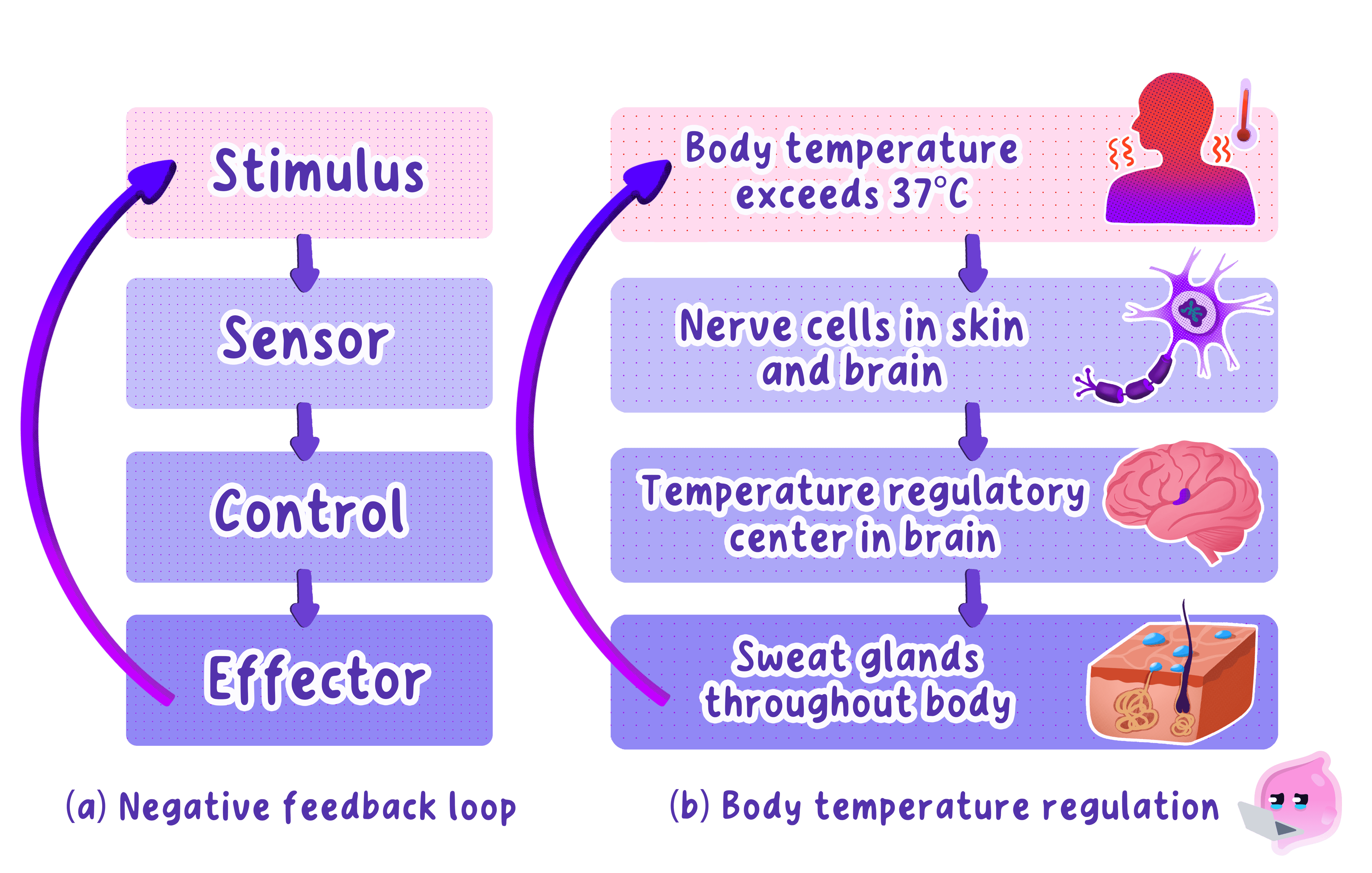
- What is meant by homeostasis?
- Why is keeping conditions steady important for enzymes?
- Name the three conditions homeostasis controls in the human body.
- Give one difference between a nervous response and a chemical response.
- State the job of a receptor, a coordination centre and an effector.
