5.2.2a The brain
The Brain Is Billions of Neurones Controlling Complex Behaviour
- The brain is part of the central nervous system and controls complex behaviour.
- It is made of billions of interconnected neurones.
- It has different regions that each carry out different functions.
Because different regions of the brain control different functions, damage to one region affects one particular function.
The Cerebral Cortex: Consciousness, Memory and Language
Cerebral cortex
The highly folded outer layer of the brain, responsible for consciousness, intelligence, memory and language.
- The cerebral cortex is the highly folded outer layer of the brain.
- It is concerned with consciousness, intelligence, memory and language.
The Cerebellum: Muscle Coordination and Balance
Cerebellum
The region at the back of the brain that coordinates muscular activity, movement and balance.
- The cerebellum sits at the back of the brain, underneath the cerebral cortex.
- It coordinates muscular activity, movement and balance.
Riding a bike smoothly, balancing and catching a ball all rely on the cerebellum coordinating your muscles.
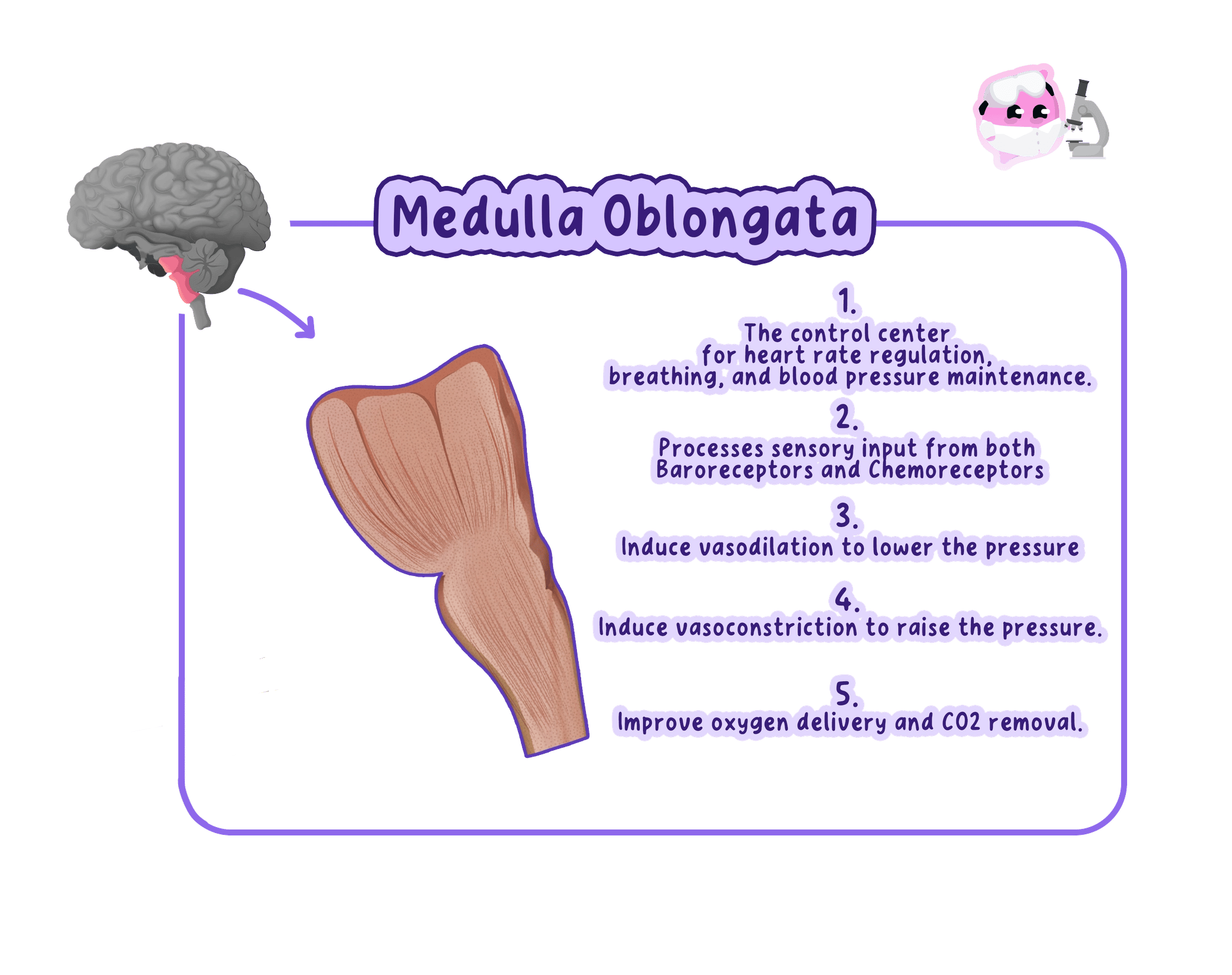
The Medulla: Unconscious Vital Functions
Medulla
The region of the brain that controls unconscious activities such as heart rate and breathing.
- The medulla controls unconscious activities such as heart rate and breathing.
- You do not have to think about these actions, which is why the medulla is vital for staying alive.
- Other regions have their own jobs too: the hypothalamus helps control body temperature and the pituitary gland releases hormones, both covered in other topics.
- What is the brain made of, and what does it control?
- Where is the cerebral cortex and what functions does it control?
- What does the cerebellum do?
- Name two activities controlled by the medulla.
5.2.2b The brain (Higher tier)
Mapping the Brain Is Hard but Possible
- The brain is extremely complex and delicate, and its regions cannot easily be studied in isolation.
- Even so, neuroscientists have mapped many regions to their functions using three main approaches.
This topic is Higher tier only.
Studying Patients With Brain Damage
- When part of the brain is damaged, scientists can match the change in behaviour or ability to the damaged region.
- This links a particular region to a particular function.
Phineas Gage survived an iron rod passing through part of his cerebral cortex, but his personality changed drastically, which helped map that region to social behaviour.
Electrically Stimulating the Brain
- Tiny electrodes can be used to give a small electrical stimulation to a region of the brain.
- The effect is observed, such as a movement or a feeling of hunger or fear, which reveals what that region does.
There are no pain receptors in the brain itself, so this can be done while a patient is conscious.
MRI Scanning
MRI scan
A magnetic resonance imaging scan that produces detailed images of the brain in a living person, showing which regions are active or damaged.
- An MRI scan uses magnetic fields to produce detailed images of the brain in a living person.
- It can show a damaged area, such as a tumour or the effects of a stroke.
- A functional MRI shows which regions are active during a task by detecting the increased blood flow to those regions.
MRI lets scientists watch a living brain at work without opening the skull, which is why it has transformed brain research.
Why Treating the Brain Is So Difficult
- The brain's complexity and delicacy make it very easy to damage and hard to repair.
- Drugs may not reach the brain because of the membranes surrounding it, and surgery is risky because it is not fully understood what every area does.
- Accidental damage can cause permanent problems with speech, movement or personality.
- When you evaluate a procedure, weigh the benefit (treating a disorder and improving quality of life) against the risk (permanent damage, made worse by our incomplete understanding).
- Give two reasons the brain is difficult to study and treat.
- How can studying patients with brain damage help map brain functions?
- What can be learned by electrically stimulating the brain, and why can it be done on a conscious patient?
- What is an MRI scan, and what does a functional MRI show?
- Give one benefit and one risk of carrying out a procedure on the brain.
