Question 4
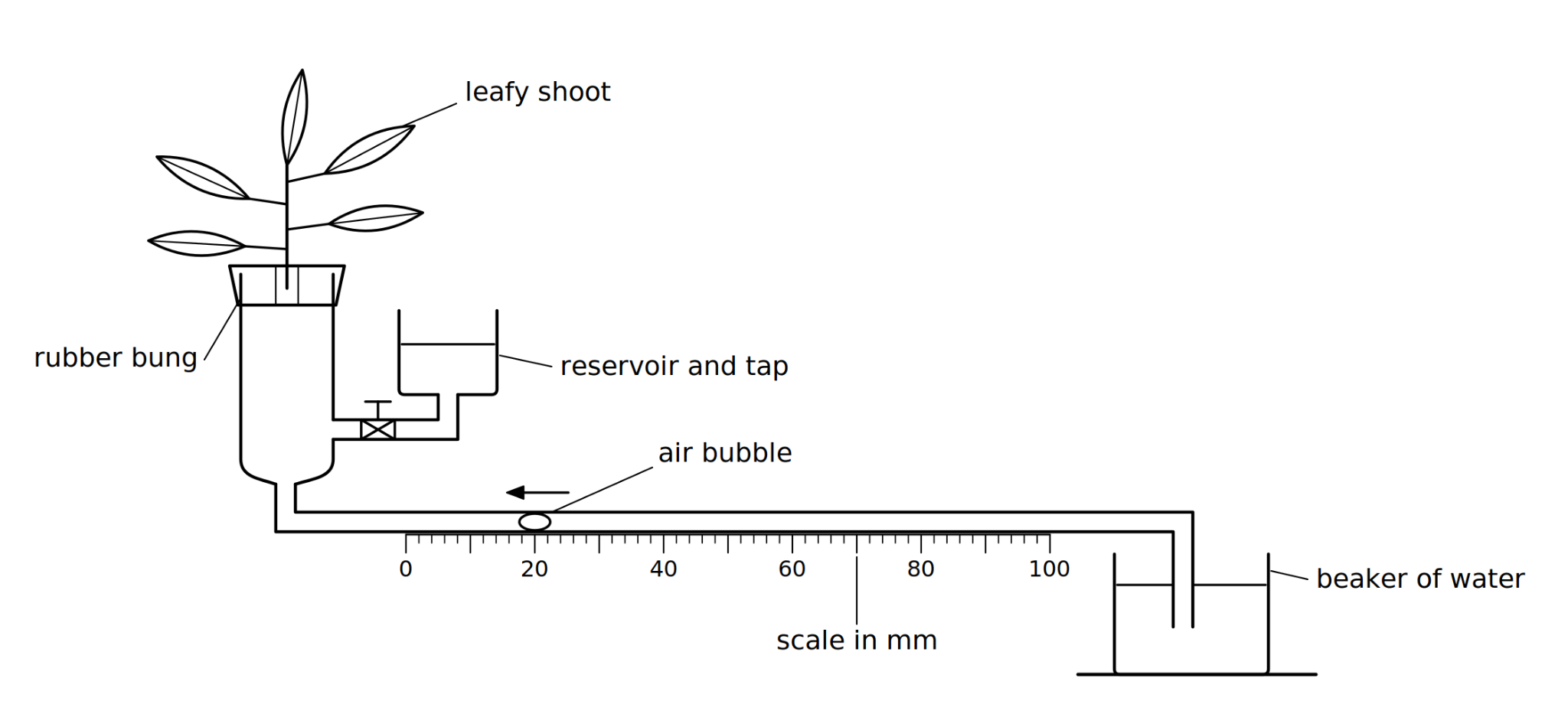
FA student used the apparatus in the figure to investigate the effect of air movement on the rate of water uptake by a leafy shoot. The student used a fan set at four different speeds.
Figure: A potometer used to measure the rate of water uptake by a leafy shoot
a.[1]
Name the independent variable in this investigation.
b.[2]
Give two variables the student should have kept the same.
c.[2]
The distance moved by the air bubble measures the rate of water uptake by the shoot. Explain why this is not the same as the rate of transpiration by the shoot.
d.[2]
At one fan speed the air bubble moved 48 mm in 12 minutes. The cross-sectional area of the capillary tube was 1.5 mm2. Calculate the mean rate of water uptake in mm3 per minute.
2.3 Plant tissues, organs and systems Questions
38 exam-style questions on AQA GCSE Biology 2.3 Plant tissues, organs and systems, covering 2.3.1 Plant tissues and 2.3.2 Plant organ system. Each one has a worked solution and a mark scheme showing where the marks go.