Question 3
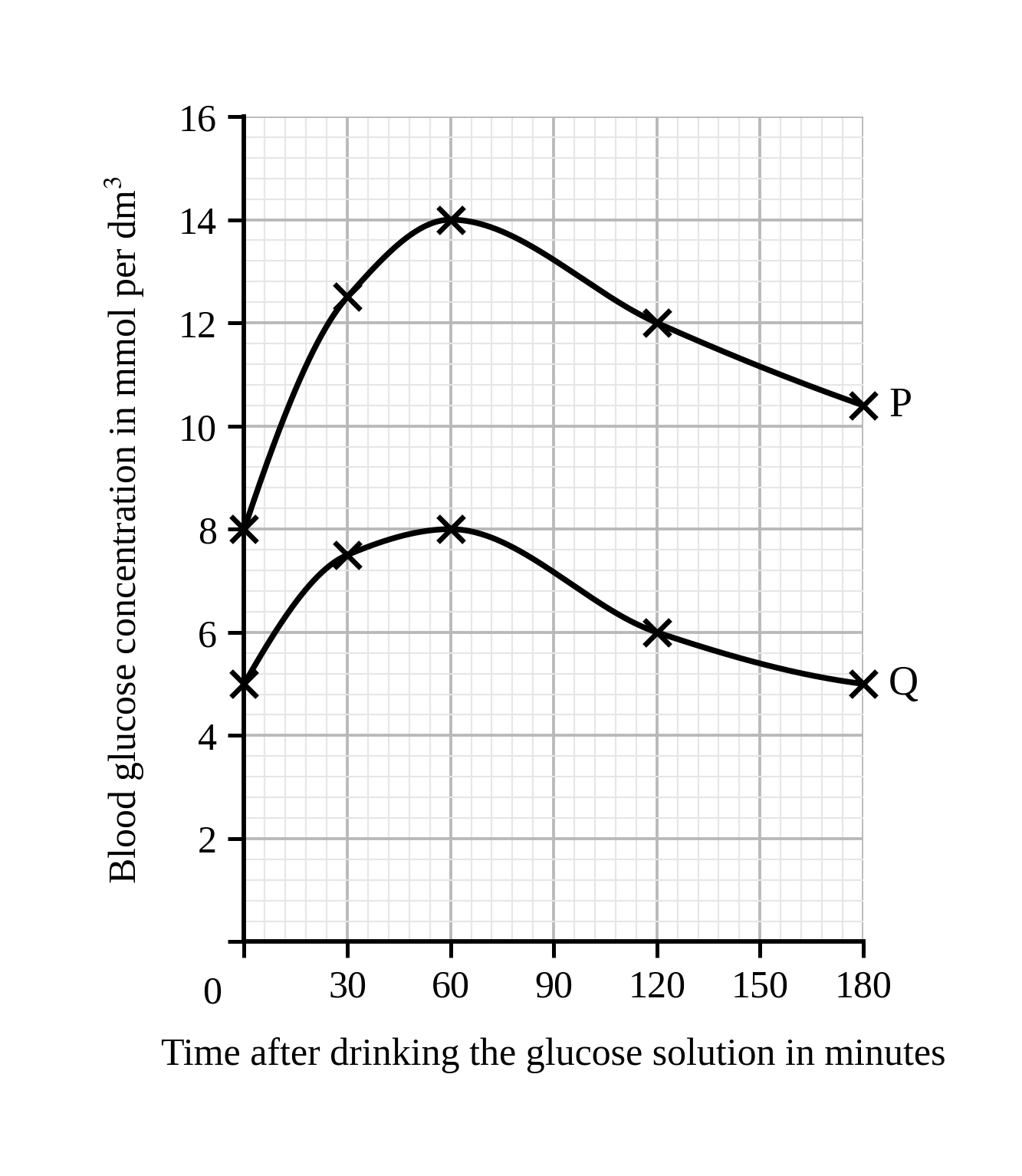
HPerson P has Type 2 diabetes. Person Q does not have diabetes. Each person drank the same glucose solution at time 0. The concentration of glucose in their blood was then measured for 180 minutes.
Figure: The concentration of glucose in the blood of a person with Type 2 diabetes and a person without diabetes, for 180 minutes after drinking a glucose solution
a.[1]
Determine the maximum blood glucose concentration reached by person P.
b.[3]
Calculate the mean rate of decrease in the blood glucose concentration of person Q between 60 and 180 minutes. Give the unit with your answer.
c.[2]
Explain why the blood glucose concentration of person P stayed high, even though person P still produces insulin.
5.3 Hormonal coordination in humans Questions
39 exam-style questions on AQA GCSE Biology 5.3 Hormonal coordination in humans, covering 5.3.1 Human endocrine system, 5.3.2 Control of blood glucose concentration, 5.3.3 Maintaining water and nitrogen balance in the body, 5.3.4 Hormones in human reproduction, 5.3.5 Contraception, 5.3.6 The use of hormones to treat infertility (HT only), and 5.3.7 Negative feedback (HT only). Each one has a worked solution and a mark scheme showing where the marks go.