Question 5
FThe figure shows the human urinary system.
Figure: The human urinary system, showing the kidneys, the blood vessels connected to them, the ureters and the bladder
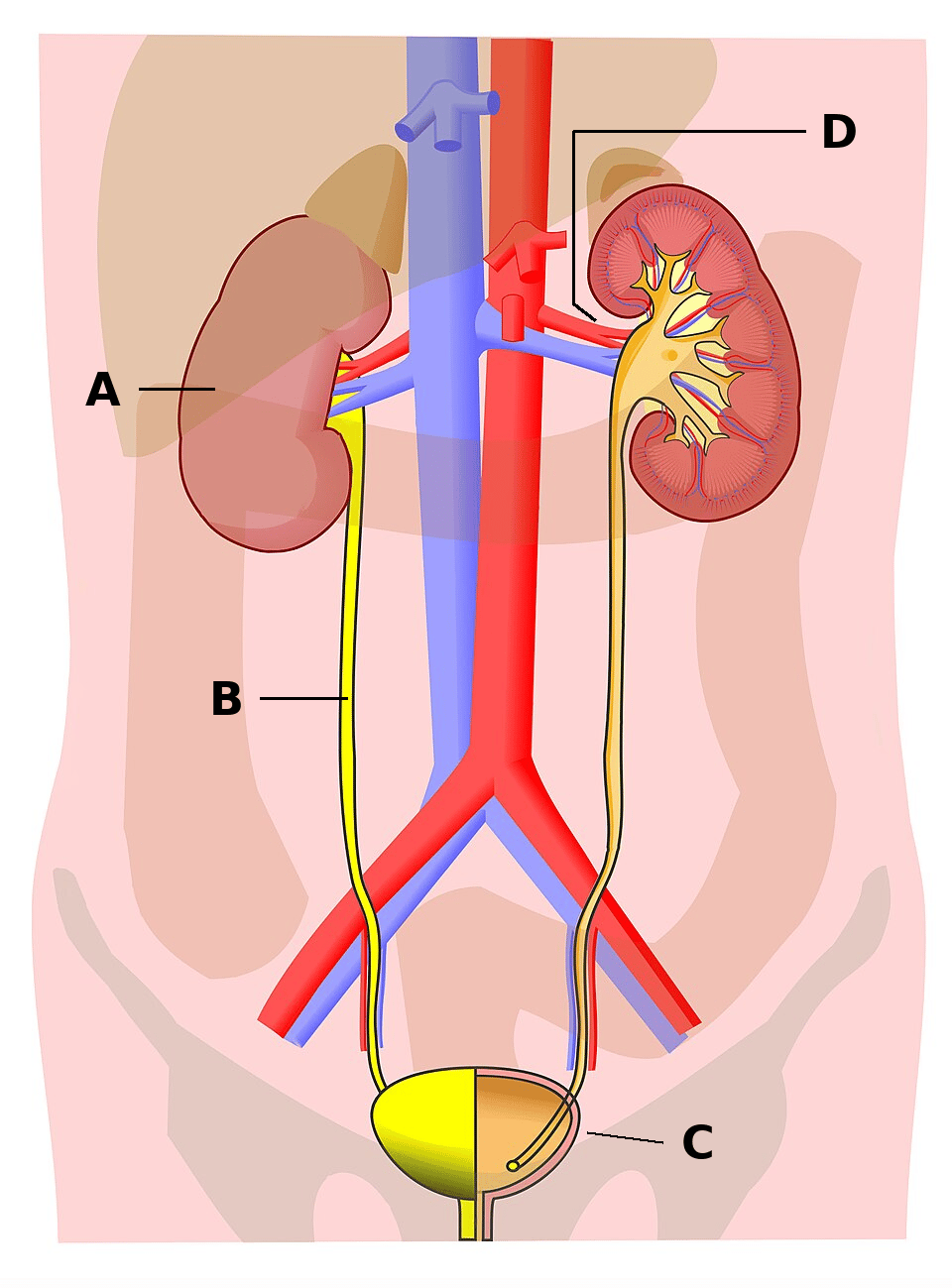
a.[1]
Give the letter of the structure in which urine is stored.
b.
[2]
The table gives the concentration of four substances in the blood plasma entering a kidney and in the urine produced by that kidney.
Table: The concentration of four substances in the blood plasma entering a kidney and in the urine produced by that kidney
| Substance | Concentration in blood plasma in g per dm3 | Concentration in urine in g per dm3 |
|---|---|---|
| Protein | 80.0 | 0.0 |
| Glucose | 1.0 | 0.0 |
| Urea | 0.3 | 20.0 |
| Ions | 7.2 | 15.0 |
Glucose is filtered out of the blood in the kidney, but there is no glucose in the urine.
Explain why there is no glucose in the urine.
c.[2]
Suggest why the concentration of urea in the urine is much higher than the concentration of urea in the blood plasma.
5.3 Hormonal coordination in humans Questions
39 exam-style questions on AQA GCSE Biology 5.3 Hormonal coordination in humans, covering 5.3.1 Human endocrine system, 5.3.2 Control of blood glucose concentration, 5.3.3 Maintaining water and nitrogen balance in the body, 5.3.4 Hormones in human reproduction, 5.3.5 Contraception, 5.3.6 The use of hormones to treat infertility (HT only), and 5.3.7 Negative feedback (HT only). Each one has a worked solution and a mark scheme showing where the marks go.