Diffusion Moves Particles Down a Concentration Gradient
Diffusion
The net movement of particles of a gas, or of a dissolved substance, from a region of higher concentration to a region of lower concentration; it is passive and needs no energy from respiration.
- Diffusion is the net movement of particles from a region of higher concentration to a region of lower concentration.
- The difference in concentration between the two regions is called a concentration gradient.
- Particles have kinetic energy and move randomly, colliding and spreading out until they are evenly spread.
- Diffusion is passive, so it uses the particles' own kinetic energy and no energy from respiration.
- Both gases and dissolved substances, called solutes, can diffuse.
Diffusion always moves a substance down its concentration gradient, from where it is more concentrated to where it is less concentrated.
Factors That Affect the Rate of Diffusion
Concentration gradient
The difference in concentration of a substance between two regions; particles diffuse down a concentration gradient, from a higher to a lower concentration.
- Three factors change how fast a substance diffuses.
- Concentration gradient:
- The bigger the difference in concentration, the steeper the gradient and the faster the rate of diffusion.
- Temperature:
- The higher the temperature, the more kinetic energy the particles have, so they move and diffuse faster.
- Surface area of the membrane:
- The larger the surface area, the more particles can cross at once, so the faster the rate of diffusion.
Oxygen diffuses faster into a cell that is respiring quickly, because using it up keeps a steep concentration gradient.
Diffusion Across the Cell Membrane
Cell membrane
The partially permeable layer around a cell that controls which substances move into and out of it.
- Cells are surrounded by a partially permeable cell membrane.
- It lets small molecules pass through but holds back larger ones, such as starch.
- Small molecules such as oxygen, carbon dioxide, glucose and urea can diffuse across it.
- The concentration gradient sets the direction, so a substance diffuses from wherever it is more concentrated to wherever it is less concentrated.
- Oxygen diffuses into a respiring cell while carbon dioxide diffuses out of it at the same time.
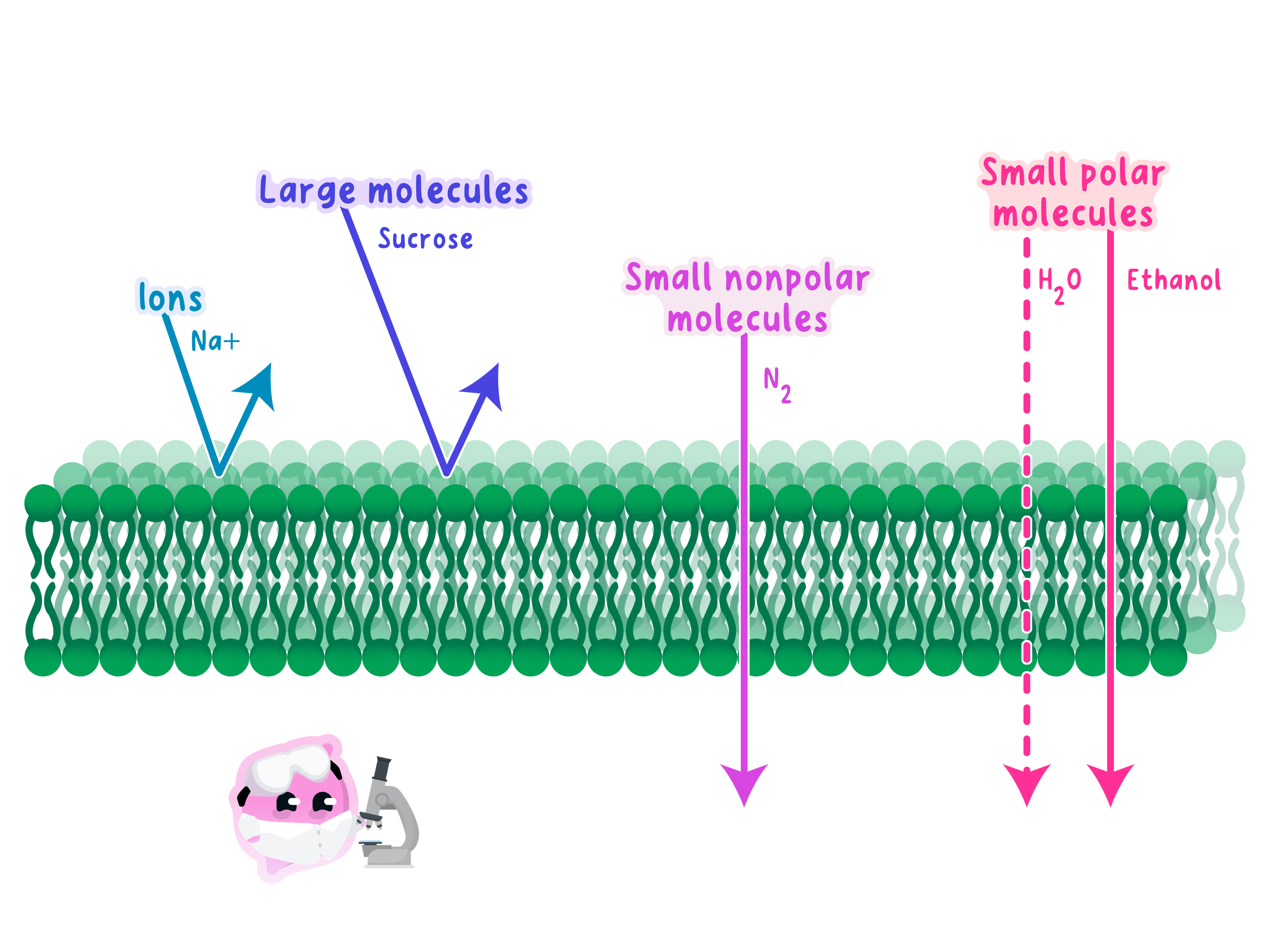
Urea made in the liver diffuses into the blood plasma and is carried to the kidneys to be excreted.
Substances Moved by Diffusion
- Oxygen diffuses into cells for aerobic respiration.
- Carbon dioxide diffuses into photosynthesising plant cells and out of respiring cells.
- The soluble products of digestion, such as glucose, diffuse from the gut into the blood.
- Urea, a waste product, diffuses out of cells into the blood for excretion by the kidney.
The direction can reverse: a leaf cell releases carbon dioxide at night, but takes it in during bright daylight when photosynthesis is faster than respiration.
Surface Area to Volume Ratio
Surface area to volume ratio
The surface area of an organism compared with its volume; it decreases as an organism gets larger, so bigger organisms need exchange surfaces and transport systems.
- Whether diffusion alone can supply a cell depends on its surface area to volume ratio.
- A small organism, such as a single-celled bacterium, has a large surface area compared with its volume.
- Substances have only a short distance to travel, so diffusion, osmosis and active transport across its surface are enough to meet its needs.
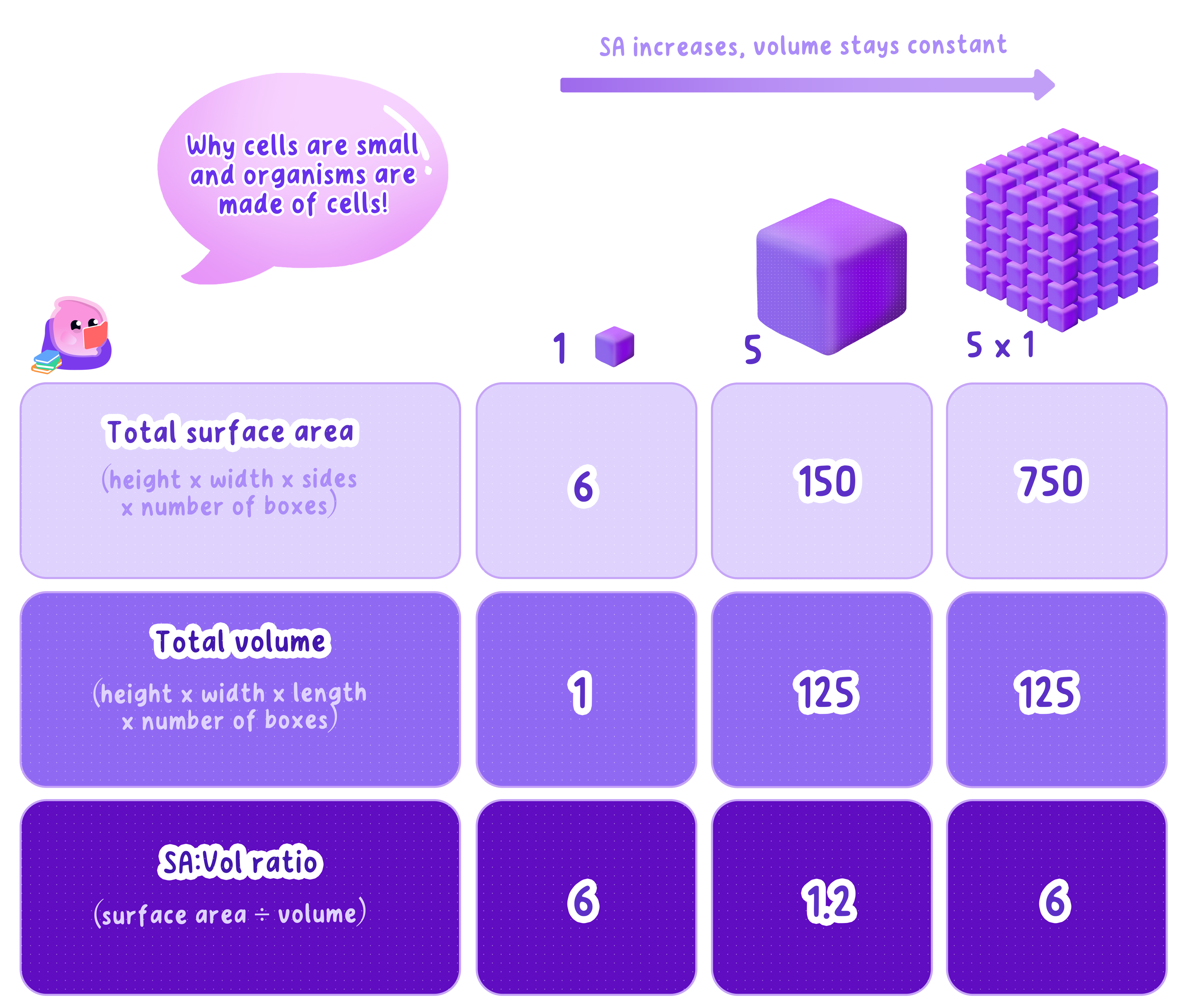
- As an organism gets larger, its surface area to volume ratio gets smaller.
- You compare ratios by working out the surface area and the volume, then dividing the surface area by the volume.
- A 1 cm cube has a surface area of 6 cm26\ \text{cm}^26 cm2 and a volume of 1 cm31\ \text{cm}^31 cm3, giving a ratio of 6:16:16:1.
- A 2 cm cube has a surface area of 24 cm224\ \text{cm}^224 cm2 and a volume of 8 cm38\ \text{cm}^38 cm3, giving a ratio of 3:13:13:1, so the larger cube has the smaller ratio.
Exchange Surfaces in Larger Organisms
Exchange surface
A surface in a multicellular organism where substances are exchanged with the environment, adapted with a large surface area and a thin barrier for a short diffusion path.
- A large, multicellular organism has a small surface area to volume ratio and a long distance from its surface to its centre.
- Diffusion across its outer surface alone is too slow to supply every cell.
- So larger organisms have specialised exchange surfaces and transport systems.
- An effective exchange surface has a large surface area and a thin membrane for a short diffusion path.
- In animals it also has a good blood supply and, for gases, is ventilated, which keeps steep concentration gradients.
The blood supply and ventilation keep a steep gradient by bringing fresh supplies to the surface and carrying exchanged substances away.
Adaptations of Exchange Surfaces
- Small intestine (animals):
- Villi and microvilli give a very large surface area for absorbing digested food.
- The lining is one cell thick, giving a short diffusion path, and a rich blood supply keeps a steep gradient.
- Lungs (mammals):
- Millions of alveoli give a huge surface area for gas exchange.
- Each alveolus wall is one cell thick and moist, and a good blood supply and ventilation maintain the gradient.
- Gills (fish):
- Many filaments covered in lamellae give a large surface area.
- A dense blood supply flowing opposite to the water maintains a steep gradient.
- Roots (plants):
- Root hair cells give a large surface area for absorbing water and mineral ions.
- Leaves (plants):
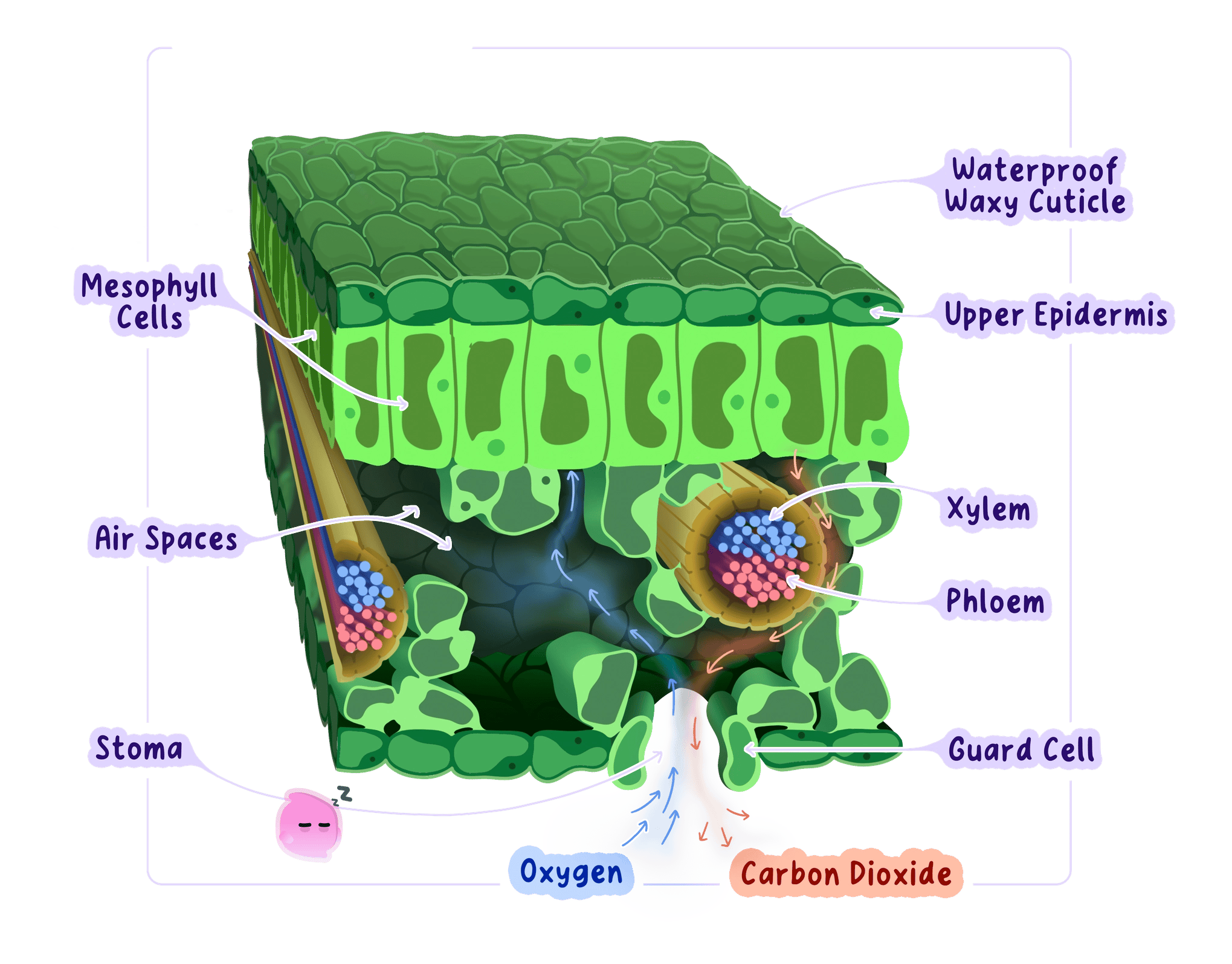
- Being flat and thin, with internal air spaces and stomata, gives a large surface area and a short path for gas exchange.
- Define diffusion.
- Give the three factors that affect the rate of diffusion.
- Why can a single-celled organism rely on diffusion alone?
- Give three features of an effective exchange surface.
- How is the small intestine adapted for absorbing digested food?
