Osmosis Is the Movement of Water Across a Membrane
Osmosis
The net movement of water molecules across a partially permeable membrane from a dilute solution to a more concentrated solution.
- Osmosis is the net movement of water molecules across a partially permeable membrane.
- Water moves from a dilute solution to a more concentrated solution.
- A dilute solution has a high proportion of water and little solute, while a concentrated solution has more solute and less water.
- Only water crosses the membrane, because the dissolved solute is usually too large to pass through.
- Water keeps moving until the concentrations on the two sides are more equal.
Osmosis is the diffusion of water only, from a dilute solution to a more concentrated solution, through a partially permeable membrane.
Osmosis Is a Special Case of Diffusion
- Osmosis is a special type of diffusion in which the moving particles are water molecules.
- A partially permeable membrane has tiny gaps that let small water molecules through.
- The larger solute molecules cannot fit through the membrane.
- Like all diffusion, osmosis is passive and driven by the random movement of the water molecules.
The membrane works like a sieve with holes big enough for water but too small for the larger solute particles.
Water Potential (Higher Tier)
Water potential
A measure of the tendency of water to move; water moves by osmosis from a higher water potential (dilute) to a lower water potential (concentrated).
- At Higher tier, osmosis can be described using water potential.
- A dilute solution has a higher water potential, and a concentrated solution has a lower water potential.
- Water moves by osmosis from a region of higher water potential to a region of lower water potential.
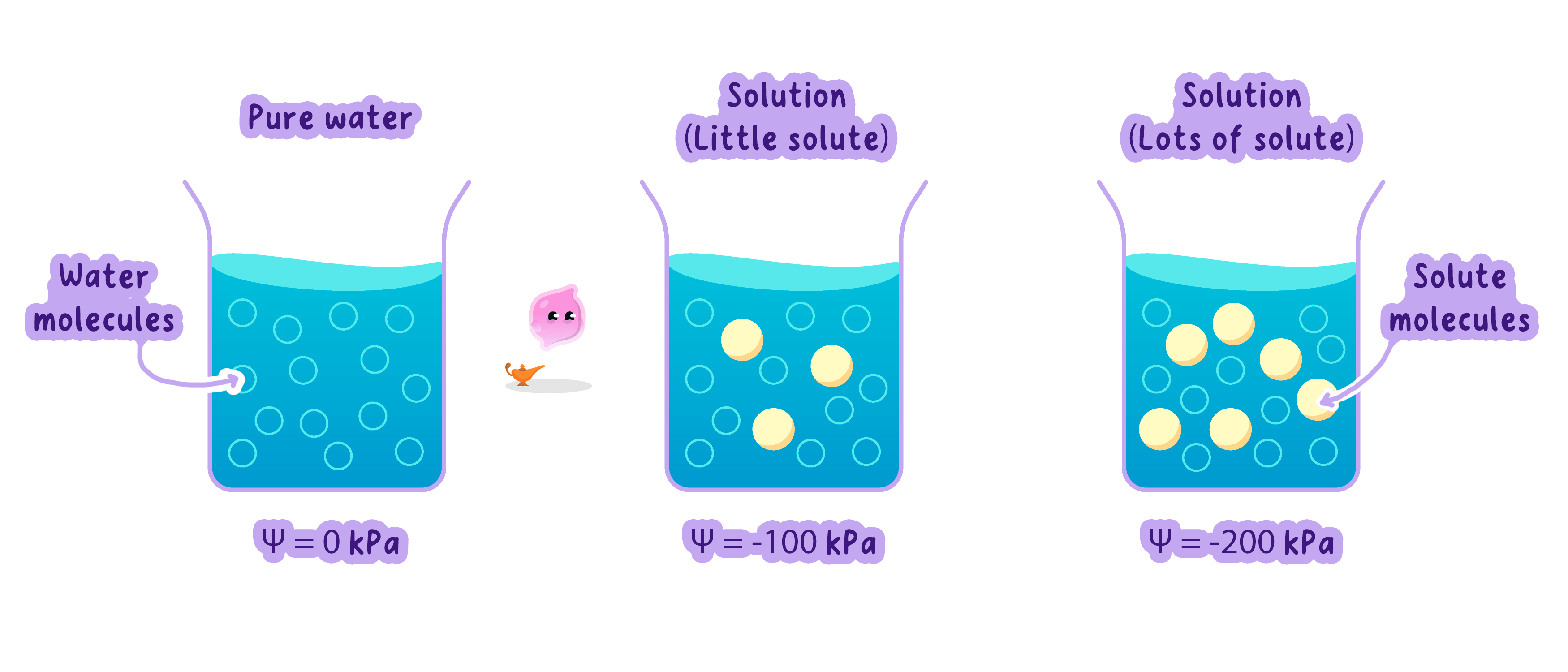
Moving from a high to a low water potential is the same as moving from a dilute to a concentrated solution.
Osmosis Into and Out of Cells
Cell membrane
The partially permeable layer around a cell that controls which substances move into and out of it.
- Water moves into and out of cells by osmosis across the partially permeable cell membrane.
- If the solution is hypotonic, outside is more dilute than the cell contents, water moves into the cell.
- If the solution is hypertonic, outside is more concentrated than the cell contents, water moves out of the cell.
- If the two are equal, isotonic, there is no net movement of water.
- Body cells must keep their water and solute balance, or they cannot work properly.
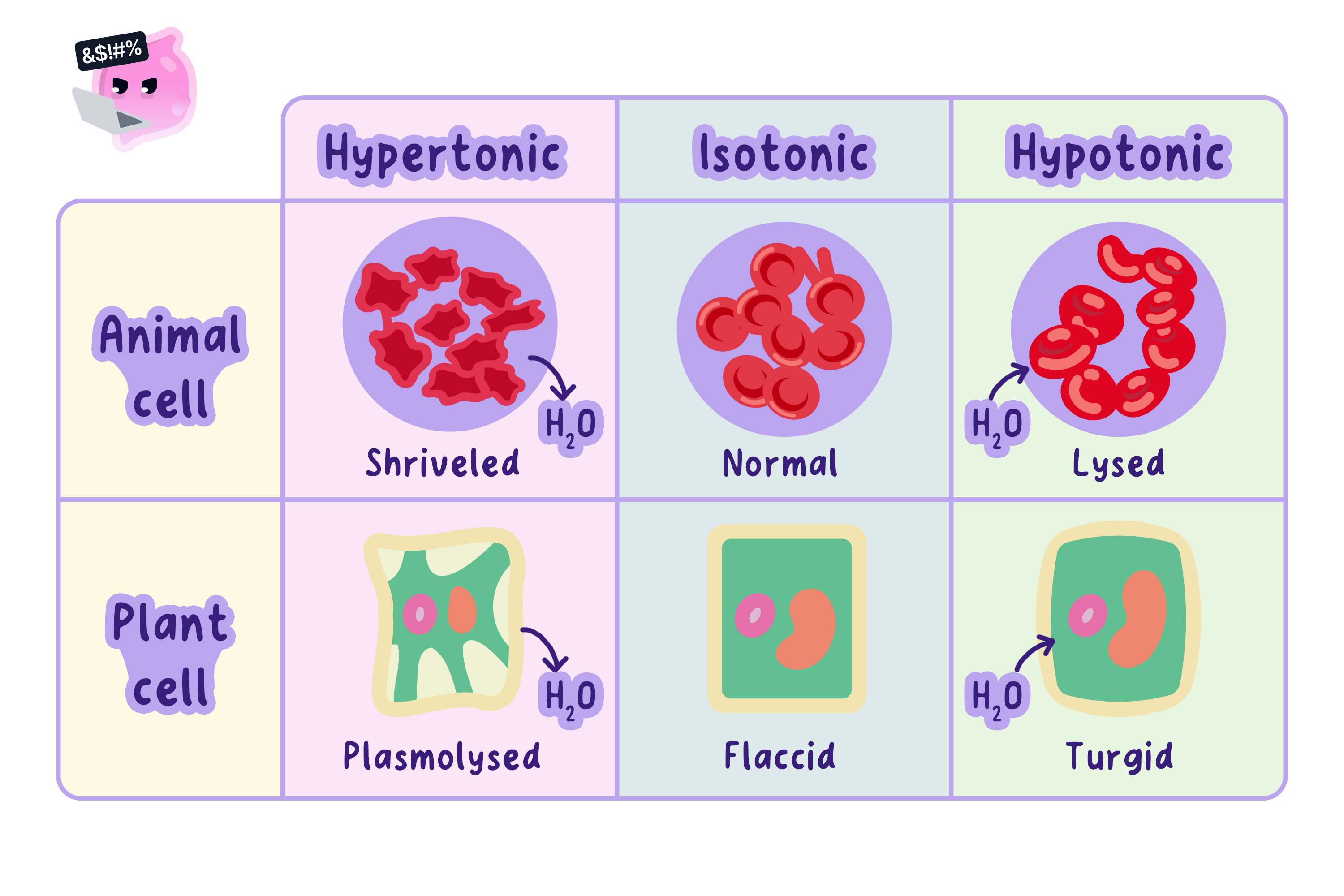
Water does not always enter a cell; it leaves if the surrounding solution is more concentrated than the cell.
Investigating Osmosis
- Aim: to investigate how the concentration of sugar or salt solution affects the mass of plant tissue.
- Cut cylinders of potato of equal size with a cork borer, and measure the mass of each.
- Place each cylinder in a different concentration of sugar or salt solution, using at least five concentrations plus distilled water.
- Leave them for a set time at the same temperature, then remove, blot dry and measure the mass again.
- The independent variable is the concentration of the solution and the dependent variable is the change in mass.
- Control the type and volume of solution, the temperature and the time.
- Define osmosis.
- Which way does water move, from a dilute or a concentrated solution?
- What moves in osmosis, the water or the solute?
- In the required practical, why is percentage change in mass used rather than change in mass?
- If a potato cylinder gains mass, what does that tell you about the solution it was in?
