6.2.5 Cloning
Cloning plants
Definition
Clone
An organism that is genetically identical to another, produced without sexual reproduction.
Definition
Tissue culture
Growing many genetically identical new plants from small groups of cells taken from a parent plant.
- A clone carries exactly the same genes as the organism it came from, made without any sexual reproduction.
- The oldest and simplest method is taking cuttings, where a gardener removes a shoot from a parent plant and grows it on into a whole new plant.
- Every plant grown this way matches the parent, so a grower can build up lots of copies of a favourite variety quickly.
- Tissue culture works on a much smaller scale, growing a few cells scraped from a parent plant on a nutrient jelly until each forms a tiny plantlet.
- This turns a scrap of tissue into large numbers of identical, disease-free plants, which helps save rare species and keep nurseries supplied all year round.
Example
One prized orchid can be turned into thousands of identical plants for sale by tissue culture.
Embryo transplants
- This method clones an animal from an embryo rather than from an adult.
- While the embryo is still a tiny ball of unspecialised cells, those cells are carefully separated from one another.
- Each separated cell can grow on into a full embryo, and because they all came from one original, they are genetically identical.
- The embryos are then placed into host mothers, which carry the clones until birth.
Note
Being genetically identical does not force clones to look the same; differences in their surroundings, such as food supply, can still change how they turn out.
Adult cell cloning
Definition
Adult cell cloning
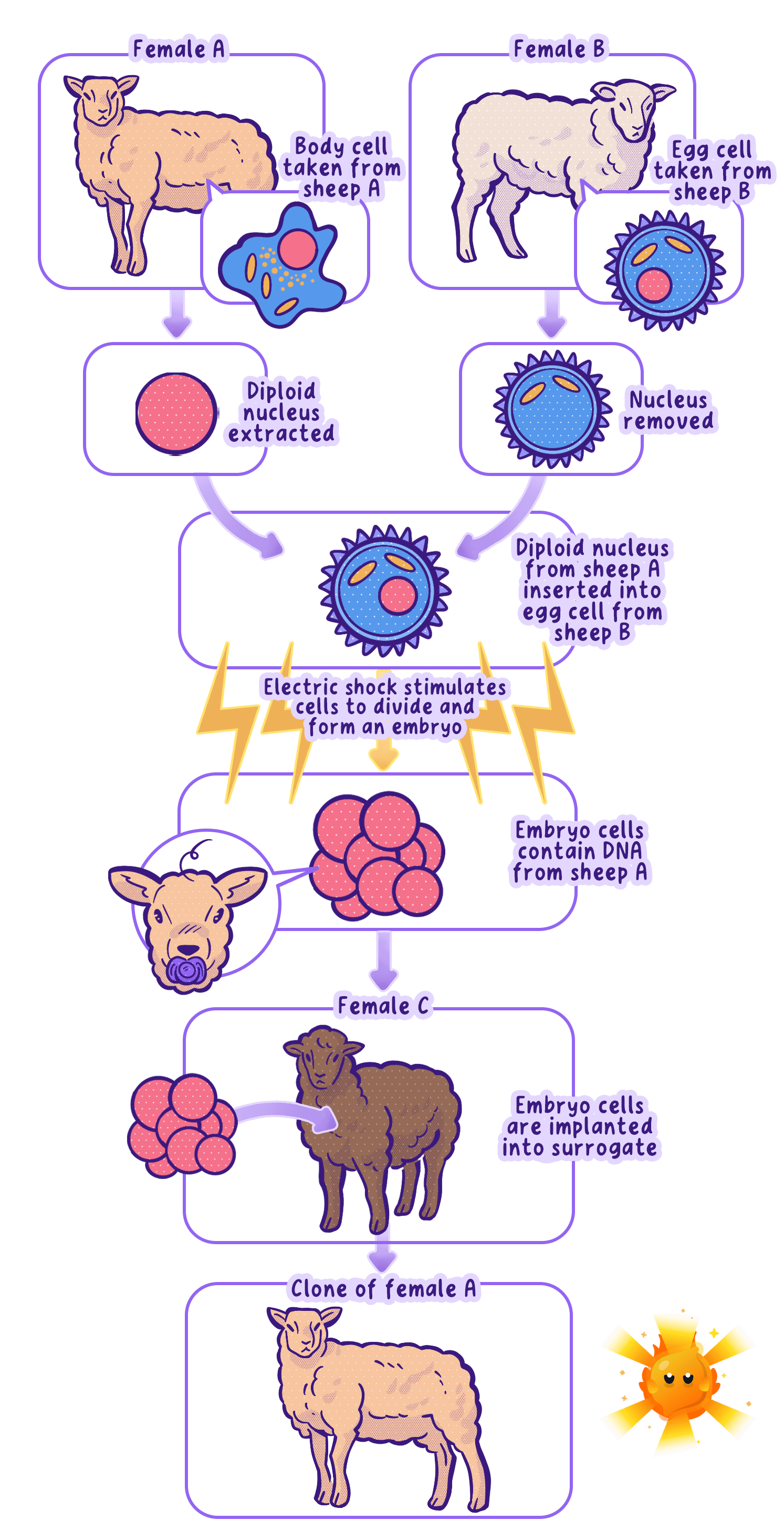
Making a clone of an animal by placing the nucleus of an adult body cell into an egg cell whose own nucleus has been removed.
- An egg cell is taken and its own nucleus is removed, leaving an empty egg with no genetic material of its own.
- The nucleus of an ordinary body cell from the animal to be cloned, often a skin cell, is then placed inside that empty egg.
- Giving the egg a brief electric shock kick-starts it into dividing, so it grows into a ball of cells just as a fertilised egg would.
- Because that nucleus came from the adult, every cell in the ball carries the adult's genes, making the new animal a genetic copy of it.
- The little ball of cells is finally implanted into the womb of a surrogate mother, where it develops until it is born.
Common Mistake
Only the genes are copied; features such as size or markings depend partly on the environment, so a clone need not look identical to its parent.
Self review
- What is a clone?
- Describe two ways of cloning plants.
- How can an early animal embryo be used to make clones?
- Describe the main steps of adult cell cloning.
- Give one benefit and one drawback of cloning.
