6.3.1 Theory of evolution
Darwin's theory of natural selection
Definition
Natural selection
The process by which organisms with alleles best suited to their environment are more likely to survive and reproduce, so those alleles become more common in the population over generations.
- Charles Darwin made observations on a round-the-world voyage and, backed by years of experiments and discussion, proposed the theory of evolution by natural selection.
- Within any species the individuals are not identical; they show a wide range of variation in their characteristics.
- Individuals whose features happen to fit their surroundings best are the ones most likely to survive and breed.
- Since it is these individuals that reproduce, the features that helped them survive are inherited by their offspring.
- Darwin published these ideas in On the Origin of Species in 185918591859.
Note
Alfred Russel Wallace independently reached the same idea of natural selection, and the two first presented it jointly.
Why the theory was accepted slowly
- It challenged the widely held religious belief that species were made separately and did not change.
- There was not enough evidence when it was first proposed to convince many scientists.
- The mechanism of inheritance, genes and DNA, was not understood until about 505050 years after the theory was published.
Note
Once genes were discovered, they explained exactly how characteristics are passed on, and the theory became widely accepted.
Lamarck's alternative idea
Definition
Lamarck's theory
The disproved idea that characteristics an organism acquires during its lifetime can be passed on to its offspring.
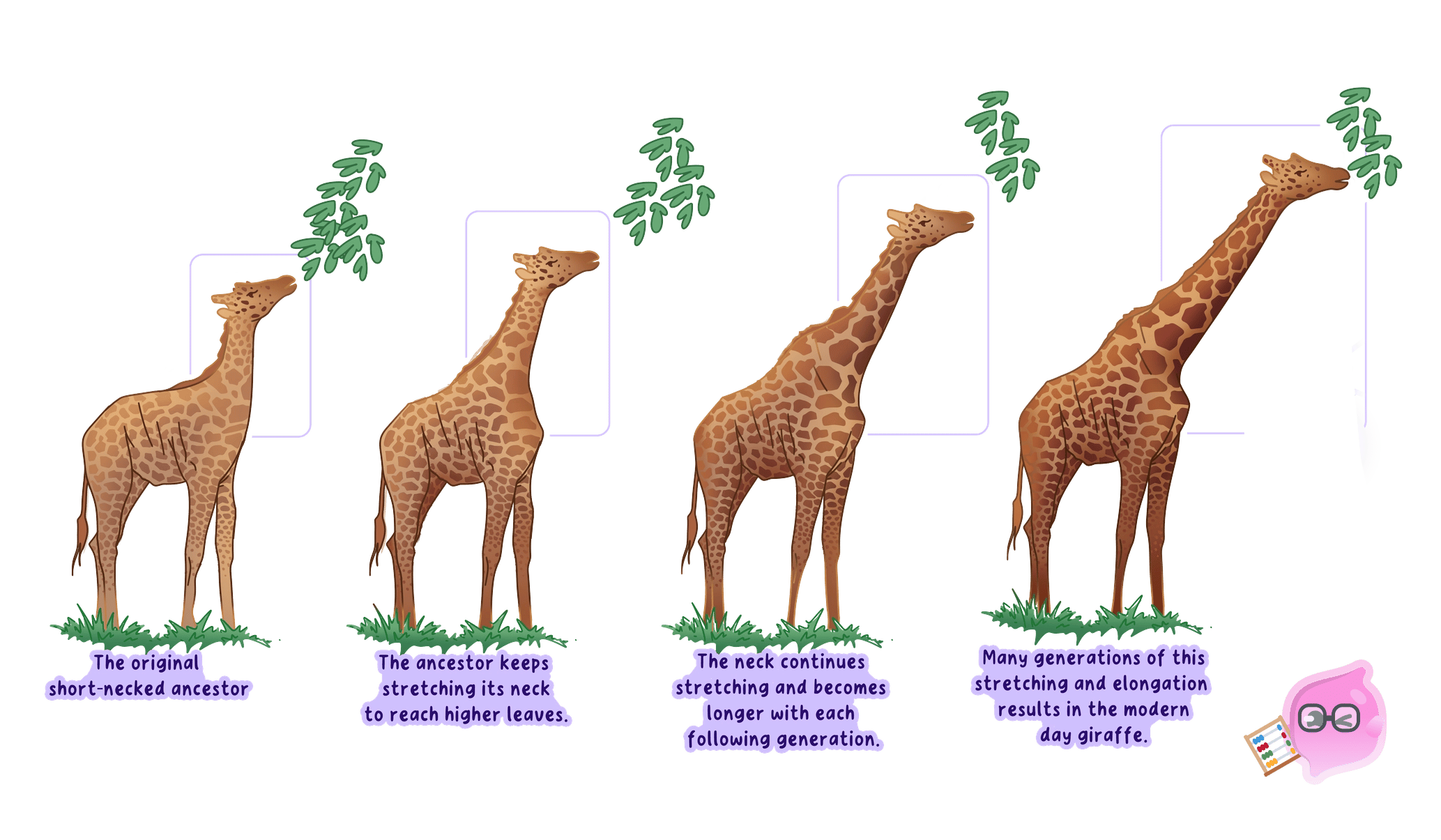
- An earlier idea by Jean-Baptiste Lamarck suggested that characteristics an organism develops during its life can be handed on to its young.
- For example, his idea would predict that a giraffe stretching its neck would have longer-necked offspring.
- In reality, we now know that this kind of inheritance almost never takes place.
- Natural selection differs, because it works on inherited alleles that were already present, not on features gained during life.
Common Mistake
Do not confuse the two: natural selection works on inherited alleles, whereas Lamarck's rejected idea relied on inheriting features gained during life.
Self review
- What theory did Charles Darwin propose, and in which book?
- State the steps of natural selection in Darwin's theory.
- Give two reasons the theory was accepted only slowly.
- How did Lamarck's idea differ from natural selection?
