Question 15
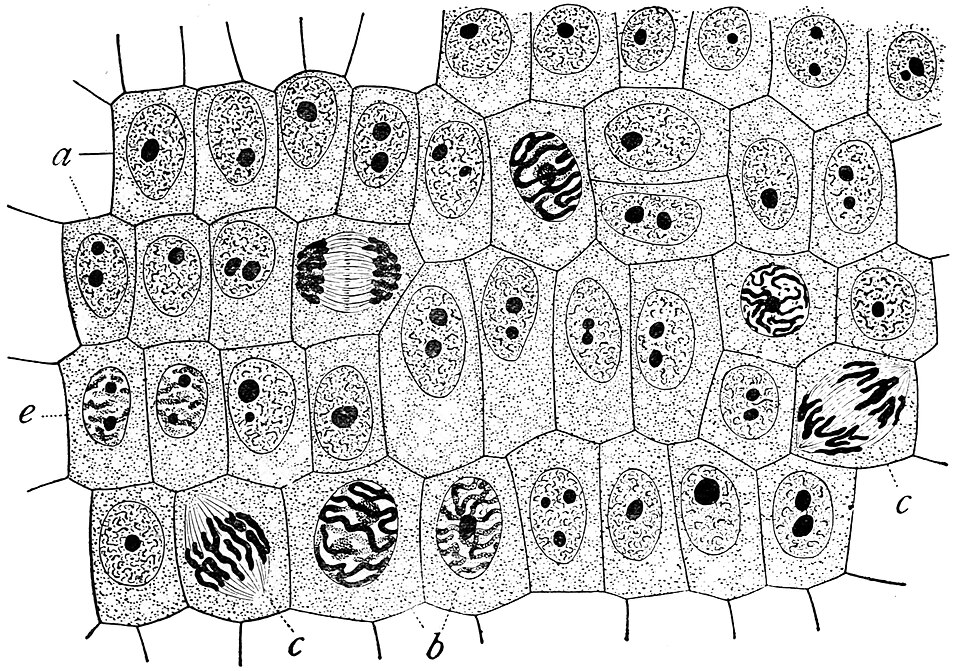
HA student stained a very thin slice of an onion root tip and looked at it using a light microscope. The figure shows some of the cells the student could see. Two of the cells are labelled c.
Figure: Cells in a stained slice of an onion root tip, seen using a light microscope
a.[1]
Most of the cells in the figure have a whole nucleus in which the chromosomes cannot be seen as separate dark structures. What is the stage of the cell cycle that these cells are in.
b.[2]
Explain what the number of cells in this stage tells the student about the length of this stage.
c.[2]
In the two cells labelled c the chromosomes are attached to cell fibres. Describe what these cell fibres do during mitosis.
d.[1]
One cell in the figure shows two separate groups of dark chromosomes, one group at each end of the cell, with cell fibres stretched between them. Name the stage of the cell cycle that this cell will enter next.
e.
[3]
The student then counted 400 cells from the root tip and recorded the stage each cell was in. The table shows the results. One complete cell cycle in these cells takes 18 hours. Calculate the time these cells spend in mitosis. Give your answer in hours.
Table: The number of cells in each stage of the cell cycle in a sample of 400 onion root tip cells
| Stage of the cell cycle | Number of cells |
|---|---|
| Growth and copying of DNA | 336 |
| Mitosis | 48 |
| Division of the cytoplasm | 16 |
1.2 Cell division Questions
58 exam-style questions on AQA GCSE Biology 1.2 Cell division, covering 1.2.1 Chromosomes, 1.2.2 Mitosis and the cell cycle, and 1.2.3 Stem cells. Each one has a worked solution and a mark scheme showing where the marks go.